




If an atom has electronic configuration $1{s^2}2{s^2}2{p^6}3{s^2}3{p^6}3{d^3}4{s^2}$, it will be placed in
A. Second group
B. Third group
C. Fifth group
D. Sixth group
Answer
 Verified
601.5k+ views
Hint: All the elements in the group have the same outer shell configuration. The periodic table can also be divided into blocks, such as the s block, p block, d block and f block. Elements are divided into these blocks on the basis of in which shell does the incoming electron go.
Complete step by step answer:
The periodic table is organised in such a way, that elements with the same outer shell configuration will fall in the same group.
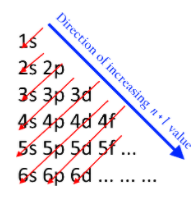
For example, all the elements in group one will have the outer shell electronic configuration as $n{s^1},n = period\,number$ Elements in first group are $Na,K$ $Na = 1{s^1}2{s^2}2{p^6}3{s^1}$
$K = 1{s^2}2{s^2}2{p^6}3{s^2}3{p^6}4{s^1}$
Notice that the last electron in both the elements goes into the s shell and the s shell is half filled with only one electron. The periodic table is divided as: $s\,block = 1 - 2group$
$d\,block = 3 - 12block$
$p\,block = 13 - 18block$
According to the Aufbau principle the of $4s$orbital is less than that of $3d$ orbital and hence the $4s$ orbital is filled first, but while writing the electronic configuration $3d$ is mentioned before $4s$ . Hence, The outermost electronic configuration for elements in the d block goes like, $(n - 1){d^{1 - 10}}n{s^2}$. The d electrons have shell number one less than the s shell number. So, in the configuration $1{s^2}2{s^2}2{p^6}3{s^2}3{p^6}3{d^3}4{s^2}$, the last shell to be filled is the d shell and the its configuration is $3{d^3}$. This means that the incoming electron goes to the d block and hence, the elements must belong to the d block in the periodic table. The general configuration of the elements is, $(n - 1){d^1}n{s^2}$, we will add the value of the outermost electron to get the value of shell number. $\therefore 1 + 2 = 3$ Hence, Elements with outer shell electronic configuration as $(n - 1){d^1}n{s^2}$ will be in the third group. In our question, the outer shell electronic configuration is $3{d^3}4{s^2}$. By adding the value of the outermost shell electrons we get $3 + 2 = 5$ Hence, this element belongs to the fifth group.
So, the correct answer is “Option C”.
Note: The d block elements are also known as transition metal, and they have a separate group called as inner transition metals or the f block elements. These elements are mostly the radioactive materials found in the periodic table.
The metal with electronic configuration: $1{s^2}2{s^2}2{p^6}3{s^2}3{p^6}3{d^3}4{s^2}$ is Chromium with atomic number $23$ .
Transition materials have the most wide range applications out of any other group of elements.If the outermost electrons are in the p orbital, for example if the element has three electrons in the p orbital and ten electrons in the d orbital, then it goes in the thirteenth group. But if it only has electrons in the d orbital and not the p, it goes in the group number which will be the sum of s and d orbital.
Complete step by step answer:
The periodic table is organised in such a way, that elements with the same outer shell configuration will fall in the same group.
For example, all the elements in group one will have the outer shell electronic configuration as $n{s^1},n = period\,number$ Elements in first group are $Na,K$ $Na = 1{s^1}2{s^2}2{p^6}3{s^1}$
$K = 1{s^2}2{s^2}2{p^6}3{s^2}3{p^6}4{s^1}$
Notice that the last electron in both the elements goes into the s shell and the s shell is half filled with only one electron. The periodic table is divided as: $s\,block = 1 - 2group$
$d\,block = 3 - 12block$
$p\,block = 13 - 18block$
According to the Aufbau principle the of $4s$orbital is less than that of $3d$ orbital and hence the $4s$ orbital is filled first, but while writing the electronic configuration $3d$ is mentioned before $4s$ . Hence, The outermost electronic configuration for elements in the d block goes like, $(n - 1){d^{1 - 10}}n{s^2}$. The d electrons have shell number one less than the s shell number. So, in the configuration $1{s^2}2{s^2}2{p^6}3{s^2}3{p^6}3{d^3}4{s^2}$, the last shell to be filled is the d shell and the its configuration is $3{d^3}$. This means that the incoming electron goes to the d block and hence, the elements must belong to the d block in the periodic table. The general configuration of the elements is, $(n - 1){d^1}n{s^2}$, we will add the value of the outermost electron to get the value of shell number. $\therefore 1 + 2 = 3$ Hence, Elements with outer shell electronic configuration as $(n - 1){d^1}n{s^2}$ will be in the third group. In our question, the outer shell electronic configuration is $3{d^3}4{s^2}$. By adding the value of the outermost shell electrons we get $3 + 2 = 5$ Hence, this element belongs to the fifth group.
So, the correct answer is “Option C”.
Note: The d block elements are also known as transition metal, and they have a separate group called as inner transition metals or the f block elements. These elements are mostly the radioactive materials found in the periodic table.
The metal with electronic configuration: $1{s^2}2{s^2}2{p^6}3{s^2}3{p^6}3{d^3}4{s^2}$ is Chromium with atomic number $23$ .
Transition materials have the most wide range applications out of any other group of elements.If the outermost electrons are in the p orbital, for example if the element has three electrons in the p orbital and ten electrons in the d orbital, then it goes in the thirteenth group. But if it only has electrons in the d orbital and not the p, it goes in the group number which will be the sum of s and d orbital.
Recently Updated Pages
Master Class 12 Economics: Engaging Questions & Answers for Success

Master Class 12 English: Engaging Questions & Answers for Success
Master Class 12 Social Science: Engaging Questions & Answers for Success
Master Class 12 Maths: Engaging Questions & Answers for Success
Master Class 12 Physics: Engaging Questions & Answers for Success
Master Class 9 General Knowledge: Engaging Questions & Answers for Success
Trending doubts
One Metric ton is equal to kg A 10000 B 1000 C 100 class 11 physics CBSE
Difference Between Prokaryotic Cells and Eukaryotic Cells
Two of the body parts which do not appear in MRI are class 11 biology CBSE
1 ton equals to A 100 kg B 1000 kg C 10 kg D 10000 class 11 physics CBSE
Draw a diagram of nephron and explain its structur class 11 biology CBSE
10 examples of friction in our daily life