




If $A\left( {y,2} \right)$, $B\left( {1,y} \right)$ and $AB = 5$, then the possible values of $y$ area
A.$6,2$
B.$5, - 2$
C.$ - 2, - 6$
D.$2,0$
Answer
 Verified
526.2k+ views
Hint: In order to find the value of $y$, check out the information given, that is two points and their distance. Use the distance formula \[{\text{Distance = }}\sqrt {{{\left( {{y_2} - {y_1}} \right)}^2} + {{\left( {{x_2} - {x_1}} \right)}^2}} \] to form an equation containing the unknown variable y. Solve the equation’s step by step and get the possible values of $y$.
Complete step by step solution:
We are given two points $A\left( {y,2} \right)$ and $B\left( {1,y} \right)$ along with the distance between the points to be $AB = 5$.
The diagram according to this:
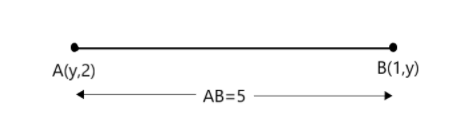
Considering the 1st point $A\left( {y,2} \right)$ to be $A\left( {{x_1},{y_1}} \right)$, comparing them, we get:
${x_1} = y$
${y_1} = 2$
Similarly, comparing the 2nd point $B\left( {1,y} \right)$ to be $B\left( {{x_2},{y_2}} \right)$ comparing them we get:
${x_2} = 1$
${y_2} = y$
From the Distance formula we know that:
\[{\text{Distance = }}\sqrt {{{\left( {{y_2} - {y_1}} \right)}^2} + {{\left( {{x_2} - {x_1}} \right)}^2}} \]
Since, we are also given with the distance between them $AB = 5$, so substituting Distance as AB;
\[{\text{AB = }}\sqrt {{{\left( {{y_2} - {y_1}} \right)}^2} + {{\left( {{x_2} - {x_1}} \right)}^2}} \]
Now, Substituting the value of $AB$, ${x_1}$, ${x_2}$, ${y_1}$ and ${y_2}$ in the above equation and we get:
\[{\text{5 = }}\sqrt {{{\left( {y - 2} \right)}^2} + {{\left( {1 - y} \right)}^2}} \]
Squaring both the sides, we get:
\[{\left( {\text{5}} \right)^2}{\text{ = }}{\left( {\sqrt {{{\left( {y - 2} \right)}^2} + {{\left( {1 - y} \right)}^2}} } \right)^2}\]
\[ \Rightarrow 25{\text{ = }}{\left( {y - 2} \right)^2} + {\left( {1 - y} \right)^2}\]
Opening the square brackets, using the formula \[{\left( {a - b} \right)^2} = {a^2} + {b^2} - 2ab\], in the above equation, we get:
\[ \Rightarrow 25{\text{ = }}{y^2} + 4 - 4y + 1 + {y^2} - 2y\]
Solving it further:
\[ \Rightarrow 25{\text{ = 2}}{y^2} + 5 - 6y\]
\[ \Rightarrow 2{y^2} - 6y + 5 = 25\]
Subtracting both the sides by \[25\]:
\[ \Rightarrow 2{y^2} - 6y + 5 - 25 = 25 - 25\]
\[ \Rightarrow 2{y^2} - 6y - 20 = 0\]
Taking \[2\] common from the left side, we get:
\[ \Rightarrow 2\left( {{y^2} - 3y - 10} \right) = 0\]
Dividing the equation by \[2\]:
\[ \Rightarrow \dfrac{{2\left( {{y^2} - 3y - 10} \right)}}{2} = 0\]
\[ \Rightarrow {y^2} - 3y - 10 = 0\]
Since, the highest degree on y is 2, therefore it’s a quadratic equation:
Using the mid-term splitting method, for splitting the mid-term \[ - 3y\] as \[ - 5y + 2y\].
\[ \Rightarrow {y^2} - 5y + 2y - 10 = 0\]
Pairing the operands:
\[ \Rightarrow \left( {{y^2} - 5y} \right) + \left( {2y - 10} \right) = 0\]
Taking \[y\] common from the first bracket and \[2\] from the second bracket:
\[ \Rightarrow y\left( {y - 5} \right) + 2\left( {y - 5} \right) = 0\]
Taking \[\left( {y - 5} \right)\] brackets common:
\[ \Rightarrow \left( {y - 5} \right)\left( {y + 2} \right) = 0\]
Equating the brackets with 0, we get:
\[ \Rightarrow \left( {y - 5} \right) = 0{\text{ or }}\left( {y + 2} \right) = 0\]
Solving the brackets separately, we get:
For the first bracket:
\[ \Rightarrow \left( {y - 5} \right) = 0{\text{ }}\]
Adding both the sides by 5:
\[ \Rightarrow y - 5 + 5 = 0 + 5\]
\[ \Rightarrow y = 5\] ……(1)
For the second bracket:
\[ \Rightarrow \left( {y + 2} \right) = 0{\text{ }}\]
Subtracting both the sides by 2:
\[ \Rightarrow y + 2 - 2 = 0 - 2\]
\[ \Rightarrow y = - 2\] …..(2)
From (1) and (2), we get:
\[ \Rightarrow y = - 2{\text{ or }}5\]
\[ \Rightarrow y = - 2,5\]
Therefore, the value of \[y\] is \[ - 2{\text{ or }}5\].
Option B is correct.
So, the correct answer is “Option B”.
Note: We have used the mid-term splitting method to solve the quadratic equation, in which the mid-term is splitted in such a way that the product of them gives the product of the remaining terms and the sum of the terms gives the mid-term itself.
We could have also used the quadratic formula to solve the quadratic equation, both will result in the same values.
Complete step by step solution:
We are given two points $A\left( {y,2} \right)$ and $B\left( {1,y} \right)$ along with the distance between the points to be $AB = 5$.
The diagram according to this:
Considering the 1st point $A\left( {y,2} \right)$ to be $A\left( {{x_1},{y_1}} \right)$, comparing them, we get:
${x_1} = y$
${y_1} = 2$
Similarly, comparing the 2nd point $B\left( {1,y} \right)$ to be $B\left( {{x_2},{y_2}} \right)$ comparing them we get:
${x_2} = 1$
${y_2} = y$
From the Distance formula we know that:
\[{\text{Distance = }}\sqrt {{{\left( {{y_2} - {y_1}} \right)}^2} + {{\left( {{x_2} - {x_1}} \right)}^2}} \]
Since, we are also given with the distance between them $AB = 5$, so substituting Distance as AB;
\[{\text{AB = }}\sqrt {{{\left( {{y_2} - {y_1}} \right)}^2} + {{\left( {{x_2} - {x_1}} \right)}^2}} \]
Now, Substituting the value of $AB$, ${x_1}$, ${x_2}$, ${y_1}$ and ${y_2}$ in the above equation and we get:
\[{\text{5 = }}\sqrt {{{\left( {y - 2} \right)}^2} + {{\left( {1 - y} \right)}^2}} \]
Squaring both the sides, we get:
\[{\left( {\text{5}} \right)^2}{\text{ = }}{\left( {\sqrt {{{\left( {y - 2} \right)}^2} + {{\left( {1 - y} \right)}^2}} } \right)^2}\]
\[ \Rightarrow 25{\text{ = }}{\left( {y - 2} \right)^2} + {\left( {1 - y} \right)^2}\]
Opening the square brackets, using the formula \[{\left( {a - b} \right)^2} = {a^2} + {b^2} - 2ab\], in the above equation, we get:
\[ \Rightarrow 25{\text{ = }}{y^2} + 4 - 4y + 1 + {y^2} - 2y\]
Solving it further:
\[ \Rightarrow 25{\text{ = 2}}{y^2} + 5 - 6y\]
\[ \Rightarrow 2{y^2} - 6y + 5 = 25\]
Subtracting both the sides by \[25\]:
\[ \Rightarrow 2{y^2} - 6y + 5 - 25 = 25 - 25\]
\[ \Rightarrow 2{y^2} - 6y - 20 = 0\]
Taking \[2\] common from the left side, we get:
\[ \Rightarrow 2\left( {{y^2} - 3y - 10} \right) = 0\]
Dividing the equation by \[2\]:
\[ \Rightarrow \dfrac{{2\left( {{y^2} - 3y - 10} \right)}}{2} = 0\]
\[ \Rightarrow {y^2} - 3y - 10 = 0\]
Since, the highest degree on y is 2, therefore it’s a quadratic equation:
Using the mid-term splitting method, for splitting the mid-term \[ - 3y\] as \[ - 5y + 2y\].
\[ \Rightarrow {y^2} - 5y + 2y - 10 = 0\]
Pairing the operands:
\[ \Rightarrow \left( {{y^2} - 5y} \right) + \left( {2y - 10} \right) = 0\]
Taking \[y\] common from the first bracket and \[2\] from the second bracket:
\[ \Rightarrow y\left( {y - 5} \right) + 2\left( {y - 5} \right) = 0\]
Taking \[\left( {y - 5} \right)\] brackets common:
\[ \Rightarrow \left( {y - 5} \right)\left( {y + 2} \right) = 0\]
Equating the brackets with 0, we get:
\[ \Rightarrow \left( {y - 5} \right) = 0{\text{ or }}\left( {y + 2} \right) = 0\]
Solving the brackets separately, we get:
For the first bracket:
\[ \Rightarrow \left( {y - 5} \right) = 0{\text{ }}\]
Adding both the sides by 5:
\[ \Rightarrow y - 5 + 5 = 0 + 5\]
\[ \Rightarrow y = 5\] ……(1)
For the second bracket:
\[ \Rightarrow \left( {y + 2} \right) = 0{\text{ }}\]
Subtracting both the sides by 2:
\[ \Rightarrow y + 2 - 2 = 0 - 2\]
\[ \Rightarrow y = - 2\] …..(2)
From (1) and (2), we get:
\[ \Rightarrow y = - 2{\text{ or }}5\]
\[ \Rightarrow y = - 2,5\]
Therefore, the value of \[y\] is \[ - 2{\text{ or }}5\].
Option B is correct.
So, the correct answer is “Option B”.
Note: We have used the mid-term splitting method to solve the quadratic equation, in which the mid-term is splitted in such a way that the product of them gives the product of the remaining terms and the sum of the terms gives the mid-term itself.
We could have also used the quadratic formula to solve the quadratic equation, both will result in the same values.
Recently Updated Pages
Three beakers labelled as A B and C each containing 25 mL of water were taken A small amount of NaOH anhydrous CuSO4 and NaCl were added to the beakers A B and C respectively It was observed that there was an increase in the temperature of the solutions contained in beakers A and B whereas in case of beaker C the temperature of the solution falls Which one of the following statements isarecorrect i In beakers A and B exothermic process has occurred ii In beakers A and B endothermic process has occurred iii In beaker C exothermic process has occurred iv In beaker C endothermic process has occurred

Master Class 11 Social Science: Engaging Questions & Answers for Success
Master Class 11 Physics: Engaging Questions & Answers for Success
Master Class 11 Maths: Engaging Questions & Answers for Success
Master Class 11 Economics: Engaging Questions & Answers for Success
Master Class 11 Computer Science: Engaging Questions & Answers for Success
Three beakers labelled as A B and C each containing 25 mL of water were taken A small amount of NaOH anhydrous CuSO4 and NaCl were added to the beakers A B and C respectively It was observed that there was an increase in the temperature of the solutions contained in beakers A and B whereas in case of beaker C the temperature of the solution falls Which one of the following statements isarecorrect i In beakers A and B exothermic process has occurred ii In beakers A and B endothermic process has occurred iii In beaker C exothermic process has occurred iv In beaker C endothermic process has occurred
Master Class 11 Social Science: Engaging Questions & Answers for Success
Master Class 11 Physics: Engaging Questions & Answers for Success
Trending doubts
One Metric ton is equal to kg A 10000 B 1000 C 100 class 11 physics CBSE
There are 720 permutations of the digits 1 2 3 4 5 class 11 maths CBSE
State and prove Bernoullis theorem class 11 physics CBSE
Difference Between Prokaryotic Cells and Eukaryotic Cells
1 Quintal is equal to a 110 kg b 10 kg c 100kg d 1000 class 11 physics CBSE
Discuss the various forms of bacteria class 11 biology CBSE