




If \[A\left( 3,4 \right)\] and $B\left( -5,-2 \right)$ are the extremities of the base of an isosceles triangle ABC with $\tan C=2$ , then point C can be
(a) $\left( \dfrac{3\sqrt{5}-1}{2},-\left( 1+2\sqrt{5} \right) \right)$
(b) $\left( -\dfrac{3\sqrt{5}-5}{2},3+2\sqrt{5} \right)$
(c) $\left( \dfrac{3\sqrt{5}-1}{2},3-2\sqrt{5} \right)$
(d) $\left( -\dfrac{\left( 3\sqrt{5}-5 \right)}{2},-\left( 1-2\sqrt{5} \right) \right)$
Answer
 Verified
594k+ views
Hint: Use mid-point theorem to find midpoint of AB. From $\Delta BCD$ find $\cot \dfrac{C}{2}$ and find distance of BD using distance formula. Thus, find the length of the altitude CD. By using a parametric form of straight line, find coordinates of C.
Complete step by step answer:
Given that $A\left( 3,4 \right)$ and $B\left( -5,-2 \right)$ are the extreme ends of the base of the isosceles triangle ABC. Let $\angle BCA$be the angle. Where $\angle BCA=C$.
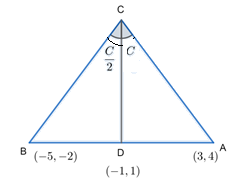
Now, let us consider D as the midpoint of base AB.
To find the coordinate of D, let us use mid-point theorem,
\[\left( \dfrac{{{X}_{1}}+{{X}_{2}}}{2},\dfrac{{{Y}_{1}}+{{Y}_{2}}}{2} \right)\]
Where,
$\begin{align}
& \left( {{X}_{1}},{{Y}_{1}} \right)=\left( -5,-2 \right) \\
& \left( {{X}_{2}},{{Y}_{2}} \right)=\left( 3,4 \right) \\
\end{align}$
$\therefore $Midpoint of $AB,D=\left( \dfrac{-5+3}{2},\dfrac{-2+4}{2} \right)=\left( -1,1 \right)$
$\therefore D\left( -1,1 \right)$ is the midpoint of AB and joins CD.
Now, let us consider the right triangle BDC.
$\begin{align}
& \angle BCA=C \\
& \angle BCA=\angle BCD+\angle ACD \\
\end{align}$
The altitude CD divides $\angle BCA$ into two equal halves,
$\begin{align}
& \therefore \angle BCD=\angle ACD \\
& \Rightarrow \angle BCA=\angle BCD+\angle BCD \\
& \angle BCA=2\angle BCD \\
& \angle C=2\angle BCD \\
& \therefore \angle BCD=\dfrac{C}{2} \\
& \therefore \angle BCD=\angle ACD=\dfrac{C}{2} \\
\end{align}$
By using basic geometry,
$\tan \dfrac{C}{2}=\dfrac{\text{opposite}\ \text{side}}{\text{adjacent}\ \text{side}}=\dfrac{BD}{CD}$
We know, $\cot \dfrac{C}{2}$ is the inverse of $\tan \dfrac{C}{2}$,
$\begin{align}
& \therefore \cot \dfrac{C}{2}=\dfrac{1}{\tan \dfrac{C}{2}}=\dfrac{1}{\dfrac{BD}{CD}} \\
& \therefore \cot \dfrac{C}{2}=\dfrac{CD}{BD} \\
& Altitude\ CD=BD.\cot \dfrac{C}{2}...........\left( 1 \right) \\
\end{align}$
We have been given that tan C = 2.
By using the trigonometric formula of $\tan \theta =\dfrac{2\tan \dfrac{\theta }{2}}{1-{{\tan }^{2}}\dfrac{\theta }{2}}$
Here, $\theta =C$
$\begin{align}
& \therefore \tan C=2 \\
& \dfrac{2\tan \dfrac{C}{2}}{1-{{\tan }^{2}}\dfrac{C}{2}}=2 \\
\end{align}$
Cross multiply and simplifying the above expression, we get,
$\begin{align}
& 2\tan \dfrac{C}{2}=2\left[ 1-{{\tan }^{2}}\dfrac{C}{2} \right] \\
& 2\tan \dfrac{C}{2}=2-2{{\tan }^{2}}\dfrac{C}{2} \\
& 2{{\tan }^{2}}\dfrac{C}{2}+2\tan \dfrac{C}{2}-2=0 \\
\end{align}$
Divide the entire equation by 2.
$\text{ ta}{{\text{n}}^{2}}\dfrac{C}{2}+\tan \dfrac{C}{2}-1=0.............\left( 2 \right)$
Here equation (2) is similar to quadratic equation whose general equation is $a{{x}^{2}}+bx+c=0$, comparing equation (2) and general equation, we get $a=1,b=1,\text{ }c=-1$.
Let us substitute these values in the Quadratic formula $\dfrac{-b\pm \sqrt{{{b}^{2}}-4ac}}{2a}$ .
\[\begin{align}
& \tan \dfrac{C}{2}=\dfrac{-1\pm \sqrt{{{1}^{2}}-4\times 1\times \left( -1 \right)}}{2\times 1} \\
& \tan \dfrac{C}{2}=\dfrac{-1\pm \sqrt{1+4}}{2}=\dfrac{-1+\sqrt{5}}{2} \\
& \therefore \tan \dfrac{C}{2}=\dfrac{-1+\sqrt{5}}{2}=\dfrac{\sqrt{5}-1}{2} \\
\end{align}\]
Now, we need to find $\cot \dfrac{C}{2}$ which is the inverse of $\tan \dfrac{C}{2}$, so we get
\[\begin{align}
& \cot \dfrac{C}{2}=\dfrac{1}{\tan \dfrac{C}{2}}=\dfrac{1}{\dfrac{\sqrt{5}-1}{2}} \\
& \therefore \cot \dfrac{C}{2}=\dfrac{2}{\sqrt{5}-1} \\
\end{align}\]
Multiply by $\left( \sqrt{5}+1 \right)$ in the numerator & denominator.
\[\begin{align}
& \cot \dfrac{C}{2}=\dfrac{2\left( \sqrt{5}+1 \right)}{\left( \sqrt{5}-1 \right)\left( \sqrt{5}+1 \right)}\ \ \ \ \ \ \ \ \ \ \ \ \ \ \ \ \ \ \ \because \left( a-b \right)\left( a+b \right)={{a}^{2}}-{{b}^{2}} \\
& =\dfrac{2\left( \sqrt{5}+1 \right)}{{{\left( \sqrt{5} \right)}^{2}}-{{1}^{2}}}=\dfrac{2\left( \sqrt{5}+1 \right)}{5-1}=\dfrac{2\left( \sqrt{5}+1 \right)}{4}=\dfrac{\sqrt{5}+1}{2} \\
& \Rightarrow \cot \dfrac{C}{2}=\dfrac{\sqrt{5}+1}{2}.............\left( 3 \right) \\
\end{align}\]
Now, let us find the length of BD.
Where, $B\left( -5,-2 \right)\text{ and D}\left( -1,1 \right)$
By using the distance formula, $d=\sqrt{{{\left( {{x}_{2}}-{{x}_{1}} \right)}^{2}}+{{\left( {{y}_{2}}-{{y}_{1}} \right)}^{2}}}$
Substitute the values,
$\begin{align}
& BD=\sqrt{{{\left( -1+5 \right)}^{2}}+{{\left( 1+2 \right)}^{2}}}=\sqrt{16+9}=\sqrt{25}=5 \\
& \therefore BD=5.........................\left( 4 \right) \\
\end{align}$
Now, let us substitute the values of (3) and (4) in equation (1), we get
\[\begin{align}
& CD=BD.\cot \dfrac{C}{2} \\
& =5\left( \dfrac{\sqrt{5}+1}{2} \right) \\
& CD=\dfrac{5}{2}\left( \sqrt{5}+1 \right) \\
\end{align}\]
We need to find the slope of BD, using the formula
Slope\[=\dfrac{{{y}_{2}}-{{y}_{1}}}{{{x}_{2}}-{{x}_{1}}}\]
$\begin{align}
& \text{Slope of BD =}\dfrac{1-\left( -2 \right)}{-1-\left( -5 \right)}=\dfrac{3}{4} \\
& \text{Slope of CD =}-\dfrac{1}{BD}=\dfrac{-4}{\dfrac{3}{4}}=\dfrac{-4}{3} \\
& \therefore \tan \alpha =\dfrac{-4}{3} \\
\end{align}$
The parametric form of straight line is given as $\left( {{x}_{1}}+r\cos \theta ,{{y}_{1}}+r\sin \theta \right)\ $here $\left( {{x}_{1}}{{y}_{1}} \right)=D\left( -1,1 \right)\ r=\dfrac{5}{2}\left( \sqrt{5}+1 \right)$
Thus, form the points,
By using parametric form of straight line, coordinates of C are;
$\begin{align}
& \left[ -1\pm \dfrac{5}{2}\left( \sqrt{5}+1 \right)\cos \alpha ,1\pm \dfrac{5}{2}\left( \sqrt{5}+1 \right)\sin \alpha \right]\ and \\
& \left( \dfrac{-5+3\sqrt{5}}{2},2\sqrt{5}+3 \right)and\left[ \dfrac{3\sqrt{5}-1}{2},-\left( 2\sqrt{5}+1 \right) \right] \\
\end{align}$
So, the correct answers are “Option A and B”.
Note: To get point C, it’s important to find the altitude CD. Remember to use a parametric form of straight line to get the final answer. Basic trigonometric formulas are also used to expand tan C. You should learn formulas so the question becomes easy to solve.
Complete step by step answer:
Given that $A\left( 3,4 \right)$ and $B\left( -5,-2 \right)$ are the extreme ends of the base of the isosceles triangle ABC. Let $\angle BCA$be the angle. Where $\angle BCA=C$.
Now, let us consider D as the midpoint of base AB.
To find the coordinate of D, let us use mid-point theorem,
\[\left( \dfrac{{{X}_{1}}+{{X}_{2}}}{2},\dfrac{{{Y}_{1}}+{{Y}_{2}}}{2} \right)\]
Where,
$\begin{align}
& \left( {{X}_{1}},{{Y}_{1}} \right)=\left( -5,-2 \right) \\
& \left( {{X}_{2}},{{Y}_{2}} \right)=\left( 3,4 \right) \\
\end{align}$
$\therefore $Midpoint of $AB,D=\left( \dfrac{-5+3}{2},\dfrac{-2+4}{2} \right)=\left( -1,1 \right)$
$\therefore D\left( -1,1 \right)$ is the midpoint of AB and joins CD.
Now, let us consider the right triangle BDC.
$\begin{align}
& \angle BCA=C \\
& \angle BCA=\angle BCD+\angle ACD \\
\end{align}$
The altitude CD divides $\angle BCA$ into two equal halves,
$\begin{align}
& \therefore \angle BCD=\angle ACD \\
& \Rightarrow \angle BCA=\angle BCD+\angle BCD \\
& \angle BCA=2\angle BCD \\
& \angle C=2\angle BCD \\
& \therefore \angle BCD=\dfrac{C}{2} \\
& \therefore \angle BCD=\angle ACD=\dfrac{C}{2} \\
\end{align}$
By using basic geometry,
$\tan \dfrac{C}{2}=\dfrac{\text{opposite}\ \text{side}}{\text{adjacent}\ \text{side}}=\dfrac{BD}{CD}$
We know, $\cot \dfrac{C}{2}$ is the inverse of $\tan \dfrac{C}{2}$,
$\begin{align}
& \therefore \cot \dfrac{C}{2}=\dfrac{1}{\tan \dfrac{C}{2}}=\dfrac{1}{\dfrac{BD}{CD}} \\
& \therefore \cot \dfrac{C}{2}=\dfrac{CD}{BD} \\
& Altitude\ CD=BD.\cot \dfrac{C}{2}...........\left( 1 \right) \\
\end{align}$
We have been given that tan C = 2.
By using the trigonometric formula of $\tan \theta =\dfrac{2\tan \dfrac{\theta }{2}}{1-{{\tan }^{2}}\dfrac{\theta }{2}}$
Here, $\theta =C$
$\begin{align}
& \therefore \tan C=2 \\
& \dfrac{2\tan \dfrac{C}{2}}{1-{{\tan }^{2}}\dfrac{C}{2}}=2 \\
\end{align}$
Cross multiply and simplifying the above expression, we get,
$\begin{align}
& 2\tan \dfrac{C}{2}=2\left[ 1-{{\tan }^{2}}\dfrac{C}{2} \right] \\
& 2\tan \dfrac{C}{2}=2-2{{\tan }^{2}}\dfrac{C}{2} \\
& 2{{\tan }^{2}}\dfrac{C}{2}+2\tan \dfrac{C}{2}-2=0 \\
\end{align}$
Divide the entire equation by 2.
$\text{ ta}{{\text{n}}^{2}}\dfrac{C}{2}+\tan \dfrac{C}{2}-1=0.............\left( 2 \right)$
Here equation (2) is similar to quadratic equation whose general equation is $a{{x}^{2}}+bx+c=0$, comparing equation (2) and general equation, we get $a=1,b=1,\text{ }c=-1$.
Let us substitute these values in the Quadratic formula $\dfrac{-b\pm \sqrt{{{b}^{2}}-4ac}}{2a}$ .
\[\begin{align}
& \tan \dfrac{C}{2}=\dfrac{-1\pm \sqrt{{{1}^{2}}-4\times 1\times \left( -1 \right)}}{2\times 1} \\
& \tan \dfrac{C}{2}=\dfrac{-1\pm \sqrt{1+4}}{2}=\dfrac{-1+\sqrt{5}}{2} \\
& \therefore \tan \dfrac{C}{2}=\dfrac{-1+\sqrt{5}}{2}=\dfrac{\sqrt{5}-1}{2} \\
\end{align}\]
Now, we need to find $\cot \dfrac{C}{2}$ which is the inverse of $\tan \dfrac{C}{2}$, so we get
\[\begin{align}
& \cot \dfrac{C}{2}=\dfrac{1}{\tan \dfrac{C}{2}}=\dfrac{1}{\dfrac{\sqrt{5}-1}{2}} \\
& \therefore \cot \dfrac{C}{2}=\dfrac{2}{\sqrt{5}-1} \\
\end{align}\]
Multiply by $\left( \sqrt{5}+1 \right)$ in the numerator & denominator.
\[\begin{align}
& \cot \dfrac{C}{2}=\dfrac{2\left( \sqrt{5}+1 \right)}{\left( \sqrt{5}-1 \right)\left( \sqrt{5}+1 \right)}\ \ \ \ \ \ \ \ \ \ \ \ \ \ \ \ \ \ \ \because \left( a-b \right)\left( a+b \right)={{a}^{2}}-{{b}^{2}} \\
& =\dfrac{2\left( \sqrt{5}+1 \right)}{{{\left( \sqrt{5} \right)}^{2}}-{{1}^{2}}}=\dfrac{2\left( \sqrt{5}+1 \right)}{5-1}=\dfrac{2\left( \sqrt{5}+1 \right)}{4}=\dfrac{\sqrt{5}+1}{2} \\
& \Rightarrow \cot \dfrac{C}{2}=\dfrac{\sqrt{5}+1}{2}.............\left( 3 \right) \\
\end{align}\]
Now, let us find the length of BD.
Where, $B\left( -5,-2 \right)\text{ and D}\left( -1,1 \right)$
By using the distance formula, $d=\sqrt{{{\left( {{x}_{2}}-{{x}_{1}} \right)}^{2}}+{{\left( {{y}_{2}}-{{y}_{1}} \right)}^{2}}}$
Substitute the values,
$\begin{align}
& BD=\sqrt{{{\left( -1+5 \right)}^{2}}+{{\left( 1+2 \right)}^{2}}}=\sqrt{16+9}=\sqrt{25}=5 \\
& \therefore BD=5.........................\left( 4 \right) \\
\end{align}$
Now, let us substitute the values of (3) and (4) in equation (1), we get
\[\begin{align}
& CD=BD.\cot \dfrac{C}{2} \\
& =5\left( \dfrac{\sqrt{5}+1}{2} \right) \\
& CD=\dfrac{5}{2}\left( \sqrt{5}+1 \right) \\
\end{align}\]
We need to find the slope of BD, using the formula
Slope\[=\dfrac{{{y}_{2}}-{{y}_{1}}}{{{x}_{2}}-{{x}_{1}}}\]
$\begin{align}
& \text{Slope of BD =}\dfrac{1-\left( -2 \right)}{-1-\left( -5 \right)}=\dfrac{3}{4} \\
& \text{Slope of CD =}-\dfrac{1}{BD}=\dfrac{-4}{\dfrac{3}{4}}=\dfrac{-4}{3} \\
& \therefore \tan \alpha =\dfrac{-4}{3} \\
\end{align}$
The parametric form of straight line is given as $\left( {{x}_{1}}+r\cos \theta ,{{y}_{1}}+r\sin \theta \right)\ $here $\left( {{x}_{1}}{{y}_{1}} \right)=D\left( -1,1 \right)\ r=\dfrac{5}{2}\left( \sqrt{5}+1 \right)$
Thus, form the points,
By using parametric form of straight line, coordinates of C are;
$\begin{align}
& \left[ -1\pm \dfrac{5}{2}\left( \sqrt{5}+1 \right)\cos \alpha ,1\pm \dfrac{5}{2}\left( \sqrt{5}+1 \right)\sin \alpha \right]\ and \\
& \left( \dfrac{-5+3\sqrt{5}}{2},2\sqrt{5}+3 \right)and\left[ \dfrac{3\sqrt{5}-1}{2},-\left( 2\sqrt{5}+1 \right) \right] \\
\end{align}$
So, the correct answers are “Option A and B”.
Note: To get point C, it’s important to find the altitude CD. Remember to use a parametric form of straight line to get the final answer. Basic trigonometric formulas are also used to expand tan C. You should learn formulas so the question becomes easy to solve.
Recently Updated Pages
Master Class 11 Computer Science: Engaging Questions & Answers for Success

Master Class 11 Business Studies: Engaging Questions & Answers for Success
Master Class 11 Economics: Engaging Questions & Answers for Success
Master Class 11 English: Engaging Questions & Answers for Success
Master Class 11 Maths: Engaging Questions & Answers for Success
Master Class 11 Biology: Engaging Questions & Answers for Success
Trending doubts
One Metric ton is equal to kg A 10000 B 1000 C 100 class 11 physics CBSE
There are 720 permutations of the digits 1 2 3 4 5 class 11 maths CBSE
Discuss the various forms of bacteria class 11 biology CBSE
Draw a diagram of a plant cell and label at least eight class 11 biology CBSE
State the laws of reflection of light
Explain zero factorial class 11 maths CBSE