




If AB=d and \[{{d}_{1}},\text{ }{{d}_{2}}~\text{and }{{d}_{3}}\] are the projections of the line segment AB on the coordinate planes, then ${{d}^{2}}=$
a) $\dfrac{d_{1}^{2}+d_{2}^{2}+d_{3}^{2}}{2}$
b) $\dfrac{{{d}_{1}}+{{d}_{2}}+{{d}_{3}}}{3}$
c) $\dfrac{{{d}_{1}}{{d}_{2}}{{d}_{3}}}{2}$
d) $2\left( d_{1}^{2}+d_{2}^{2}+d_{3}^{2} \right)$
Answer
 Verified
597k+ views
Hint: In this question, we are given a line segment AB and are asked to find the relation between its length and the lengths of its projections on the coordinate planes. As in a projection on a coordinate plane the coordinates corresponding to the coordinate axes not belonging to the plane should be set to zero and those coordinates belonging to the plane should remain unchanged, we can assume the coordinates of A and B to be $\left( {{x}_{A}},{{y}_{A}},{{z}_{A}} \right)$ and $\left( {{x}_{B}},{{y}_{B}},{{z}_{B}} \right)$ respectively, find the coordinates of the projections and use the distance formula to find the length of the projections and hence the required relation which is asked in the question.
Complete step by step solution:
Let AB be be line segment such that the coordinates of A and B are $\left( {{x}_{A}},{{y}_{A}},{{z}_{A}} \right)$ and $\left( {{x}_{B}},{{y}_{B}},{{z}_{B}} \right)$ respectively.
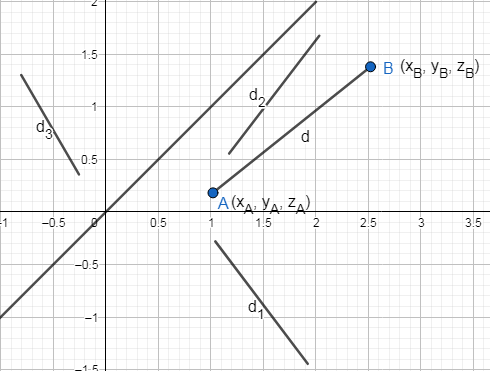
Now, we know that the square of the distance(r) between two points $\left( {{x}_{1}},{{y}_{1}},{{z}_{1}} \right)$ and $\left( {{x}_{2}},{{y}_{2}},{{z}_{2}} \right)$ is given by
${{r}^{2}}={{\left( {{x}_{1}}-{{x}_{2}} \right)}^{2}}+{{\left( {{y}_{1}}-{{y}_{2}} \right)}^{2}}+{{\left( {{z}_{1}}-{{z}_{2}} \right)}^{2}}$ ………………………………………(1.1)
Therefore, as the length of AB is the distance between the points A and B and it given to be d, we can write
${{d}^{2}}={{\left( {{x}_{A}}-{{x}_{B}} \right)}^{2}}+{{\left( {{y}_{A}}-{{y}_{B}} \right)}^{2}}+{{\left( {{z}_{A}}-{{z}_{B}} \right)}^{2}}$ ……………………………..(1.2)
Also, we know that in a projection on a coordinate plane the coordinates corresponding to the coordinate axes not belonging to the plane should be set to zero and those coordinates belonging to the plane should remain unchanged.
Therefore, upon projection onto the x-y plane, the x and y coordinates of A and B should remain unchanged and the z coordinates should be set to zero, therefore, using (1.1) and (1.2), the length of the projection of AB onto the x-y plane should be given by
\[{{d}_{1}}^{2}={{\left( {{x}_{A}}-{{x}_{B}} \right)}^{2}}+{{\left( {{y}_{A}}-{{y}_{B}} \right)}^{2}}+{{\left( 0-0 \right)}^{2}}={{\left( {{x}_{A}}-{{x}_{B}} \right)}^{2}}+{{\left( {{y}_{A}}-{{y}_{B}} \right)}^{2}}\] ………………………………(1.3)
Similarly, upon projection onto the y-z plane, the y and z coordinates of A and B should remain unchanged and the x coordinates should be set to zero, therefore, using (1.1) and (1.2), the length of the projection of AB onto the x-y plane should be given by
\[{{d}_{2}}^{2}={{\left( 0-0 \right)}^{2}}+{{\left( {{y}_{A}}-{{y}_{B}} \right)}^{2}}+{{\left( {{z}_{A}}-{{z}_{B}} \right)}^{2}}={{\left( {{y}_{A}}-{{y}_{B}} \right)}^{2}}+{{\left( {{z}_{A}}-{{z}_{B}} \right)}^{2}}\] ………………………………(1.4)
Upon projection onto the x-z plane, the x and z coordinates of A and B should remain unchanged and the y coordinates should be set to zero, therefore, using (1.1) and (1.2), the length of the projection of AB onto the x-y plane should be given by
\[{{d}_{3}}^{2}={{\left( {{x}_{A}}-{{x}_{B}} \right)}^{2}}+{{\left( 0-0 \right)}^{2}}+{{\left( {{z}_{A}}-{{z}_{B}} \right)}^{2}}={{\left( {{x}_{A}}-{{x}_{B}} \right)}^{2}}+{{\left( {{z}_{A}}-{{z}_{B}} \right)}^{2}}\] ………………………………(1.5)
Adding (1.3), (1.4) and (1.5), and using (1.2), we obtain
\[\begin{align}
& d_{1}^{2}+d_{2}^{2}+d_{3}^{2}=2{{\left( {{x}_{A}}-{{x}_{B}} \right)}^{2}}+2{{\left( {{y}_{A}}-{{y}_{B}} \right)}^{2}}+2{{\left( {{z}_{A}}-{{z}_{B}} \right)}^{2}}=2{{d}^{2}} \\
& \Rightarrow {{d}^{2}}=\dfrac{d_{1}^{2}+d_{2}^{2}+d_{3}^{2}}{2} \\
\end{align}\]
Which matches option(a) of the question. Therefore, option (a) is the correct answer to this question.
Note: We should note that we have taken ${{d}_{1}}$ as the projection of AB onto the x-y plane, ${{d}_{2}}$ as the projection of AB onto the y-z plane and ${{d}_{3}}$ as the projection of AB onto the x-z plane. However, one can interchange the names ${{d}_{1}},{{d}_{2}}\text{ and }{{d}_{3}}$ for the projections as ultimately we would be adding all the squares of the three projections and thus the particular order of naming will not affect the solution.
Complete step by step solution:
Let AB be be line segment such that the coordinates of A and B are $\left( {{x}_{A}},{{y}_{A}},{{z}_{A}} \right)$ and $\left( {{x}_{B}},{{y}_{B}},{{z}_{B}} \right)$ respectively.
Now, we know that the square of the distance(r) between two points $\left( {{x}_{1}},{{y}_{1}},{{z}_{1}} \right)$ and $\left( {{x}_{2}},{{y}_{2}},{{z}_{2}} \right)$ is given by
${{r}^{2}}={{\left( {{x}_{1}}-{{x}_{2}} \right)}^{2}}+{{\left( {{y}_{1}}-{{y}_{2}} \right)}^{2}}+{{\left( {{z}_{1}}-{{z}_{2}} \right)}^{2}}$ ………………………………………(1.1)
Therefore, as the length of AB is the distance between the points A and B and it given to be d, we can write
${{d}^{2}}={{\left( {{x}_{A}}-{{x}_{B}} \right)}^{2}}+{{\left( {{y}_{A}}-{{y}_{B}} \right)}^{2}}+{{\left( {{z}_{A}}-{{z}_{B}} \right)}^{2}}$ ……………………………..(1.2)
Also, we know that in a projection on a coordinate plane the coordinates corresponding to the coordinate axes not belonging to the plane should be set to zero and those coordinates belonging to the plane should remain unchanged.
Therefore, upon projection onto the x-y plane, the x and y coordinates of A and B should remain unchanged and the z coordinates should be set to zero, therefore, using (1.1) and (1.2), the length of the projection of AB onto the x-y plane should be given by
\[{{d}_{1}}^{2}={{\left( {{x}_{A}}-{{x}_{B}} \right)}^{2}}+{{\left( {{y}_{A}}-{{y}_{B}} \right)}^{2}}+{{\left( 0-0 \right)}^{2}}={{\left( {{x}_{A}}-{{x}_{B}} \right)}^{2}}+{{\left( {{y}_{A}}-{{y}_{B}} \right)}^{2}}\] ………………………………(1.3)
Similarly, upon projection onto the y-z plane, the y and z coordinates of A and B should remain unchanged and the x coordinates should be set to zero, therefore, using (1.1) and (1.2), the length of the projection of AB onto the x-y plane should be given by
\[{{d}_{2}}^{2}={{\left( 0-0 \right)}^{2}}+{{\left( {{y}_{A}}-{{y}_{B}} \right)}^{2}}+{{\left( {{z}_{A}}-{{z}_{B}} \right)}^{2}}={{\left( {{y}_{A}}-{{y}_{B}} \right)}^{2}}+{{\left( {{z}_{A}}-{{z}_{B}} \right)}^{2}}\] ………………………………(1.4)
Upon projection onto the x-z plane, the x and z coordinates of A and B should remain unchanged and the y coordinates should be set to zero, therefore, using (1.1) and (1.2), the length of the projection of AB onto the x-y plane should be given by
\[{{d}_{3}}^{2}={{\left( {{x}_{A}}-{{x}_{B}} \right)}^{2}}+{{\left( 0-0 \right)}^{2}}+{{\left( {{z}_{A}}-{{z}_{B}} \right)}^{2}}={{\left( {{x}_{A}}-{{x}_{B}} \right)}^{2}}+{{\left( {{z}_{A}}-{{z}_{B}} \right)}^{2}}\] ………………………………(1.5)
Adding (1.3), (1.4) and (1.5), and using (1.2), we obtain
\[\begin{align}
& d_{1}^{2}+d_{2}^{2}+d_{3}^{2}=2{{\left( {{x}_{A}}-{{x}_{B}} \right)}^{2}}+2{{\left( {{y}_{A}}-{{y}_{B}} \right)}^{2}}+2{{\left( {{z}_{A}}-{{z}_{B}} \right)}^{2}}=2{{d}^{2}} \\
& \Rightarrow {{d}^{2}}=\dfrac{d_{1}^{2}+d_{2}^{2}+d_{3}^{2}}{2} \\
\end{align}\]
Which matches option(a) of the question. Therefore, option (a) is the correct answer to this question.
Note: We should note that we have taken ${{d}_{1}}$ as the projection of AB onto the x-y plane, ${{d}_{2}}$ as the projection of AB onto the y-z plane and ${{d}_{3}}$ as the projection of AB onto the x-z plane. However, one can interchange the names ${{d}_{1}},{{d}_{2}}\text{ and }{{d}_{3}}$ for the projections as ultimately we would be adding all the squares of the three projections and thus the particular order of naming will not affect the solution.
Recently Updated Pages
Master Class 12 Economics: Engaging Questions & Answers for Success

Master Class 12 Physics: Engaging Questions & Answers for Success
Master Class 12 English: Engaging Questions & Answers for Success
Master Class 12 Social Science: Engaging Questions & Answers for Success
Master Class 12 Maths: Engaging Questions & Answers for Success
Master Class 12 Business Studies: Engaging Questions & Answers for Success
Trending doubts
Which are the Top 10 Largest Countries of the World?
What are the major means of transport Explain each class 12 social science CBSE
Draw a labelled sketch of the human eye class 12 physics CBSE
Differentiate between insitu conservation and exsitu class 12 biology CBSE
Draw a neat and well labeled diagram of TS of ovary class 12 biology CBSE
Give 10 examples of unisexual and bisexual flowers