




If ABCD is a parallelogram and E, F the centroids of triangles ABD and BCD respectively, then EF equals

(a) AE
(b) BE
(c) CE
(d) DE
Answer
 Verified
612.3k+ views
Hint: To solve this question, we are going to use the fact that in a triangle ABC,
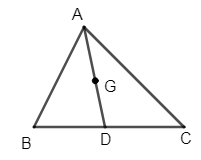
If G is the centroid of the above triangle then, \[\dfrac{AG}{GD}=\dfrac{2}{1}\]. Also, we will use the fact that the triangles ABD and BCD are congruents in the parallelogram.
Complete step-by-step answer:
Before solving the question, we must know what is a parallelogram and what is a centroid in a triangle. A parallelogram is a quadrilateral with two pairs of parallel sides. The opposite or facing sides of a parallelogram are of equal length. In parallelogram ABCD given in question, AB = CD and AD = BC. A centroid is a point of intersection of all the medians in a triangle.
Now first we will prove that the triangle ABD and triangle BCD are congruent. We know that the sides AB = CD and AD = BC. Also, the side BD is common in both the triangles.
Thus in \[\Delta ABD\] and \[\Delta BCD\], we have
AB = CD
AD = BC
And, BD = BD
Thus the triangles ABD and BCD are congruent. So, here we can say that, AE = CF and OE = OF.
Now, we are going to use a property of a centroid. In \[\Delta ABD\], E is the centroid of the triangles. The centroid E will divide the median in the ratio 2:1. Thus, we can say that,
\[\Rightarrow \dfrac{AE}{EO}=\dfrac{2}{1}\]
\[\Rightarrow AE=2EO\] - (i)
Similarly, in \[\Delta BCD\] F is the centroid of the triangle. The centroid F will divide the median in the ratio 2:1. Thus we can say that,
\[\Rightarrow \dfrac{CF}{FO}=\dfrac{2}{1}\]
\[\Rightarrow CF=2FO\] - (ii)
Now, we know that, AC = AE + ED + FO + CF – (iii)
Now we will put the values of AE and CF from (i) and (ii) into (iii). After doing this, we will get:
\[\begin{align}
& \Rightarrow AC=2EO+EO+FO+2FO \\
& \Rightarrow AC=3EO+3FO\left( \because EO=FO \right) \\
& \Rightarrow AC=3EO+3EO \\
& \Rightarrow AC=6EO \\
\end{align}\]
\[\Rightarrow EO=\dfrac{AC}{6}\] - (iv)
Now, EF = EO + FO
\[\Rightarrow EF=2EO\]
\[\Rightarrow EF=2\dfrac{AC}{6}\] (From (iv))
\[\Rightarrow EF=\dfrac{AC}{3}\]
Also, AE = 2EO
\[\Rightarrow AE=2\dfrac{AC}{6}\] (From (iv))
\[\Rightarrow AE=\dfrac{AC}{3}\]
Here, we can see that, AE = EF
Hence option (a) is correct.
Note: If the triangles ABD and BCD had been equilateral triangles, then in that case, DE = BE = AE. Thus, in that case, option (a), (b) and (d) had been correct.
If G is the centroid of the above triangle then, \[\dfrac{AG}{GD}=\dfrac{2}{1}\]. Also, we will use the fact that the triangles ABD and BCD are congruents in the parallelogram.
Complete step-by-step answer:
Before solving the question, we must know what is a parallelogram and what is a centroid in a triangle. A parallelogram is a quadrilateral with two pairs of parallel sides. The opposite or facing sides of a parallelogram are of equal length. In parallelogram ABCD given in question, AB = CD and AD = BC. A centroid is a point of intersection of all the medians in a triangle.
Now first we will prove that the triangle ABD and triangle BCD are congruent. We know that the sides AB = CD and AD = BC. Also, the side BD is common in both the triangles.
Thus in \[\Delta ABD\] and \[\Delta BCD\], we have
AB = CD
AD = BC
And, BD = BD
Thus the triangles ABD and BCD are congruent. So, here we can say that, AE = CF and OE = OF.
Now, we are going to use a property of a centroid. In \[\Delta ABD\], E is the centroid of the triangles. The centroid E will divide the median in the ratio 2:1. Thus, we can say that,
\[\Rightarrow \dfrac{AE}{EO}=\dfrac{2}{1}\]
\[\Rightarrow AE=2EO\] - (i)
Similarly, in \[\Delta BCD\] F is the centroid of the triangle. The centroid F will divide the median in the ratio 2:1. Thus we can say that,
\[\Rightarrow \dfrac{CF}{FO}=\dfrac{2}{1}\]
\[\Rightarrow CF=2FO\] - (ii)
Now, we know that, AC = AE + ED + FO + CF – (iii)
Now we will put the values of AE and CF from (i) and (ii) into (iii). After doing this, we will get:
\[\begin{align}
& \Rightarrow AC=2EO+EO+FO+2FO \\
& \Rightarrow AC=3EO+3FO\left( \because EO=FO \right) \\
& \Rightarrow AC=3EO+3EO \\
& \Rightarrow AC=6EO \\
\end{align}\]
\[\Rightarrow EO=\dfrac{AC}{6}\] - (iv)
Now, EF = EO + FO
\[\Rightarrow EF=2EO\]
\[\Rightarrow EF=2\dfrac{AC}{6}\] (From (iv))
\[\Rightarrow EF=\dfrac{AC}{3}\]
Also, AE = 2EO
\[\Rightarrow AE=2\dfrac{AC}{6}\] (From (iv))
\[\Rightarrow AE=\dfrac{AC}{3}\]
Here, we can see that, AE = EF
Hence option (a) is correct.
Note: If the triangles ABD and BCD had been equilateral triangles, then in that case, DE = BE = AE. Thus, in that case, option (a), (b) and (d) had been correct.
Recently Updated Pages
Master Class 10 English: Engaging Questions & Answers for Success

Master Class 10 Social Science: Engaging Questions & Answers for Success
Master Class 10 Computer Science: Engaging Questions & Answers for Success
Class 10 Question and Answer - Your Ultimate Solutions Guide
Master Class 10 General Knowledge: Engaging Questions & Answers for Success
Master Class 10 Maths: Engaging Questions & Answers for Success
Trending doubts
A boat goes 24 km upstream and 28 km downstream in class 10 maths CBSE
State and explain Ohms law class 10 physics CBSE
Distinguish between soap and detergent class 10 chemistry CBSE
a Why did Mendel choose pea plants for his experiments class 10 biology CBSE
What is a "free hit" awarded for in limited-overs cricket?
Draw the diagram of the sectional view of the human class 10 biology CBSE