



If ABCD is a cyclic quadrilateral, then the value of $\cos A + \cos B + \cos C + \cos D$ is:
A) $1$
B) $0$
C) $2$
D) None of these
Answer
 Verified
585k+ views
Hint: According to given in the question we have to determine the value of $\cos A + \cos B + \cos C + \cos D$. So, first of all we have to understand about the cyclic quadrilateral which is explained as below:
Cyclic quadrilateral: A cyclic quadrilateral is a four-sided polygon whose vertices are inscribed in a circle and its all four vertices lying on the circle. The circle which consists of all the vertices of any polygon on its circumference is called as the circumcircle and the sum of its two opposite angle is ${180^\circ}$
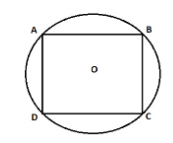
Now, with the help of the sum of the opposite angle of the cyclic quadrilateral we can obtain a relation between two angles.
Now, we have to multiply with $\cos $ in the both sides of the expression obtained and now we have to use the formula to solve the expression obtained which is given below:
Formula used: $ \Rightarrow \cos (A - B) = \cos A\cos B + \sin A\sin B.............................(A)$
Now, we have to do the same for the remaining to opposite angles of the cyclic quadrilateral. Hence, by adding all the expressions we can obtain the value of $\cos A + \cos B + \cos C + \cos D$.
Complete step-by-step answer:
Step 1: First of all we have to consider the diagram of a cyclic quadrilateral ABCD which is as mentioned below:
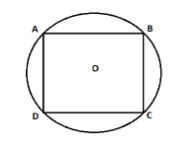
Step 2: now, as we know that for the cyclic quadrilateral the sum of its two opposite angles are equal to ${180^\circ}$ or $\pi $ as mentioned in the solution hint hence, we have to consider the two opposite angles A and C,
$ \Rightarrow A + C = \pi $
On rearranging the terms on the expression obtained just above,
$ \Rightarrow A = \pi - C.................(1)$
Step 3: Now, we have to multiply with $\cos $in the both sides of the expression (1) as mentioned in the solution hint.
$ \Rightarrow \cos A = \cos (\pi - C)...............(2)$
Step 4: Now, to solve the expression (2) as obtained in the solution step 3 we have to use the formula (A) as mentioned in the solution hint.
$ \Rightarrow \cos A = \cos \pi \cos C + \sin \pi \sin C$
Now, on substituting the values of $\cos \pi $which is equal to -1, and $\sin \pi $which is equal to 0
$
\Rightarrow \cos A = ( - 1)\cos C + (0)\sin C \\
\Rightarrow \cos A = - \cos C + 0 \\
\Rightarrow \operatorname{Cos} A + \cos C = 0............(3)
$
Step 5: Now, as we know that for the cyclic quadrilateral the sum of its two opposite angles are equal to ${180^\circ}$ or $\pi $ as mentioned in the solution hint hence, we have to consider the two opposite angles B and D,
$ \Rightarrow B + C = \pi $
On rearranging the terms on the expression obtained just above,
$ \Rightarrow B = \pi - D.................(4)$
Step 6: Now, we have to multiply with $\cos $in the both sides of the expression (4) as mentioned in the solution hint.
$ \Rightarrow \cos B = \cos (\pi - D)...............(5)$
Step 7: Now, to solve the expression (5) as obtained in the solution step 3 we have to use the formula (A) as mentioned in the solution hint.
$ \Rightarrow \cos B = \cos \pi \cos D + \sin \pi \sin D$
Now, on substituting the values of $\cos \pi $which is equal to -1, and $\sin \pi $which is equal to 0
$
\Rightarrow \cos B = ( - 1)\cos D + (0)\sin D \\
\Rightarrow \cos B = - \cos D + 0 \\
\Rightarrow \cos B + \cos D = 0............(6)
$
Step 8: Now, we have to add the expressions (3) and (6) to obtain the value of $\cos A + \cos B + \cos C + \cos D$ as mentioned in the solution hint. Hence,
$
\Rightarrow \cos A + \cos B + \cos C + \cos D = 0 + 0 \\
\Rightarrow \cos A + \cos B + \cos C + \cos D = 0
$
Final solution: Hence, with the help of formula (A) as mentioned in the solution hint we have obtained the value of $\cos A + \cos B + \cos C + \cos D = 0$.
Therefore option (B) is correct.
Note: The sum of the opposite angles of a cyclic quadrilateral is supplementary angles and for the cyclic quadrilateral we know that the sum of its opposite angle is equal to $\pi $ or ${180^\circ}$
The ratio between the diagonals and the sides can be defined as a cyclic quadrilateral theorem and if there is a quadrilateral which is inscribed inside a circle, then the product of the diagonals is equal to the sum of the product of its two pairs of its opposite sides.
Cyclic quadrilateral: A cyclic quadrilateral is a four-sided polygon whose vertices are inscribed in a circle and its all four vertices lying on the circle. The circle which consists of all the vertices of any polygon on its circumference is called as the circumcircle and the sum of its two opposite angle is ${180^\circ}$
Now, with the help of the sum of the opposite angle of the cyclic quadrilateral we can obtain a relation between two angles.
Now, we have to multiply with $\cos $ in the both sides of the expression obtained and now we have to use the formula to solve the expression obtained which is given below:
Formula used: $ \Rightarrow \cos (A - B) = \cos A\cos B + \sin A\sin B.............................(A)$
Now, we have to do the same for the remaining to opposite angles of the cyclic quadrilateral. Hence, by adding all the expressions we can obtain the value of $\cos A + \cos B + \cos C + \cos D$.
Complete step-by-step answer:
Step 1: First of all we have to consider the diagram of a cyclic quadrilateral ABCD which is as mentioned below:
Step 2: now, as we know that for the cyclic quadrilateral the sum of its two opposite angles are equal to ${180^\circ}$ or $\pi $ as mentioned in the solution hint hence, we have to consider the two opposite angles A and C,
$ \Rightarrow A + C = \pi $
On rearranging the terms on the expression obtained just above,
$ \Rightarrow A = \pi - C.................(1)$
Step 3: Now, we have to multiply with $\cos $in the both sides of the expression (1) as mentioned in the solution hint.
$ \Rightarrow \cos A = \cos (\pi - C)...............(2)$
Step 4: Now, to solve the expression (2) as obtained in the solution step 3 we have to use the formula (A) as mentioned in the solution hint.
$ \Rightarrow \cos A = \cos \pi \cos C + \sin \pi \sin C$
Now, on substituting the values of $\cos \pi $which is equal to -1, and $\sin \pi $which is equal to 0
$
\Rightarrow \cos A = ( - 1)\cos C + (0)\sin C \\
\Rightarrow \cos A = - \cos C + 0 \\
\Rightarrow \operatorname{Cos} A + \cos C = 0............(3)
$
Step 5: Now, as we know that for the cyclic quadrilateral the sum of its two opposite angles are equal to ${180^\circ}$ or $\pi $ as mentioned in the solution hint hence, we have to consider the two opposite angles B and D,
$ \Rightarrow B + C = \pi $
On rearranging the terms on the expression obtained just above,
$ \Rightarrow B = \pi - D.................(4)$
Step 6: Now, we have to multiply with $\cos $in the both sides of the expression (4) as mentioned in the solution hint.
$ \Rightarrow \cos B = \cos (\pi - D)...............(5)$
Step 7: Now, to solve the expression (5) as obtained in the solution step 3 we have to use the formula (A) as mentioned in the solution hint.
$ \Rightarrow \cos B = \cos \pi \cos D + \sin \pi \sin D$
Now, on substituting the values of $\cos \pi $which is equal to -1, and $\sin \pi $which is equal to 0
$
\Rightarrow \cos B = ( - 1)\cos D + (0)\sin D \\
\Rightarrow \cos B = - \cos D + 0 \\
\Rightarrow \cos B + \cos D = 0............(6)
$
Step 8: Now, we have to add the expressions (3) and (6) to obtain the value of $\cos A + \cos B + \cos C + \cos D$ as mentioned in the solution hint. Hence,
$
\Rightarrow \cos A + \cos B + \cos C + \cos D = 0 + 0 \\
\Rightarrow \cos A + \cos B + \cos C + \cos D = 0
$
Final solution: Hence, with the help of formula (A) as mentioned in the solution hint we have obtained the value of $\cos A + \cos B + \cos C + \cos D = 0$.
Therefore option (B) is correct.
Note: The sum of the opposite angles of a cyclic quadrilateral is supplementary angles and for the cyclic quadrilateral we know that the sum of its opposite angle is equal to $\pi $ or ${180^\circ}$
The ratio between the diagonals and the sides can be defined as a cyclic quadrilateral theorem and if there is a quadrilateral which is inscribed inside a circle, then the product of the diagonals is equal to the sum of the product of its two pairs of its opposite sides.
Recently Updated Pages
Basicity of sulphurous acid and sulphuric acid are

Master Class 11 Business Studies: Engaging Questions & Answers for Success
Master Class 11 Computer Science: Engaging Questions & Answers for Success
Master Class 11 Economics: Engaging Questions & Answers for Success
Master Class 12 English: Engaging Questions & Answers for Success
Master Class 12 Social Science: Engaging Questions & Answers for Success
Trending doubts
Fill the blanks with the suitable prepositions 1 The class 9 english CBSE
Difference Between Plant Cell and Animal Cell
Find the sum of series 1 + 2 + 3 + 4 + 5 + + 100 class 9 maths CBSE
Distinguish between Conventional and nonconventional class 9 social science CBSE
Find the greatest fivedigit number which is a perfect class 9 maths CBSE
Find the mode and median of the data 13 16 12 14 1-class-9-maths-CBSE