




If $ ABC $ is an equilateral triangle inscribed in a circle and $ P $ be any point on the minor arc $ BC $ which does not coincide with $ B $ or $ C $ prove that $ PA $ is an angle bisector of $ \angle BPC $ .
Answer
 Verified
637.8k+ views
Hint: We will construct a circle and triangle inscribed in it as given in the question. Then we draw a point $ P $ on the arc $ BC $ . Since the triangle is an equilateral triangle, its angle and sides must be equal. We will then join $ AP $ . The angle subtended by the same arc is always equal. Hence by using this property and property of the equilateral triangle, we will prove that the line $ PA $ is angle bisector.
Complete step-by-step answer:
We will draw $ \Delta ABC $ is an equilateral triangle which is inscribed in a circle. We will assume the center of the circle as $ O $ . We also show the point $ P $ on the arc $ BC $ and we will join $ AP $ .
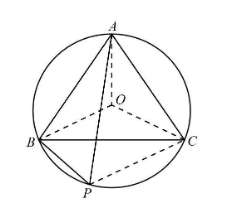
If $ \Delta ABC $ is an equilateral triangle, then all the sides of the triangle must be equal. This can be expressed as,
$ AB = BC = CA $
We know that angles in a triangle which are opposite to the equal side must be equal. This can be expressed as,
$ \angle ABC = \angle BCA \ldots \ldots \left( {\rm{i}} \right) $
We know that $ \angle BPA $ and $ \angle BCA $ are subtended by the same segment $ BA $ . Hence from the property of the circle we can say that both these angles will be equal. This can be expressed as:
$ \angle BPA = \angle BCA $ ……(ii)
We know that $ \angle APC $ and $ \angle ABC $ are subtended by the same segment $ BA $ . Hence from the property of the circle we can say that both these angles will be equal. This can be expressed as:
$ \angle APC = \angle ABC $ ……(iii)
From equation (i), we have $ \angle ABC = \angle BCA $ . Hence from equation (ii) and (iii) we can say that
$ \angle BPA = \angle APC $
Since the line $ PA $ is dividing $ \angle BPC $ into equal parts, hence $ PA $ is the angle bisector of $ \angle BPC $ .
Hence proved.
Note: To solve this question, we are using the properties of circles, chords on a circle, properties of an equilateral triangle and the angles formed by the same segment. We should have prior knowledge about these properties to prove the condition given in the question. The angle subtended at the center by the chord, which are always equal. We can also use this property to prove the given condition.
Complete step-by-step answer:
We will draw $ \Delta ABC $ is an equilateral triangle which is inscribed in a circle. We will assume the center of the circle as $ O $ . We also show the point $ P $ on the arc $ BC $ and we will join $ AP $ .
If $ \Delta ABC $ is an equilateral triangle, then all the sides of the triangle must be equal. This can be expressed as,
$ AB = BC = CA $
We know that angles in a triangle which are opposite to the equal side must be equal. This can be expressed as,
$ \angle ABC = \angle BCA \ldots \ldots \left( {\rm{i}} \right) $
We know that $ \angle BPA $ and $ \angle BCA $ are subtended by the same segment $ BA $ . Hence from the property of the circle we can say that both these angles will be equal. This can be expressed as:
$ \angle BPA = \angle BCA $ ……(ii)
We know that $ \angle APC $ and $ \angle ABC $ are subtended by the same segment $ BA $ . Hence from the property of the circle we can say that both these angles will be equal. This can be expressed as:
$ \angle APC = \angle ABC $ ……(iii)
From equation (i), we have $ \angle ABC = \angle BCA $ . Hence from equation (ii) and (iii) we can say that
$ \angle BPA = \angle APC $
Since the line $ PA $ is dividing $ \angle BPC $ into equal parts, hence $ PA $ is the angle bisector of $ \angle BPC $ .
Hence proved.
Note: To solve this question, we are using the properties of circles, chords on a circle, properties of an equilateral triangle and the angles formed by the same segment. We should have prior knowledge about these properties to prove the condition given in the question. The angle subtended at the center by the chord, which are always equal. We can also use this property to prove the given condition.
Recently Updated Pages
Basicity of sulphurous acid and sulphuric acid are

Master Class 12 Economics: Engaging Questions & Answers for Success
Master Class 12 Biology: Engaging Questions & Answers for Success
Master Class 11 English: Engaging Questions & Answers for Success
Master Class 11 Physics: Engaging Questions & Answers for Success
Master Class 11 Computer Science: Engaging Questions & Answers for Success
Trending doubts
Difference Between Plant Cell and Animal Cell
Fill the blanks with the suitable prepositions 1 The class 9 english CBSE
What is pollution? How many types of pollution? Define it
What is the full form of pH?
What is the Full Form of ICSE, CBSE and SSC
Name 10 Living and Non living things class 9 biology CBSE