




If $A=B={{60}^{{}^\circ }}$, verify that $\tan \left( A-B \right)=\dfrac{\tan A-\tan B}{1+\tan A\tan B}$.
Answer
 Verified
630.9k+ views
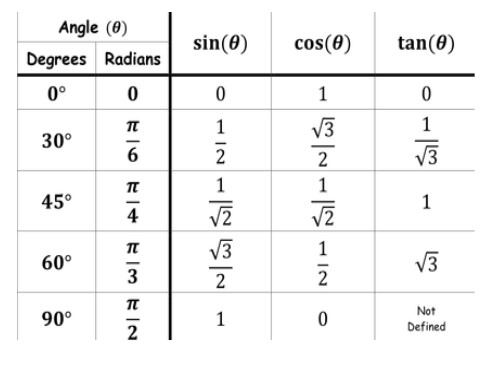
Hint:We know that the given relation is $\tan \left( A-B \right)=\dfrac{\tan A-\tan B}{1+\tan A\tan B}$. We will put A and B as ${{60}^{{}^\circ }}$ and then solve LHS and RHS individually and if we get $LHS=RHS$, then the above relation is verified. We will also use the values $\tan {{0}^{{}^\circ }}=0$ , $\tan {{30}^{{}^\circ }}=\dfrac{1}{\sqrt{3}}$, $\tan {{45}^{{}^\circ }}=1$, $\tan {{60}^{{}^\circ }}=\sqrt{3}$ and $\tan {{90}^{{}^\circ }}=\infty $.
Complete step-by-step answer:
It is given in the question that , then we have to verify that $\tan \left( A-B \right)=\dfrac{\tan A-\tan B}{1+\tan A\tan B}$. We will solve LHS and RHS individually by putting the value of $A=B={{60}^{{}^\circ }}$ both sides and if both LHS and RHS are equal then the given relation will be verified.
To proceed with the question, let us first consider the below table. It shows the values of the trigonometric ratios at standard angles.
In LHS we have $\tan \left( A-B \right)$, putting the value $A=B={{60}^{{}^\circ }}$, we get
$=\tan \left( {{60}^{{}^\circ }}-{{60}^{{}^\circ }} \right)$ or
$=\tan \left( {{0}^{{}^\circ }} \right)$
We know that that the value of $\tan {{0}^{{}^\circ }}=0$. therefore,
$=0$.
In RHS we have $\dfrac{\tan A-\tan B}{1+\tan A\tan B}$ , we put the given values $A=B={{60}^{{}^\circ }}$, we get
$=\dfrac{\tan {{60}^{{}^\circ }}-\tan {{60}^{{}^\circ }}}{1+\tan {{60}^{{}^\circ }}\tan {{60}^{{}^\circ }}}$, we know that the value of $\tan {{60}^{{}^\circ }}=\sqrt{3}$, therefore putting this value in the RHS expression, we get
$=\dfrac{\sqrt{3}-\sqrt{3}}{1+\sqrt{3}\sqrt{3}}$ , therefore, on solving, we get
$=0$.
Thus, RHS evaluates to zero.
Now comparing LHS and RHS, we find that \[LHS\text{ }=\text{ }RHS=0\] or simply we can say that
$LHS=RHS$.
Hence Proved.
Note: Student may take the value of $\tan {{60}^{{}^\circ }}=\dfrac{1}{\sqrt{3}}$ and value of $\tan {{30}^{{}^\circ }}=\sqrt{3}$ as both these values are confusing and if someone takes the wrong values, solution may be wrong.So, students should remember trigonometric standard angles and formulas to solve these types of questions.
Complete step-by-step answer:
It is given in the question that , then we have to verify that $\tan \left( A-B \right)=\dfrac{\tan A-\tan B}{1+\tan A\tan B}$. We will solve LHS and RHS individually by putting the value of $A=B={{60}^{{}^\circ }}$ both sides and if both LHS and RHS are equal then the given relation will be verified.
To proceed with the question, let us first consider the below table. It shows the values of the trigonometric ratios at standard angles.
In LHS we have $\tan \left( A-B \right)$, putting the value $A=B={{60}^{{}^\circ }}$, we get
$=\tan \left( {{60}^{{}^\circ }}-{{60}^{{}^\circ }} \right)$ or
$=\tan \left( {{0}^{{}^\circ }} \right)$
We know that that the value of $\tan {{0}^{{}^\circ }}=0$. therefore,
$=0$.
In RHS we have $\dfrac{\tan A-\tan B}{1+\tan A\tan B}$ , we put the given values $A=B={{60}^{{}^\circ }}$, we get
$=\dfrac{\tan {{60}^{{}^\circ }}-\tan {{60}^{{}^\circ }}}{1+\tan {{60}^{{}^\circ }}\tan {{60}^{{}^\circ }}}$, we know that the value of $\tan {{60}^{{}^\circ }}=\sqrt{3}$, therefore putting this value in the RHS expression, we get
$=\dfrac{\sqrt{3}-\sqrt{3}}{1+\sqrt{3}\sqrt{3}}$ , therefore, on solving, we get
$=0$.
Thus, RHS evaluates to zero.
Now comparing LHS and RHS, we find that \[LHS\text{ }=\text{ }RHS=0\] or simply we can say that
$LHS=RHS$.
Hence Proved.
Note: Student may take the value of $\tan {{60}^{{}^\circ }}=\dfrac{1}{\sqrt{3}}$ and value of $\tan {{30}^{{}^\circ }}=\sqrt{3}$ as both these values are confusing and if someone takes the wrong values, solution may be wrong.So, students should remember trigonometric standard angles and formulas to solve these types of questions.
Recently Updated Pages
Master Class 11 Social Science: Engaging Questions & Answers for Success

Master Class 11 English: Engaging Questions & Answers for Success
Master Class 11 Maths: Engaging Questions & Answers for Success
Master Class 11 Chemistry: Engaging Questions & Answers for Success
Master Class 11 Biology: Engaging Questions & Answers for Success
Master Class 11 Physics: Engaging Questions & Answers for Success
Trending doubts
Differentiate between an exothermic and an endothermic class 11 chemistry CBSE
One Metric ton is equal to kg A 10000 B 1000 C 100 class 11 physics CBSE
Difference Between Prokaryotic Cells and Eukaryotic Cells
There are 720 permutations of the digits 1 2 3 4 5 class 11 maths CBSE
Draw a diagram of a plant cell and label at least eight class 11 biology CBSE
Which chemical is known as king of chemicals A H 2 class 11 chemistry CBSE