



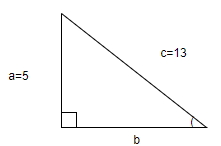
If $a=5$ and $c=13$, how do you find $b$ ?
Additional Information: Here $a$ , $b$ and $c$ are sides of a right angle triangle.
Answer
 Verified
561.6k+ views
Hint: For answering this question we will use the statement given for the Pythagoras theorem that is “the square of the length of the largest side is equal to the sum of the squares of the other two sides” and assume the side $c$ as hypotenuse and simplify it further.
Complete step by step answer:
As given from the question we have the lengths of two sides of a right angle triangle and we need to find the length of the third side of the right angle triangle.
From the Pythagoras theorem we know that “the square of the length of the largest side is equal to the sum of the squares of the other two sides.”
Hence we can say that if we assume $c$ as the hypotenuse or the longest side then ${{c}^{2}}={{a}^{2}}+{{b}^{2}}$ .
Since we have $a=5$ and $c=13$ by substituting these values in ${{c}^{2}}={{a}^{2}}+{{b}^{2}}$ we will have ${{13}^{2}}={{5}^{2}}+{{b}^{2}}$ .
By performing the arithmetic calculations we will have $169=25+{{b}^{2}}$ .
By further simplifying this
$\begin{align}
& 169-25={{b}^{2}} \\
& \Rightarrow 144={{b}^{2}} \\
& \Rightarrow 12=b \\
\end{align}$ .
Hence we can conclude that when in a right angle triangle $a=5$ and $c=13$ then the value of $b$ will be $12$.
Note: We should be careful while performing calculations and applying concepts in questions of this type. If by mistake as the question is not very clear here we assume the side $b$ as the longest side or hypotenuse then we will have its value as ${{b}^{2}}={{a}^{2}}+{{c}^{2}}\Rightarrow {{b}^{2}}={{5}^{2}}+{{13}^{2}}\Rightarrow b=\sqrt{169+25}$ which will yield the value of $b$ as $\sqrt{194}=13.92$ according to you this may be right but most of the people accept the answer as given above so it is preferred to solve the question as given above.
Complete step by step answer:
As given from the question we have the lengths of two sides of a right angle triangle and we need to find the length of the third side of the right angle triangle.
From the Pythagoras theorem we know that “the square of the length of the largest side is equal to the sum of the squares of the other two sides.”
Hence we can say that if we assume $c$ as the hypotenuse or the longest side then ${{c}^{2}}={{a}^{2}}+{{b}^{2}}$ .
Since we have $a=5$ and $c=13$ by substituting these values in ${{c}^{2}}={{a}^{2}}+{{b}^{2}}$ we will have ${{13}^{2}}={{5}^{2}}+{{b}^{2}}$ .
By performing the arithmetic calculations we will have $169=25+{{b}^{2}}$ .
By further simplifying this
$\begin{align}
& 169-25={{b}^{2}} \\
& \Rightarrow 144={{b}^{2}} \\
& \Rightarrow 12=b \\
\end{align}$ .
Hence we can conclude that when in a right angle triangle $a=5$ and $c=13$ then the value of $b$ will be $12$.
Note: We should be careful while performing calculations and applying concepts in questions of this type. If by mistake as the question is not very clear here we assume the side $b$ as the longest side or hypotenuse then we will have its value as ${{b}^{2}}={{a}^{2}}+{{c}^{2}}\Rightarrow {{b}^{2}}={{5}^{2}}+{{13}^{2}}\Rightarrow b=\sqrt{169+25}$ which will yield the value of $b$ as $\sqrt{194}=13.92$ according to you this may be right but most of the people accept the answer as given above so it is preferred to solve the question as given above.
Recently Updated Pages
Master Class 9 General Knowledge: Engaging Questions & Answers for Success

Master Class 9 Social Science: Engaging Questions & Answers for Success
Master Class 9 English: Engaging Questions & Answers for Success
Master Class 9 Maths: Engaging Questions & Answers for Success
Master Class 9 Science: Engaging Questions & Answers for Success
Class 9 Question and Answer - Your Ultimate Solutions Guide
Trending doubts
Difference Between Plant Cell and Animal Cell
Fill the blanks with the suitable prepositions 1 The class 9 english CBSE
Who is eligible for RTE class 9 social science CBSE
Which places in India experience sunrise first and class 9 social science CBSE
What is pollution? How many types of pollution? Define it
Name 10 Living and Non living things class 9 biology CBSE