




If $A={{30}^{{}^\circ }}$ and $B={{60}^{{}^\circ }}$, verify that $\cos \left( A+B \right)=\cos A\cos B-sinA\sin B$.
Answer
 Verified
631.5k+ views
Hint:We know that the given relation is $\cos \left( A+B \right)=\cos A\cos B-sinA\sin B$. We will put the given values as $A={{30}^{{}^\circ }}$ and $B={{60}^{{}^\circ }}$, then solve LHS and RHS individually and find if we get $LHS=RHS$ then the above relation will be verified.
Complete step-by-step answer:
It is given in the question that $A={{30}^{{}^\circ }}$ and $B={{60}^{{}^\circ }}$ then we have to verify that $\cos \left( A+B \right)=\cos A\cos B-sinA\sin B$. We will solve LHS and RHS individually by putting the values of $A={{30}^{{}^\circ }}$ and $B={{60}^{{}^\circ }}$ on both sides. If both sides get the same value then the given relation will be verified.
To proceed with the question, let us first consider the below table. It shows the values of the trigonometric ratios at standard angles.
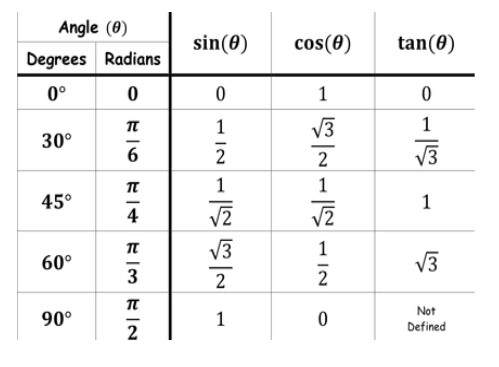
In LHS, we have $\cos \left( A+B \right)$, on putting the given values as $A={{30}^{{}^\circ }}$ and $B={{60}^{{}^\circ }}$, we get
$=\cos \left( {{30}^{{}^\circ }}+{{90}^{{}^\circ }} \right)$, solving further, we get,
$=\cos \left( {{90}^{{}^\circ }} \right)$, now considering the table, and finding the value of $\cos \left( {{90}^{{}^\circ }} \right)$ from it, we get $\cos \left( {{90}^{{}^\circ }} \right)=0$, therefore LHS reduces to
$=0$.
Thus \[LHS=0\].
Now in RHS we have $\cos A\cos B-sinA\sin B$, on putting the given values as $A={{30}^{{}^\circ }}$ and $B={{60}^{{}^\circ }}$, we get
\[=\cos {{30}^{{}^\circ }}\cos {{60}^{{}^\circ }}-sin{{30}^{{}^\circ }}\sin {{60}^{{}^\circ }}\], now referring to the table, we can find the required values of the angle and then put them into the last step equation, we get
$=\dfrac{\sqrt{3}}{2}\times \dfrac{1}{2}-\dfrac{1}{2}\times \dfrac{\sqrt{3}}{2}$, on solving further, we get
$=\dfrac{\sqrt{3}}{4}-\dfrac{\sqrt{3}}{4}$, that is,
$=0$.
On comparing LHS and RHS we get $LHS=RHS=0$, thus, $LHS=RHS$.
Hence Proved.
Note: We must note here that the given expression to be proved is actually an identity related to the sum of angles of trigonometric functions. Usually students make mistakes in hurry while substituting the value of angle and this led to the formation of wrong answers. Many time student take $\cos {{30}^{{}^\circ }}=\dfrac{1}{2}$ and $\cos {{60}^{{}^\circ }}=\dfrac{\sqrt{3}}{2}$ which is not correct at all.Students should remember the standard trigonometric angles and formulas for solving these types of questions.
Complete step-by-step answer:
It is given in the question that $A={{30}^{{}^\circ }}$ and $B={{60}^{{}^\circ }}$ then we have to verify that $\cos \left( A+B \right)=\cos A\cos B-sinA\sin B$. We will solve LHS and RHS individually by putting the values of $A={{30}^{{}^\circ }}$ and $B={{60}^{{}^\circ }}$ on both sides. If both sides get the same value then the given relation will be verified.
To proceed with the question, let us first consider the below table. It shows the values of the trigonometric ratios at standard angles.
In LHS, we have $\cos \left( A+B \right)$, on putting the given values as $A={{30}^{{}^\circ }}$ and $B={{60}^{{}^\circ }}$, we get
$=\cos \left( {{30}^{{}^\circ }}+{{90}^{{}^\circ }} \right)$, solving further, we get,
$=\cos \left( {{90}^{{}^\circ }} \right)$, now considering the table, and finding the value of $\cos \left( {{90}^{{}^\circ }} \right)$ from it, we get $\cos \left( {{90}^{{}^\circ }} \right)=0$, therefore LHS reduces to
$=0$.
Thus \[LHS=0\].
Now in RHS we have $\cos A\cos B-sinA\sin B$, on putting the given values as $A={{30}^{{}^\circ }}$ and $B={{60}^{{}^\circ }}$, we get
\[=\cos {{30}^{{}^\circ }}\cos {{60}^{{}^\circ }}-sin{{30}^{{}^\circ }}\sin {{60}^{{}^\circ }}\], now referring to the table, we can find the required values of the angle and then put them into the last step equation, we get
$=\dfrac{\sqrt{3}}{2}\times \dfrac{1}{2}-\dfrac{1}{2}\times \dfrac{\sqrt{3}}{2}$, on solving further, we get
$=\dfrac{\sqrt{3}}{4}-\dfrac{\sqrt{3}}{4}$, that is,
$=0$.
On comparing LHS and RHS we get $LHS=RHS=0$, thus, $LHS=RHS$.
Hence Proved.
Note: We must note here that the given expression to be proved is actually an identity related to the sum of angles of trigonometric functions. Usually students make mistakes in hurry while substituting the value of angle and this led to the formation of wrong answers. Many time student take $\cos {{30}^{{}^\circ }}=\dfrac{1}{2}$ and $\cos {{60}^{{}^\circ }}=\dfrac{\sqrt{3}}{2}$ which is not correct at all.Students should remember the standard trigonometric angles and formulas for solving these types of questions.
Recently Updated Pages
Master Class 11 Social Science: Engaging Questions & Answers for Success

Master Class 11 English: Engaging Questions & Answers for Success
Master Class 11 Maths: Engaging Questions & Answers for Success
Master Class 11 Chemistry: Engaging Questions & Answers for Success
Master Class 11 Biology: Engaging Questions & Answers for Success
Master Class 11 Physics: Engaging Questions & Answers for Success
Trending doubts
Differentiate between an exothermic and an endothermic class 11 chemistry CBSE
One Metric ton is equal to kg A 10000 B 1000 C 100 class 11 physics CBSE
Difference Between Prokaryotic Cells and Eukaryotic Cells
There are 720 permutations of the digits 1 2 3 4 5 class 11 maths CBSE
Draw a diagram of a plant cell and label at least eight class 11 biology CBSE
Two of the body parts which do not appear in MRI are class 11 biology CBSE