




If A(-3, -5), B(-2, -7), C(1, -8) and D(6, 3) are the vertices of the quadrilateral ABCD then find its area.
Answer
 Verified
594.3k+ views
Hint: First, before proceeding for this, we must know that in this type of problem we are required to split the quadrilateral ABCD in two triangles by using a diagonal. Then, we know that the area A of the triangle is given by the formula with vertices$\left( {{x}_{1}},{{y}_{1}} \right),\left( {{x}_{2}},{{y}_{2}} \right),\left( {{x}_{3}},{{y}_{3}} \right)$as $A=\dfrac{1}{2}\left[ {{x}_{1}}\left( {{y}_{2}}-{{y}_{3}} \right)+{{x}_{2}}\left( {{y}_{3}}-{{y}_{1}} \right)+{{x}_{3}}\left( {{y}_{1}}-{{y}_{2}} \right) \right]$. Then, find the area of both the triangles and add them to get the area of the quadrilateral.
Complete step-by-step answer:
In this question, we are supposed to find the area of the quadrilateral ABCD with vertices as A(-3, -5), B(-2, -7), C(1, -8) and D(6, 3).
So, before proceeding for this, we must know that in this type of problem we are required to split the quadrilateral ABCD in two triangles by using a diagonal as shown in the figure:
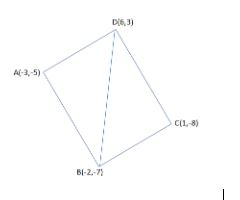
Now, we get the area of the quadrilateral broken down into two triangles as $\Delta BCD$ and $\Delta ABD$.
Now, we know that the area A of the triangle is given by the formula with vertices$\left( {{x}_{1}},{{y}_{1}} \right),\left( {{x}_{2}},{{y}_{2}} \right),\left( {{x}_{3}},{{y}_{3}} \right)$as:
$A=\dfrac{1}{2}\left[ {{x}_{1}}\left( {{y}_{2}}-{{y}_{3}} \right)+{{x}_{2}}\left( {{y}_{3}}-{{y}_{1}} \right)+{{x}_{3}}\left( {{y}_{1}}-{{y}_{2}} \right) \right]$
Now, by using the above stated formula for the triangle $\Delta ABD$as:
$\begin{align}
& A=\dfrac{1}{2}\left[ -3\left( -7-3 \right)+\left( -2 \right)\left( 3-\left( -5 \right) \right)+6\left( -5-\left( -7 \right) \right) \right] \\
& \Rightarrow A=\dfrac{1}{2}\left[ -3\left( -10 \right)+\left( -2 \right)\left( 8 \right)+6\left( 2 \right) \right] \\
& \Rightarrow A=\dfrac{1}{2}\left[ 30-16+12 \right] \\
& \Rightarrow A=\dfrac{1}{2}\left[ 26 \right] \\
& \Rightarrow A=13 \\
\end{align}$
So, we get the area of the $\Delta ABD$as 13 cm square.
Similarly, we can use the same formula to calculate the value of the area of the $\Delta BCD$as:
$\begin{align}
& A=\dfrac{1}{2}\left[ -2\left( -8-3 \right)+1\left( 3-\left( -7 \right) \right)+6\left( -2-\left( -8 \right) \right) \right] \\
& \Rightarrow A=\dfrac{1}{2}\left[ -2\left( -11 \right)+1\left( 10 \right)+6\left( 6 \right) \right] \\
& \Rightarrow A=\dfrac{1}{2}\left[ 22+10+36 \right] \\
& \Rightarrow A=\dfrac{1}{2}\left[ 68 \right] \\
& \Rightarrow A=34 \\
\end{align}$
So, we get the area of the $\Delta BCD$as 34 cm square.
Now, we know that we require the area of the quadrilateral which is made up of two triangles.
The, we add the area of both the triangles to get the area of the quadrilateral as:
13+34=47
So, we get the area of the quadrilateral ABCD is 47 cm square.
Hence, the area of the quadrilateral with vertices A(-3, -5), B(-2, -7), C(1, -8) and D(6, 3) is 47.
Note: Now, in this type of the question, there is no fixed pattern to be followed as it was our assumption to tale diagonal as BD, we can also take the diagonal at Ac and use the triangle ABC and triangle ACD to get the value of area and then add the area to get the area of the quadrilateral ABCD.
Complete step-by-step answer:
In this question, we are supposed to find the area of the quadrilateral ABCD with vertices as A(-3, -5), B(-2, -7), C(1, -8) and D(6, 3).
So, before proceeding for this, we must know that in this type of problem we are required to split the quadrilateral ABCD in two triangles by using a diagonal as shown in the figure:
Now, we get the area of the quadrilateral broken down into two triangles as $\Delta BCD$ and $\Delta ABD$.
Now, we know that the area A of the triangle is given by the formula with vertices$\left( {{x}_{1}},{{y}_{1}} \right),\left( {{x}_{2}},{{y}_{2}} \right),\left( {{x}_{3}},{{y}_{3}} \right)$as:
$A=\dfrac{1}{2}\left[ {{x}_{1}}\left( {{y}_{2}}-{{y}_{3}} \right)+{{x}_{2}}\left( {{y}_{3}}-{{y}_{1}} \right)+{{x}_{3}}\left( {{y}_{1}}-{{y}_{2}} \right) \right]$
Now, by using the above stated formula for the triangle $\Delta ABD$as:
$\begin{align}
& A=\dfrac{1}{2}\left[ -3\left( -7-3 \right)+\left( -2 \right)\left( 3-\left( -5 \right) \right)+6\left( -5-\left( -7 \right) \right) \right] \\
& \Rightarrow A=\dfrac{1}{2}\left[ -3\left( -10 \right)+\left( -2 \right)\left( 8 \right)+6\left( 2 \right) \right] \\
& \Rightarrow A=\dfrac{1}{2}\left[ 30-16+12 \right] \\
& \Rightarrow A=\dfrac{1}{2}\left[ 26 \right] \\
& \Rightarrow A=13 \\
\end{align}$
So, we get the area of the $\Delta ABD$as 13 cm square.
Similarly, we can use the same formula to calculate the value of the area of the $\Delta BCD$as:
$\begin{align}
& A=\dfrac{1}{2}\left[ -2\left( -8-3 \right)+1\left( 3-\left( -7 \right) \right)+6\left( -2-\left( -8 \right) \right) \right] \\
& \Rightarrow A=\dfrac{1}{2}\left[ -2\left( -11 \right)+1\left( 10 \right)+6\left( 6 \right) \right] \\
& \Rightarrow A=\dfrac{1}{2}\left[ 22+10+36 \right] \\
& \Rightarrow A=\dfrac{1}{2}\left[ 68 \right] \\
& \Rightarrow A=34 \\
\end{align}$
So, we get the area of the $\Delta BCD$as 34 cm square.
Now, we know that we require the area of the quadrilateral which is made up of two triangles.
The, we add the area of both the triangles to get the area of the quadrilateral as:
13+34=47
So, we get the area of the quadrilateral ABCD is 47 cm square.
Hence, the area of the quadrilateral with vertices A(-3, -5), B(-2, -7), C(1, -8) and D(6, 3) is 47.
Note: Now, in this type of the question, there is no fixed pattern to be followed as it was our assumption to tale diagonal as BD, we can also take the diagonal at Ac and use the triangle ABC and triangle ACD to get the value of area and then add the area to get the area of the quadrilateral ABCD.
Recently Updated Pages
Master Class 11 Computer Science: Engaging Questions & Answers for Success

Master Class 11 Business Studies: Engaging Questions & Answers for Success
Master Class 11 Economics: Engaging Questions & Answers for Success
Master Class 11 English: Engaging Questions & Answers for Success
Master Class 11 Maths: Engaging Questions & Answers for Success
Master Class 11 Biology: Engaging Questions & Answers for Success
Trending doubts
One Metric ton is equal to kg A 10000 B 1000 C 100 class 11 physics CBSE
There are 720 permutations of the digits 1 2 3 4 5 class 11 maths CBSE
Discuss the various forms of bacteria class 11 biology CBSE
Draw a diagram of a plant cell and label at least eight class 11 biology CBSE
State the laws of reflection of light
Explain zero factorial class 11 maths CBSE