



If a young man rides his motorcycle at 25km/h, he has to spend 2 per km on petrol. If he rides at a faster speed of 40km/h, the petrol cost increases at 5 per km. He has 100 to spend on petrol and wishes to find what is the maximum distance he can travel in one hour. Express this as an LPP and solve it graphically.
Answer
 Verified
555.3k+ views
Hint: We solve this question by using the concept of linear programming. We need to use the given data for the two cases and write two inequalities. Then we plot both these inequalities on the graph and check for boundary points. We substitute this in the equation for total distance travelled and substituting these points, we check for the maximum distance travelled.
Complete step by step answer:
In order to solve this question, let us first form equations using the given data. Let us assume that the man travels a distance of x km riding at a speed of 25km/h and he travels a distance of y km riding at a speed of 40km/h. We are also given the cost of travelling at 25km/h which is 2 per km. So, by travelling x km, the cost is 2x. Similarly, we are given the cost of travelling at 40km/h which is 5 per km. So, by travelling y km, the cost is 5y.
Now, there is a constraint on the cost that it should be less than or equal to 100. We make this in the form of an inequality as shown,
$\Rightarrow 2x+5y\le 100\ldots \left( 1 \right)$
Now, it is assumed that he travels a distance of x km by moving at a speed of 25km/h. The duration for this can be found by using the formula $\text{Time=}\dfrac{\text{Distance}}{\text{Speed}}.$ Substituting in this,
$\Rightarrow {{t}_{1}}\text{=}\dfrac{\text{x}}{\text{25}}$
This time is measured in hours. Similarly, it is assumed that he travels a distance of y km by moving at a speed of 40km/h. The duration for this can be found by using the same formula. Substituting in the equation,
$\Rightarrow {{t}_{2}}\text{=}\dfrac{y}{40}$
We have a constraint on the time which says he should travel for an hour. So, the sum of these two times should be less than or equal to one hour.
$\Rightarrow {{t}_{1}}+{{t}_{2}}\le 1$
$\Rightarrow \dfrac{x}{25}+\dfrac{y}{40}\le 1$
Taking the LCM of the two as 200 and multiplying the numerator and denominator by 8 for the first term and by 5 for the second term on the left-hand side,
$\Rightarrow \dfrac{x\times 8}{25\times 8}+\dfrac{y\times 5}{40\times 5}\le 1$
Simplifying this by multiplying,
$\Rightarrow \dfrac{8x}{200}+\dfrac{5y}{200}\le 1$
Multiplying both sides of this equation by 200,
$\Rightarrow 8x+5y\le 200\ldots \left( 2 \right)$
We also know the equation for the total distance travelled is given by the equation,
$\Rightarrow z=x+y\ldots \left( 3 \right)$
Plotting equations 1 and 2 on the graph, we get
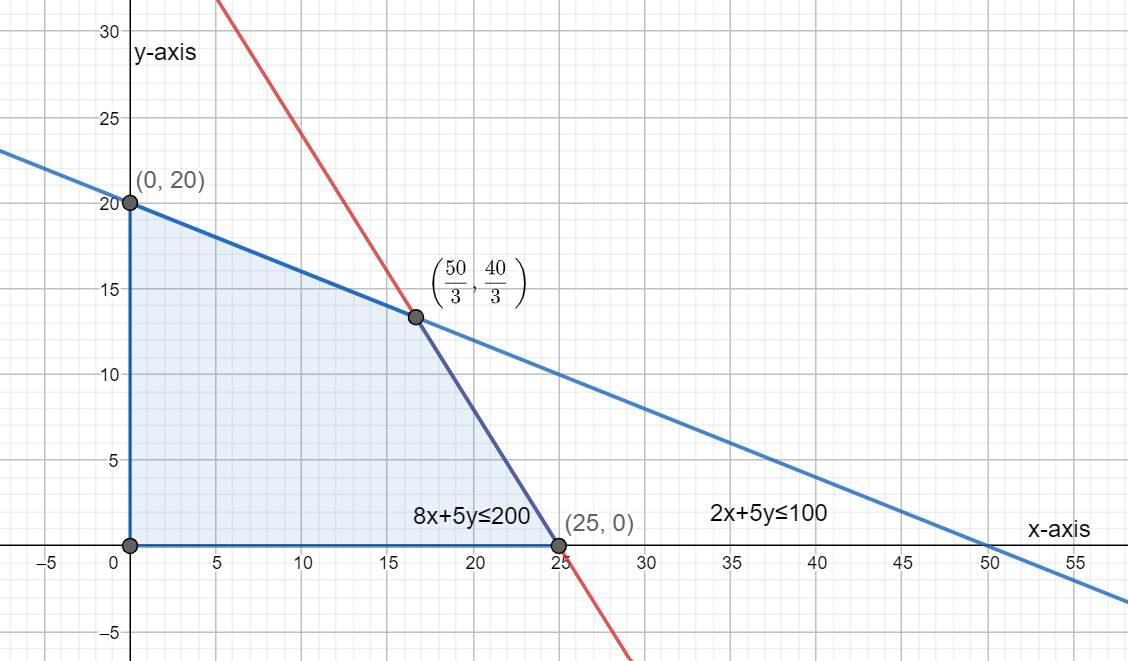
Looking at the graph, we mark the region which is intersecting under both the lines. We then consider the boundary points for this region which are $\left( 0,20 \right),\left( \dfrac{50}{3},\dfrac{40}{3} \right),\left( 25,0 \right).$ Then, we substitute this in the equation 3 to see which of these cases best produces the maximum distance travelled. Substituting $\left( 0,20 \right),$
$\Rightarrow z=0+20=20$
Similarly, substituting $\left( 25,0 \right),$
$\Rightarrow z=25+0=25$
Similarly, substituting $\left( \dfrac{50}{3},\dfrac{40}{3} \right),$
$\Rightarrow z=\dfrac{50}{3}+\dfrac{40}{3}$
Adding the two numerators and dividing by 3,
$\Rightarrow z=\dfrac{90}{3}=30$
Hence, the maximum distance is produced in the last case which is for the point $\left( \dfrac{50}{3},\dfrac{40}{3} \right).$ Hence, he can travel a maximum distance of 30 km.
Note: We need to note the point that we have considered the points on the edge of the boundary away from the origin because we are required to maximize the function. The boundary points away from the origin will always give the maximum value.
Complete step by step answer:
In order to solve this question, let us first form equations using the given data. Let us assume that the man travels a distance of x km riding at a speed of 25km/h and he travels a distance of y km riding at a speed of 40km/h. We are also given the cost of travelling at 25km/h which is 2 per km. So, by travelling x km, the cost is 2x. Similarly, we are given the cost of travelling at 40km/h which is 5 per km. So, by travelling y km, the cost is 5y.
Now, there is a constraint on the cost that it should be less than or equal to 100. We make this in the form of an inequality as shown,
$\Rightarrow 2x+5y\le 100\ldots \left( 1 \right)$
Now, it is assumed that he travels a distance of x km by moving at a speed of 25km/h. The duration for this can be found by using the formula $\text{Time=}\dfrac{\text{Distance}}{\text{Speed}}.$ Substituting in this,
$\Rightarrow {{t}_{1}}\text{=}\dfrac{\text{x}}{\text{25}}$
This time is measured in hours. Similarly, it is assumed that he travels a distance of y km by moving at a speed of 40km/h. The duration for this can be found by using the same formula. Substituting in the equation,
$\Rightarrow {{t}_{2}}\text{=}\dfrac{y}{40}$
We have a constraint on the time which says he should travel for an hour. So, the sum of these two times should be less than or equal to one hour.
$\Rightarrow {{t}_{1}}+{{t}_{2}}\le 1$
$\Rightarrow \dfrac{x}{25}+\dfrac{y}{40}\le 1$
Taking the LCM of the two as 200 and multiplying the numerator and denominator by 8 for the first term and by 5 for the second term on the left-hand side,
$\Rightarrow \dfrac{x\times 8}{25\times 8}+\dfrac{y\times 5}{40\times 5}\le 1$
Simplifying this by multiplying,
$\Rightarrow \dfrac{8x}{200}+\dfrac{5y}{200}\le 1$
Multiplying both sides of this equation by 200,
$\Rightarrow 8x+5y\le 200\ldots \left( 2 \right)$
We also know the equation for the total distance travelled is given by the equation,
$\Rightarrow z=x+y\ldots \left( 3 \right)$
Plotting equations 1 and 2 on the graph, we get
Looking at the graph, we mark the region which is intersecting under both the lines. We then consider the boundary points for this region which are $\left( 0,20 \right),\left( \dfrac{50}{3},\dfrac{40}{3} \right),\left( 25,0 \right).$ Then, we substitute this in the equation 3 to see which of these cases best produces the maximum distance travelled. Substituting $\left( 0,20 \right),$
$\Rightarrow z=0+20=20$
Similarly, substituting $\left( 25,0 \right),$
$\Rightarrow z=25+0=25$
Similarly, substituting $\left( \dfrac{50}{3},\dfrac{40}{3} \right),$
$\Rightarrow z=\dfrac{50}{3}+\dfrac{40}{3}$
Adding the two numerators and dividing by 3,
$\Rightarrow z=\dfrac{90}{3}=30$
Hence, the maximum distance is produced in the last case which is for the point $\left( \dfrac{50}{3},\dfrac{40}{3} \right).$ Hence, he can travel a maximum distance of 30 km.
Note: We need to note the point that we have considered the points on the edge of the boundary away from the origin because we are required to maximize the function. The boundary points away from the origin will always give the maximum value.
Recently Updated Pages
Master Class 9 General Knowledge: Engaging Questions & Answers for Success

Master Class 9 Maths: Engaging Questions & Answers for Success
Master Class 9 Science: Engaging Questions & Answers for Success
Master Class 9 English: Engaging Questions & Answers for Success
Master Class 9 Social Science: Engaging Questions & Answers for Success
Class 9 Question and Answer - Your Ultimate Solutions Guide
Trending doubts
Find the sum of series 1 + 2 + 3 + 4 + 5 + + 100 class 9 maths CBSE
Difference Between Plant Cell and Animal Cell
Fill the blanks with the suitable prepositions 1 The class 9 english CBSE
What is pollution? How many types of pollution? Define it
Name 10 Living and Non living things class 9 biology CBSE
What is the full form of pH?