




If a tangent to the parabola $ {{y}^{2}}=4ax $ meets the $ x- $ axis at $ T $ and the tangent at the vertex $ A $ in $ P $ and the rectangle $ TAPQ $ is completed. Then the locus of $ Q $ is;
A. $ {{y}^{2}}+4ax=0 $ \[\]
B. $ {{y}^{2}}+2ax=0 $ \[\]
C. $ {{y}^{2}}=2ax $ \[\]
D. $ {{y}^{2}}+ax=0 $ \[\]
Answer
 Verified
568.8k+ views
Hint: We take the point of contact of tangent in parametric form as $ \left( a{{t}^{2}},2at \right) $ which gives us equation of the tangent $ ty=x+a{{t}^{2}} $ . We denote the coordinate of Q as $ Q\left( h,k \right) $ for instance. We find the coordinates of $ A,P,T $ . We use the fact that diagonals in a rectangle bisect each other and find the equate the coordinates of midpoints of diagonal TP and AQ. We find $ h,k $ in terms of $ t $ . We eliminate $ t $ and replace $ \left( h,k \right) $ by $ \left( x,y \right) $ to get the focus. \[\]
Complete step by step answer:
We are given in the question the equation of rightward parabola $ {{y}^{2}}=4ax $ meets the $ x- $ axis at $ T $ and the tangent vertex $ A $ in $ P $ . We know that any point on the parabola $ {{y}^{2}}=4ax $ with a parameter $ t $ is given by $ \left( a{{t}^{2}},2at \right) $ and the equation of the tangent at the point $ \left( a{{t}^{2}},2at \right) $ is given by
\[ty=x+a{{t}^{2}}\]
Let the $ V\left( a{{t}^{2}},2at \right) $ be the variable point where our given tangent with equation $ ty=x+a{{t}^{2}} $ is drawn which meets the $ x- $ axis at $ T $ and the tangent vertex $ A $ in $ P $ . Let us assume the fourth vertex $ Q $ of the rectangle at one instance has coordinate $ Q\left( h,k \right) $ . We have the rough figure as; \[\]
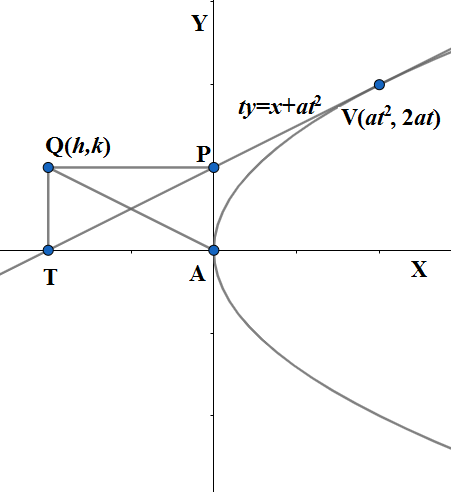
Let us find the other 3 coordinates of vertices of the rectangle TAPQ. Since all parabolas of the type $ {{y}^{2}}=4ax $ have the coordinate of their vertex at the origin the coordinate of $ A $ is $ A\left( 0,0 \right) $ and tangent at the vertex is $ y- $ axis. Since all the points on $ x- $ axis like $ T $ has their $ y- $ coordinate zero and also $ T $ lies on the tangent $ ty=x+a{{t}^{2}} $ we have;
\[\begin{align}
& t\left( 0 \right)=x+a{{t}^{2}} \\
& \Rightarrow x=-a{{t}^{2}} \\
\end{align}\]
So the coordinate of $ T $ is $ T\left( -a{{t}^{2}},0 \right) $ . Since all the points on $ y- $ axis like $ P $ has their $ y- $ coordinate zero and also $ P $ lies on the tangent $ ty=x+a{{t}^{2}} $ we have;
\[\begin{align}
& ty=0+a{{t}^{2}} \\
& \Rightarrow y=at \\
\end{align}\]
So the coordinate of $ P $ is $ P\left( 0,at \right) $ . Let us denote the point of intersection of diagonals TP and AQ as M.
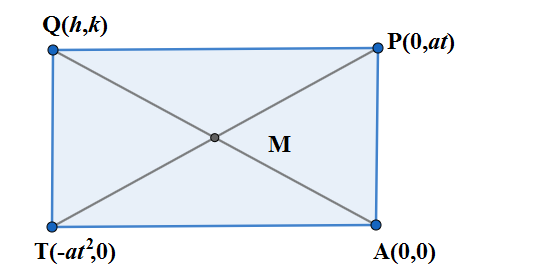
Since the midpoints of the diagonals QA and TP will be same and that is M irrespective of motion of the point Q, we use the midpoint formula and have the coordinate of M as ;
\[\begin{align}
& \text{midpoint of TP}=\text{midpoint of AQ} \\
& \Rightarrow \left( \dfrac{-a{{t}^{2}}+0}{2},\dfrac{0+at}{2} \right)=\left( \dfrac{0+h}{2},\dfrac{0+k}{2} \right) \\
& \Rightarrow \left( \dfrac{-a{{t}^{2}}}{2},\dfrac{at}{2} \right)=\left( \dfrac{h}{2},\dfrac{k}{2} \right) \\
& \Rightarrow \dfrac{h}{2}=\dfrac{-a{{t}^{2}}}{2},\dfrac{k}{2}=\dfrac{at}{2} \\
& \Rightarrow h=-a{{t}^{2}},k=at \\
\end{align}\]
Let us eliminate $ t $ from the above equations.
\[\begin{align}
& \because k=at\Rightarrow t=\dfrac{k}{a} \\
& h=-a{{t}^{2}} \\
& \Rightarrow h=-a{{\left( \dfrac{k}{a} \right)}^{2}} \\
& \Rightarrow h=-a\dfrac{{{k}^{2}}}{{{a}^{2}}} \\
& \Rightarrow {{k}^{2}}+ah=0 \\
\end{align}\]
Let us replace $ \left( h,k \right) $ by $ \left( x,y \right) $ for all instances during the motion of Q. We have the locus of $ Q $ as;
\[{{y}^{2}}+ax=0\]
So the correct option is D. \[\]
Note:
We know that if $ \left( {{x}_{1}},{{y}_{1}} \right) $ and $ \left( {{x}_{2}},{{y}_{2}} \right) $ be two end points of a lines segment the coordinates of the midpoint is given by $ \left( \dfrac{{{x}_{1}}+{{x}_{2}}}{2},\dfrac{{{y}_{1}}+{{y}_{2}}}{2} \right) $ . We can alternatively find $ h,k $ in terms of $ t $ by observing that the $ x- $ coordinates of all points of line parallel $ y- $ axis like T and Q and the $ y- $ coordinates of all points of line parallel $ y- $ axis like Q and P will be same. We can also use the equation of tangent to the parabola $ {{y}^{2}}=4ax $ in slope-point from $ y=mx+\dfrac{a}{m} $ to solve the problem quickly.
Complete step by step answer:
We are given in the question the equation of rightward parabola $ {{y}^{2}}=4ax $ meets the $ x- $ axis at $ T $ and the tangent vertex $ A $ in $ P $ . We know that any point on the parabola $ {{y}^{2}}=4ax $ with a parameter $ t $ is given by $ \left( a{{t}^{2}},2at \right) $ and the equation of the tangent at the point $ \left( a{{t}^{2}},2at \right) $ is given by
\[ty=x+a{{t}^{2}}\]
Let the $ V\left( a{{t}^{2}},2at \right) $ be the variable point where our given tangent with equation $ ty=x+a{{t}^{2}} $ is drawn which meets the $ x- $ axis at $ T $ and the tangent vertex $ A $ in $ P $ . Let us assume the fourth vertex $ Q $ of the rectangle at one instance has coordinate $ Q\left( h,k \right) $ . We have the rough figure as; \[\]
Let us find the other 3 coordinates of vertices of the rectangle TAPQ. Since all parabolas of the type $ {{y}^{2}}=4ax $ have the coordinate of their vertex at the origin the coordinate of $ A $ is $ A\left( 0,0 \right) $ and tangent at the vertex is $ y- $ axis. Since all the points on $ x- $ axis like $ T $ has their $ y- $ coordinate zero and also $ T $ lies on the tangent $ ty=x+a{{t}^{2}} $ we have;
\[\begin{align}
& t\left( 0 \right)=x+a{{t}^{2}} \\
& \Rightarrow x=-a{{t}^{2}} \\
\end{align}\]
So the coordinate of $ T $ is $ T\left( -a{{t}^{2}},0 \right) $ . Since all the points on $ y- $ axis like $ P $ has their $ y- $ coordinate zero and also $ P $ lies on the tangent $ ty=x+a{{t}^{2}} $ we have;
\[\begin{align}
& ty=0+a{{t}^{2}} \\
& \Rightarrow y=at \\
\end{align}\]
So the coordinate of $ P $ is $ P\left( 0,at \right) $ . Let us denote the point of intersection of diagonals TP and AQ as M.
Since the midpoints of the diagonals QA and TP will be same and that is M irrespective of motion of the point Q, we use the midpoint formula and have the coordinate of M as ;
\[\begin{align}
& \text{midpoint of TP}=\text{midpoint of AQ} \\
& \Rightarrow \left( \dfrac{-a{{t}^{2}}+0}{2},\dfrac{0+at}{2} \right)=\left( \dfrac{0+h}{2},\dfrac{0+k}{2} \right) \\
& \Rightarrow \left( \dfrac{-a{{t}^{2}}}{2},\dfrac{at}{2} \right)=\left( \dfrac{h}{2},\dfrac{k}{2} \right) \\
& \Rightarrow \dfrac{h}{2}=\dfrac{-a{{t}^{2}}}{2},\dfrac{k}{2}=\dfrac{at}{2} \\
& \Rightarrow h=-a{{t}^{2}},k=at \\
\end{align}\]
Let us eliminate $ t $ from the above equations.
\[\begin{align}
& \because k=at\Rightarrow t=\dfrac{k}{a} \\
& h=-a{{t}^{2}} \\
& \Rightarrow h=-a{{\left( \dfrac{k}{a} \right)}^{2}} \\
& \Rightarrow h=-a\dfrac{{{k}^{2}}}{{{a}^{2}}} \\
& \Rightarrow {{k}^{2}}+ah=0 \\
\end{align}\]
Let us replace $ \left( h,k \right) $ by $ \left( x,y \right) $ for all instances during the motion of Q. We have the locus of $ Q $ as;
\[{{y}^{2}}+ax=0\]
So the correct option is D. \[\]
Note:
We know that if $ \left( {{x}_{1}},{{y}_{1}} \right) $ and $ \left( {{x}_{2}},{{y}_{2}} \right) $ be two end points of a lines segment the coordinates of the midpoint is given by $ \left( \dfrac{{{x}_{1}}+{{x}_{2}}}{2},\dfrac{{{y}_{1}}+{{y}_{2}}}{2} \right) $ . We can alternatively find $ h,k $ in terms of $ t $ by observing that the $ x- $ coordinates of all points of line parallel $ y- $ axis like T and Q and the $ y- $ coordinates of all points of line parallel $ y- $ axis like Q and P will be same. We can also use the equation of tangent to the parabola $ {{y}^{2}}=4ax $ in slope-point from $ y=mx+\dfrac{a}{m} $ to solve the problem quickly.
Recently Updated Pages
Master Class 10 Computer Science: Engaging Questions & Answers for Success

Master Class 10 General Knowledge: Engaging Questions & Answers for Success
Master Class 10 English: Engaging Questions & Answers for Success
Master Class 10 Social Science: Engaging Questions & Answers for Success
Master Class 10 Maths: Engaging Questions & Answers for Success
Master Class 10 Science: Engaging Questions & Answers for Success
Trending doubts
Which women's tennis player has 24 Grand Slam singles titles?
Who is the Brand Ambassador of Incredible India?
Why is there a time difference of about 5 hours between class 10 social science CBSE
Which Country is Called "The Land of Festivals"?
What type of cell is found in the Seminiferous tub class 10 biology CBSE
What are the public facilities provided by the government? Also explain each facility