




If a tangent of slope $m$ at a point of the ellipse $\dfrac{{{x}^{2}}}{{{a}^{2}}}+\dfrac{{{y}^{2}}}{{{b}^{2}}}=1$ passes through $\left( 2a,0 \right)$ and if “$e$” denotes the eccentricity of the ellipse then
(A) ${{m}^{2}}+{{e}^{2}}=1$
(B) $2{{m}^{2}}+{{e}^{2}}=1$
(C) $3{{m}^{2}}+{{e}^{2}}=1$
(D) ${{m}^{2}}+{{e}^{2}}-2=0$
Answer
 Verified
562.5k+ views
Hint: For answering this question we will use the formulae for the equation of any tangent to the given ellipse $\dfrac{{{x}^{2}}}{{{a}^{2}}}+\dfrac{{{y}^{2}}}{{{b}^{2}}}=1$ with slope $m$ is given by $y=mx\pm \sqrt{{{a}^{2}}{{m}^{2}}+{{b}^{2}}}$ . From the basic concepts we can say that the eccentricity of the ellipse is given by the formulae $e=\sqrt{1-\dfrac{{{b}^{2}}}{{{a}^{2}}}}$ . By using them we will answer this question.
Complete step-by-step answer:
Now considering from the question we have a tangent of slope $m$ at a point of the ellipse $\dfrac{{{x}^{2}}}{{{a}^{2}}}+\dfrac{{{y}^{2}}}{{{b}^{2}}}=1$ passes through $\left( 2a,0 \right)$ and “$e$” denotes the eccentricity of the ellipse.
From the basics concept we can say that the equation of any tangent to the given ellipse $\dfrac{{{x}^{2}}}{{{a}^{2}}}+\dfrac{{{y}^{2}}}{{{b}^{2}}}=1$ with slope $m$ is given by $y=mx\pm \sqrt{{{a}^{2}}{{m}^{2}}+{{b}^{2}}}$
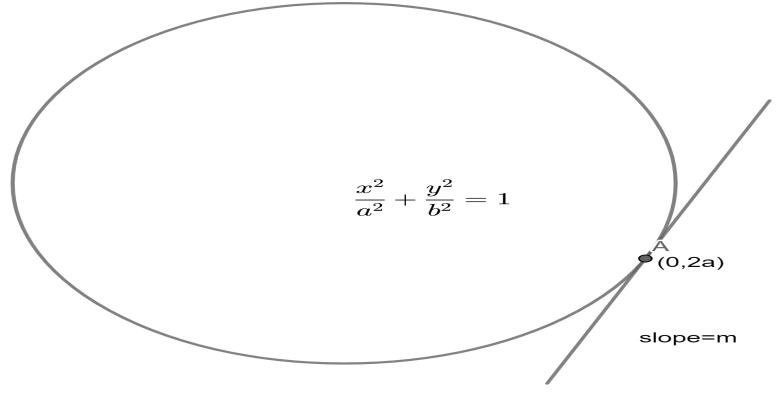
Since tangent with slope $m$ passes through the point $\left( 2a,0 \right)$, then the equation of the tangent to the ellipse is given by substituting the values in the equation $y=mx\pm \sqrt{{{a}^{2}}{{m}^{2}}+{{b}^{2}}}$ we will have
$0=2am\pm \sqrt{{{a}^{2}}{{m}^{2}}+{{b}^{2}}}$
By shifting it to left hand side and squaring on both sides we will have
$4{{a}^{2}}{{m}^{2}}={{a}^{2}}{{m}^{2}}+{{b}^{2}}$ ….$\left( 1 \right)$
From the basic concepts we can say that the eccentricity of the ellipse is given by $e=\sqrt{1-\dfrac{{{b}^{2}}}{{{a}^{2}}}}$ .
From this formula of eccentricity we can get,
$\begin{align}
& {{e}^{2}}=1-\dfrac{{{b}^{2}}}{{{a}^{2}}} \\
& \Rightarrow {{b}^{2}}={{a}^{2}}\left( 1-{{e}^{2}} \right) \\
\end{align}$
Now, by substituting this value of ${{b}^{2}}$ in …….$\left( 1 \right)$
We will get
$\begin{align}
& 4{{a}^{2}}{{m}^{2}}={{a}^{2}}{{m}^{2}}+{{a}^{2}}\left( 1-{{e}^{2}} \right) \\
& \Rightarrow 3{{a}^{2}}{{m}^{2}}={{a}^{2}}\left( 1-{{e}^{2}} \right) \\
& \Rightarrow 2{{m}^{2}}=1-{{e}^{2}} \\
& \Rightarrow 2{{m}^{2}}+{{e}^{2}}=1 \\
\end{align}$
Hence, option C is the correct option.
So, the correct answer is “Option C”.
Note: While answering this type of questions of this type we should be sure with the calculations and formulae. From the basic concepts we can say that the eccentricity of the ellipse is given by $e=\sqrt{1-\dfrac{{{b}^{2}}}{{{a}^{2}}}}$ . The eccentricity for different curves is different like for the hyperbola it is given as $e=\sqrt{1+\dfrac{{{b}^{2}}}{{{a}^{2}}}}$ and similarly for parabola it is given as $1$ .
Complete step-by-step answer:
Now considering from the question we have a tangent of slope $m$ at a point of the ellipse $\dfrac{{{x}^{2}}}{{{a}^{2}}}+\dfrac{{{y}^{2}}}{{{b}^{2}}}=1$ passes through $\left( 2a,0 \right)$ and “$e$” denotes the eccentricity of the ellipse.
From the basics concept we can say that the equation of any tangent to the given ellipse $\dfrac{{{x}^{2}}}{{{a}^{2}}}+\dfrac{{{y}^{2}}}{{{b}^{2}}}=1$ with slope $m$ is given by $y=mx\pm \sqrt{{{a}^{2}}{{m}^{2}}+{{b}^{2}}}$
Since tangent with slope $m$ passes through the point $\left( 2a,0 \right)$, then the equation of the tangent to the ellipse is given by substituting the values in the equation $y=mx\pm \sqrt{{{a}^{2}}{{m}^{2}}+{{b}^{2}}}$ we will have
$0=2am\pm \sqrt{{{a}^{2}}{{m}^{2}}+{{b}^{2}}}$
By shifting it to left hand side and squaring on both sides we will have
$4{{a}^{2}}{{m}^{2}}={{a}^{2}}{{m}^{2}}+{{b}^{2}}$ ….$\left( 1 \right)$
From the basic concepts we can say that the eccentricity of the ellipse is given by $e=\sqrt{1-\dfrac{{{b}^{2}}}{{{a}^{2}}}}$ .
From this formula of eccentricity we can get,
$\begin{align}
& {{e}^{2}}=1-\dfrac{{{b}^{2}}}{{{a}^{2}}} \\
& \Rightarrow {{b}^{2}}={{a}^{2}}\left( 1-{{e}^{2}} \right) \\
\end{align}$
Now, by substituting this value of ${{b}^{2}}$ in …….$\left( 1 \right)$
We will get
$\begin{align}
& 4{{a}^{2}}{{m}^{2}}={{a}^{2}}{{m}^{2}}+{{a}^{2}}\left( 1-{{e}^{2}} \right) \\
& \Rightarrow 3{{a}^{2}}{{m}^{2}}={{a}^{2}}\left( 1-{{e}^{2}} \right) \\
& \Rightarrow 2{{m}^{2}}=1-{{e}^{2}} \\
& \Rightarrow 2{{m}^{2}}+{{e}^{2}}=1 \\
\end{align}$
Hence, option C is the correct option.
So, the correct answer is “Option C”.
Note: While answering this type of questions of this type we should be sure with the calculations and formulae. From the basic concepts we can say that the eccentricity of the ellipse is given by $e=\sqrt{1-\dfrac{{{b}^{2}}}{{{a}^{2}}}}$ . The eccentricity for different curves is different like for the hyperbola it is given as $e=\sqrt{1+\dfrac{{{b}^{2}}}{{{a}^{2}}}}$ and similarly for parabola it is given as $1$ .
Recently Updated Pages
Master Class 11 Computer Science: Engaging Questions & Answers for Success

Master Class 11 Business Studies: Engaging Questions & Answers for Success
Master Class 11 Economics: Engaging Questions & Answers for Success
Master Class 11 English: Engaging Questions & Answers for Success
Master Class 11 Maths: Engaging Questions & Answers for Success
Master Class 11 Biology: Engaging Questions & Answers for Success
Trending doubts
One Metric ton is equal to kg A 10000 B 1000 C 100 class 11 physics CBSE
There are 720 permutations of the digits 1 2 3 4 5 class 11 maths CBSE
Discuss the various forms of bacteria class 11 biology CBSE
Draw a diagram of a plant cell and label at least eight class 11 biology CBSE
State the laws of reflection of light
10 examples of friction in our daily life