




If a straight object is at a distance $ 30cm $ and moving with uniform speed of $ 1cm{s^{ - 1}} $ towards the mirror. Then the magnitude of the speed of the image is:
(A) $ 1cm{s^{ - 1}} $
(B) $ 2cm{s^{ - 1}} $
(C) $ 3cm{s^{ - 1}} $
(D) $ 4cm{s^{ - 1}} $
Answer
 Verified
557.4k+ views
Hint: In these types of questions, we must have a look at the orientation of the object. That is, if it is straight or it is inclined at an angle to the mirror. If it is a straight object, then the angle of inclination will be zero.
Formula Used: We will be using the following formula,
$ v = 2u\cos \theta $
Where
$ v $ is the magnitude of speed of the image
$ u $ is the magnitude of speed of the object
$ \theta $ is the angle of inclination of the object to the mirror.
Complete solution Step-by-Step
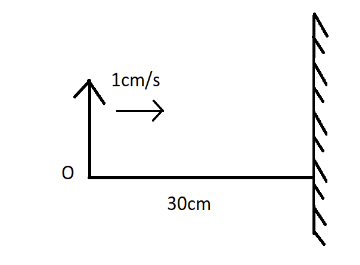
According to the question, the speed of the object is given as $ u = 1cm/s $
And the distance of the object with mirror is $ 30cm $
Now, let us look at the formula used
We can see that the angle of inclination of the image with the mirror is $ {0^ \circ } $
Then,
$ \cos {0^ \circ } = 1 $
Now, we will put the known values provided in the question
So, we get
$ v = 2u\cos \theta $
$ \Rightarrow v = 2 \times 1 \times 1 $
Upon solving for $ v $ , we get
$ \therefore v = 2cm/s $
So, the speed of the object in the mirror is calculated as $ 2cm{s^{ - 1}} $
Hence, the correct option is (B.)
Additional Information
Different forms of image include a real image and a virtual image. The main difference between images that are real and virtual lies in the way they are produced. When rays converge, a real image is formed, whereas a virtual image occurs where rays only appear to diverge.
Note
The image of an object is the spot where, after reflecting from a mirror, light rays from that object intersect. More precisely, when, due to reflection or refraction, a beam of rays from a point source undergoes a change in direction and the refracted or reflected rays converge or appear to diverge from another point, then the second point is known as an image. Based on whether the beam of rays converge or diverge at a given point, two kinds of images are formed; real image and virtual image.
Formula Used: We will be using the following formula,
$ v = 2u\cos \theta $
Where
$ v $ is the magnitude of speed of the image
$ u $ is the magnitude of speed of the object
$ \theta $ is the angle of inclination of the object to the mirror.
Complete solution Step-by-Step
According to the question, the speed of the object is given as $ u = 1cm/s $
And the distance of the object with mirror is $ 30cm $
Now, let us look at the formula used
We can see that the angle of inclination of the image with the mirror is $ {0^ \circ } $
Then,
$ \cos {0^ \circ } = 1 $
Now, we will put the known values provided in the question
So, we get
$ v = 2u\cos \theta $
$ \Rightarrow v = 2 \times 1 \times 1 $
Upon solving for $ v $ , we get
$ \therefore v = 2cm/s $
So, the speed of the object in the mirror is calculated as $ 2cm{s^{ - 1}} $
Hence, the correct option is (B.)
Additional Information
Different forms of image include a real image and a virtual image. The main difference between images that are real and virtual lies in the way they are produced. When rays converge, a real image is formed, whereas a virtual image occurs where rays only appear to diverge.
Note
The image of an object is the spot where, after reflecting from a mirror, light rays from that object intersect. More precisely, when, due to reflection or refraction, a beam of rays from a point source undergoes a change in direction and the refracted or reflected rays converge or appear to diverge from another point, then the second point is known as an image. Based on whether the beam of rays converge or diverge at a given point, two kinds of images are formed; real image and virtual image.
Recently Updated Pages
Master Class 12 Economics: Engaging Questions & Answers for Success

Master Class 12 Physics: Engaging Questions & Answers for Success
Master Class 12 English: Engaging Questions & Answers for Success
Master Class 12 Social Science: Engaging Questions & Answers for Success
Master Class 12 Maths: Engaging Questions & Answers for Success
Master Class 12 Business Studies: Engaging Questions & Answers for Success
Trending doubts
Which are the Top 10 Largest Countries of the World?
What are the major means of transport Explain each class 12 social science CBSE
Draw a labelled sketch of the human eye class 12 physics CBSE
Differentiate between insitu conservation and exsitu class 12 biology CBSE
Draw a neat and well labeled diagram of TS of ovary class 12 biology CBSE
Give 10 examples of unisexual and bisexual flowers