




If a source emitting waves of frequency \[f\] moves towards an observer with a velocity \[\dfrac{v}{4}\] and the observer moves away from the source with a velocity \[\dfrac{v}{6}\], the apparent frequency as heard by the observer will be (\[v\] =velocity of sound)
A. \[\dfrac{{14}}{{15}}f\]
B. \[\dfrac{{14}}{9}f\]
C. \[\dfrac{{10}}{9}f\]
D. \[\dfrac{2}{3}f\]
Answer
 Verified
564.3k+ views
Hint:It is given that source moves towards an observer with certain velocity and the observer moves away from the source with a certain velocity. This means that the source is approaching the receding observer. Therefore, there will be a change in frequency from \[f\](initial frequency) to \[f'\](apparent frequency). The apparent frequency can be calculated by using the formula for Doppler’s effect. The Doppler’s effect is observed due to change in wavelength.
Formula Used:
The apparent frequency as heard by the observer is given by:
\[f' = f\left( {\dfrac{{v - {v_L}}}{{v - {v_S}}}} \right)\]
where, \[{v_L}\] is the velocity of the observer, \[{v_S}\] is the velocity of the source, \[f\] is the initial frequency emitted by the source and \[f'\] is apparent frequency as heard by the observer.
Complete step by step answer:
Let \[f\] be the initial frequency and \[f'\] be the apparent frequency. The apparent change in frequency is due to the contraction or expansion of the wave. That is, the wavelength changes. Therefore, the frequency also changes. When the source moves towards the observer, the wave contracts. When the source moves away from the observer, the wave expands.
In the problem, the source moves towards the observer with a velocity \[\dfrac{v}{4}\] and the observer moves away from the source with a velocity \[\dfrac{v}{6}\]. The source is approaching the receding observer.
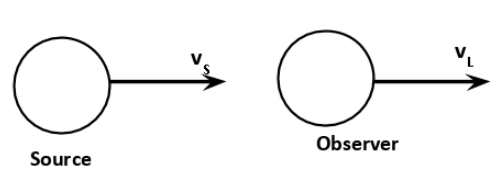
If \[f\] is the initial frequency emitted by the source, then the apparent frequency as heard by the observer is given by the formula,
\[f' = f\left( {\dfrac{{v - {v_L}}}{{v - {v_S}}}} \right)\] \[ \to (1)\]
Substituting these values in equation (1)
\[f' = f\left( {\dfrac{{v - {v_L}}}{{v - {v_S}}}} \right) \\
\Rightarrow f' = f\left( {\dfrac{{v - \dfrac{v}{6}}}{{v - \dfrac{v}{4}}}} \right) \\
\Rightarrow f' = f\left( {\dfrac{{\dfrac{{6v - v}}{6}}}{{\dfrac{{4v - v}}{4}}}} \right) \\
\Rightarrow f' = f\left( {\dfrac{{5v}}{3} \times \dfrac{2}{{3v}}} \right) \\
\therefore f' = f\left( {\dfrac{{10}}{9}} \right) \]
Therefore, the apparent frequency as heard by the observer will be \[\dfrac{{10}}{9}f\].
Hence, option C is the correct answer.
Note:When a source of sound moves, it causes change in wavelength of the sound received by the observer. And when the observer moves, it causes change in the number of waves received by the listener. In the problem, the source and the observer are assumed to move in a direction parallel to each other. Because, no Doppler’s effect is observed when the source of the sound and the observer are moving in mutually perpendicular directions.
Formula Used:
The apparent frequency as heard by the observer is given by:
\[f' = f\left( {\dfrac{{v - {v_L}}}{{v - {v_S}}}} \right)\]
where, \[{v_L}\] is the velocity of the observer, \[{v_S}\] is the velocity of the source, \[f\] is the initial frequency emitted by the source and \[f'\] is apparent frequency as heard by the observer.
Complete step by step answer:
Let \[f\] be the initial frequency and \[f'\] be the apparent frequency. The apparent change in frequency is due to the contraction or expansion of the wave. That is, the wavelength changes. Therefore, the frequency also changes. When the source moves towards the observer, the wave contracts. When the source moves away from the observer, the wave expands.
In the problem, the source moves towards the observer with a velocity \[\dfrac{v}{4}\] and the observer moves away from the source with a velocity \[\dfrac{v}{6}\]. The source is approaching the receding observer.
If \[f\] is the initial frequency emitted by the source, then the apparent frequency as heard by the observer is given by the formula,
\[f' = f\left( {\dfrac{{v - {v_L}}}{{v - {v_S}}}} \right)\] \[ \to (1)\]
Substituting these values in equation (1)
\[f' = f\left( {\dfrac{{v - {v_L}}}{{v - {v_S}}}} \right) \\
\Rightarrow f' = f\left( {\dfrac{{v - \dfrac{v}{6}}}{{v - \dfrac{v}{4}}}} \right) \\
\Rightarrow f' = f\left( {\dfrac{{\dfrac{{6v - v}}{6}}}{{\dfrac{{4v - v}}{4}}}} \right) \\
\Rightarrow f' = f\left( {\dfrac{{5v}}{3} \times \dfrac{2}{{3v}}} \right) \\
\therefore f' = f\left( {\dfrac{{10}}{9}} \right) \]
Therefore, the apparent frequency as heard by the observer will be \[\dfrac{{10}}{9}f\].
Hence, option C is the correct answer.
Note:When a source of sound moves, it causes change in wavelength of the sound received by the observer. And when the observer moves, it causes change in the number of waves received by the listener. In the problem, the source and the observer are assumed to move in a direction parallel to each other. Because, no Doppler’s effect is observed when the source of the sound and the observer are moving in mutually perpendicular directions.
Recently Updated Pages
Master Class 11 Computer Science: Engaging Questions & Answers for Success

Master Class 11 Business Studies: Engaging Questions & Answers for Success
Master Class 11 Economics: Engaging Questions & Answers for Success
Master Class 11 English: Engaging Questions & Answers for Success
Master Class 11 Maths: Engaging Questions & Answers for Success
Master Class 11 Biology: Engaging Questions & Answers for Success
Trending doubts
One Metric ton is equal to kg A 10000 B 1000 C 100 class 11 physics CBSE
There are 720 permutations of the digits 1 2 3 4 5 class 11 maths CBSE
Discuss the various forms of bacteria class 11 biology CBSE
Draw a diagram of a plant cell and label at least eight class 11 biology CBSE
State the laws of reflection of light
Explain zero factorial class 11 maths CBSE