




If a Snapdragon plant with genotype RrGg is self-pollinated then what would be the phenotypic ratio?
Answer
 Verified
542.1k+ views
Hint: Self-pollination of Snapdragon plants shows a great deviation from Mendel’s law of dominance in the ${ F }_{ 1 }$ generation. The offspring of the inbred red and white flower-bearing plants show some pink flowers in the ${ F }_{ 1 }$ generation.
Complete answer:
When the snapdragon plants were self-pollinated which had the genotype RrGg, we see the following results-
From the diagram, it is clear that the phenotypic ratio would be 1:2:1
Which is the same as the genotypic ratio(1: 2: 1)
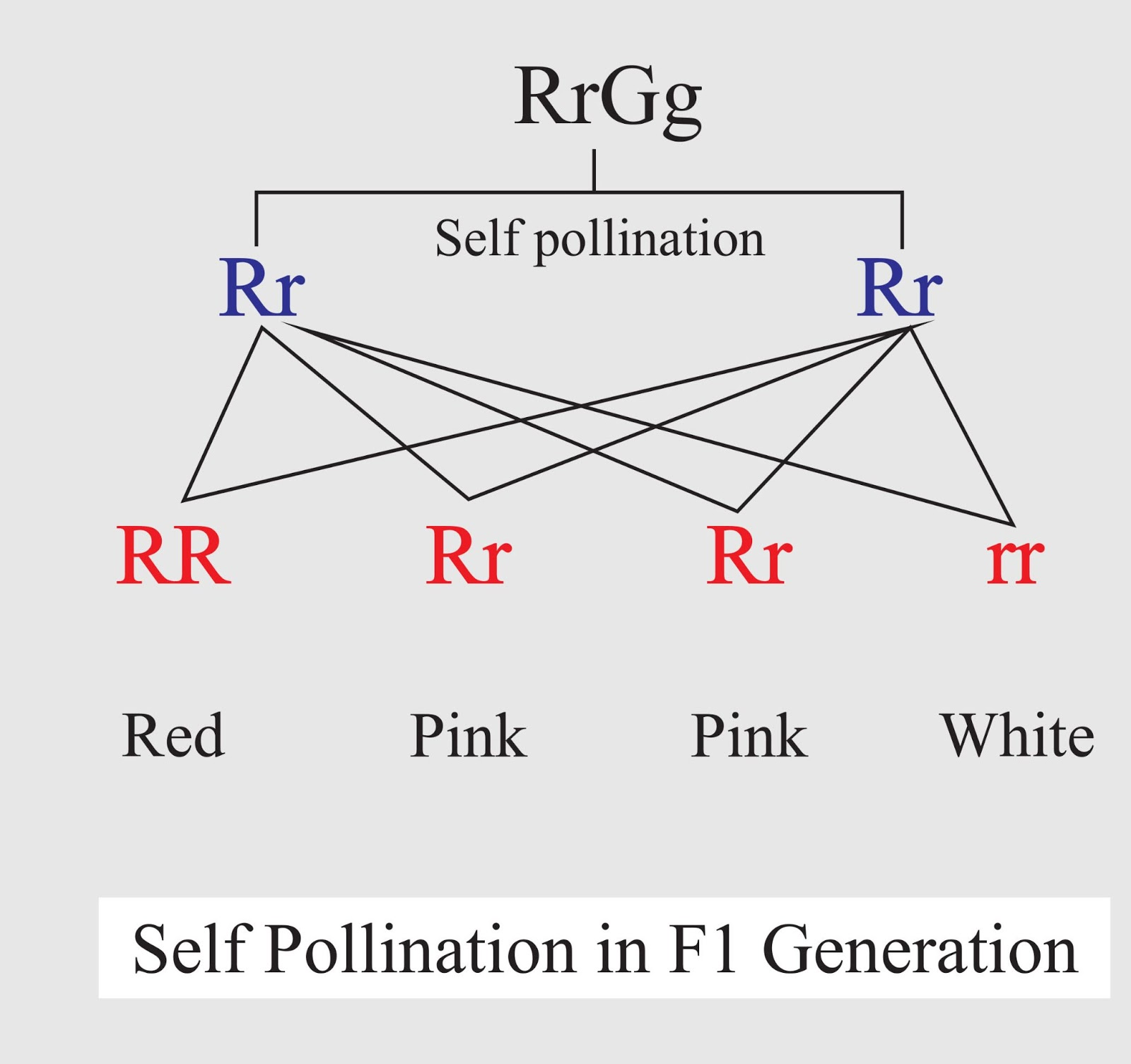
Therefore, we see that ${ F }_{ 1 }$ plants have a different phenotype i.e. the pink coloration of flowers from both of the true true-breeding plants. It is a deviation from Mandel's law of dominance and hence, known as incomplete dominance.
Note:
Incomplete dominance occurs when a dominant allele does not completely sabotage the effects of a recessive allele which results in a blend of both alleles in the progenies. This phenomenon challenges Mandel's famous law of dominance. Besides flowers of snapdragon plants, the phenomenon of incomplete dominance is seen in heterozygous roses which show pink coloration in spite of the fact that the red color allele is dominant over white.
When purebred organisms of two different species are bred to give rise to a new type of animal or plant it is known as crossbreeding. It is used to create higher quality animals or plants with vitality and good health, sometimes irresponsible crossbreeding may cause deterioration of quality as well. In animal breeding, when the breeding is between single species it is called crossbreeds whereas in different species it is known as hybrids. But in the case of plants, these two terms are not distinguishable.
Complete answer:
When the snapdragon plants were self-pollinated which had the genotype RrGg, we see the following results-
From the diagram, it is clear that the phenotypic ratio would be 1:2:1
Which is the same as the genotypic ratio(1: 2: 1)
Therefore, we see that ${ F }_{ 1 }$ plants have a different phenotype i.e. the pink coloration of flowers from both of the true true-breeding plants. It is a deviation from Mandel's law of dominance and hence, known as incomplete dominance.
Note:
Incomplete dominance occurs when a dominant allele does not completely sabotage the effects of a recessive allele which results in a blend of both alleles in the progenies. This phenomenon challenges Mandel's famous law of dominance. Besides flowers of snapdragon plants, the phenomenon of incomplete dominance is seen in heterozygous roses which show pink coloration in spite of the fact that the red color allele is dominant over white.
When purebred organisms of two different species are bred to give rise to a new type of animal or plant it is known as crossbreeding. It is used to create higher quality animals or plants with vitality and good health, sometimes irresponsible crossbreeding may cause deterioration of quality as well. In animal breeding, when the breeding is between single species it is called crossbreeds whereas in different species it is known as hybrids. But in the case of plants, these two terms are not distinguishable.
Recently Updated Pages
Master Class 12 Economics: Engaging Questions & Answers for Success

Master Class 12 English: Engaging Questions & Answers for Success
Master Class 12 Social Science: Engaging Questions & Answers for Success
Master Class 12 Maths: Engaging Questions & Answers for Success
Master Class 12 Physics: Engaging Questions & Answers for Success
Master Class 9 General Knowledge: Engaging Questions & Answers for Success
Trending doubts
Which are the Top 10 Largest Countries of the World?
Draw a labelled sketch of the human eye class 12 physics CBSE
Differentiate between homogeneous and heterogeneous class 12 chemistry CBSE
Why is the cell called the structural and functional class 12 biology CBSE
Draw ray diagrams each showing i myopic eye and ii class 12 physics CBSE
Which is the correct genotypic ratio of mendel dihybrid class 12 biology CBSE