




If a rubber ball is taken at the depth of $200m$in a pool, its volume decreases by $0.1\%$. If the density of the water is $1\times {{10}^{3}}kg{{m}^{-3}}$ and $g=10m{{s}^{-2}}$, then, the volume elasticity in $N{{m}^{-2}}$ will be
A) ${{10}^{8}}$
B) $2\times {{10}^{8}}$
C) ${{10}^{9}}$
D) $2\times {{10}^{9}}$
Answer
 Verified
606.3k+ views
Hint: When a ball is immersed in water, it undergoes change in volume due to force or pressure from the surroundings. Volumetric strain is defined as the ratio of change in volume to the original volume. Volume elasticity is nothing but bulk modulus of elasticity. Pressure change is calculated from the parameters provided.
Formula used:
$K=-\dfrac{dP}{{{\varepsilon }_{v}}}$
where
$K$ is the bulk modulus of elasticity or volume elasticity $(N{{m}^{-2}})$
$dP$ is the change in pressure$(N{{m}^{-2}})$
${{\varepsilon }_{v}}$ is the volumetric strain
Complete step by step answer:
Let us understand the problem by drawing a diagram.
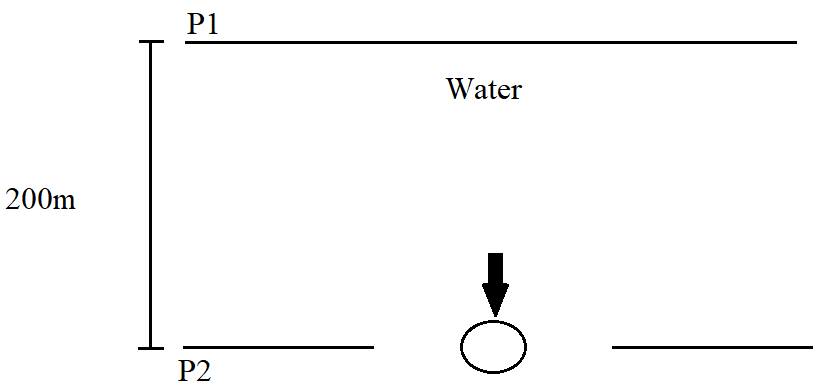
The ball is at a depth of $200m$ from the surface of water as shown in the figure. The pressure at the surface of water is atmospheric pressure. Let us call this pressure ${{P}_{1}}$. When the ball is kept inside the pool, water molecules above the ball exert pressure on the ball. The pressure on the ball increases by a factor of $\rho gh$, where $\rho $ is the density of water, $g$ is the acceleration due to gravity and $h$ is the depth at which the ball is kept. The density of water is given as ${{10}^{3}}kg{{m}^{-3}}$. The acceleration due to gravity is given as $10m{{s}^{-2}}$. Let us call the pressure on the ball at a depth of $200m$ inside the pool ${{P}_{2}}$. This pressure causes volumetric strain $({{\varepsilon }_{v}})$ on the ball. Volumetric strain is the ratio of change in volume to the original volume under elastic conditions. Its value is given as $0.1\%$. In such conditions, we have the equation
${{P}_{2}}={{P}_{1}}+\rho gh$
where $\rho $ is the density of water $(={{10}^{3}}kg{{m}^{-3}})$
$g$ is the acceleration due to gravity $(=10m{{s}^{-2}})$
$h$ is the depth at which the ball is placed $(=200m)$.
Let us assume the change in pressure to be $dP$. It is given by
$dP={{P}_{1}}-{{P}_{2}}=-\rho gh=-{{10}^{3}}\times 10\times 200=-2\times {{10}^{6}}N{{m}^{-2}}$
Now,
the volumetric strain $({{\varepsilon }_{v}})$ is already provided and is equal to $0.1\%=\dfrac{0.1}{100}={{10}^{-3}}$
Substituting both the values of $dP$ and ${{\varepsilon }_{v}}$ in the required formula, we have
$K=-\dfrac{dP}{{{\varepsilon }_{v}}}=-\dfrac{(-2\times {{10}^{6}})}{{{10}^{-3}}}=2\times {{10}^{9}}N{{m}^{-2}}$
Therefore, the correct option is D.
Note:
Students can also directly use the formula mentioned below to arrive at the answer easily. $K=\dfrac{\Delta P}{(\dfrac{\Delta V}{V})}$
Here,
$K$ is the bulk modulus of elasticity
$\Delta P$ is the change in pressure
$\dfrac{\Delta V}{V}$ is the change in volume
This formula comes in handy when pressure change is directly given in the question. If not, students may have to follow the formula mentioned in the first solution.
Formula used:
$K=-\dfrac{dP}{{{\varepsilon }_{v}}}$
where
$K$ is the bulk modulus of elasticity or volume elasticity $(N{{m}^{-2}})$
$dP$ is the change in pressure$(N{{m}^{-2}})$
${{\varepsilon }_{v}}$ is the volumetric strain
Complete step by step answer:
Let us understand the problem by drawing a diagram.
The ball is at a depth of $200m$ from the surface of water as shown in the figure. The pressure at the surface of water is atmospheric pressure. Let us call this pressure ${{P}_{1}}$. When the ball is kept inside the pool, water molecules above the ball exert pressure on the ball. The pressure on the ball increases by a factor of $\rho gh$, where $\rho $ is the density of water, $g$ is the acceleration due to gravity and $h$ is the depth at which the ball is kept. The density of water is given as ${{10}^{3}}kg{{m}^{-3}}$. The acceleration due to gravity is given as $10m{{s}^{-2}}$. Let us call the pressure on the ball at a depth of $200m$ inside the pool ${{P}_{2}}$. This pressure causes volumetric strain $({{\varepsilon }_{v}})$ on the ball. Volumetric strain is the ratio of change in volume to the original volume under elastic conditions. Its value is given as $0.1\%$. In such conditions, we have the equation
${{P}_{2}}={{P}_{1}}+\rho gh$
where $\rho $ is the density of water $(={{10}^{3}}kg{{m}^{-3}})$
$g$ is the acceleration due to gravity $(=10m{{s}^{-2}})$
$h$ is the depth at which the ball is placed $(=200m)$.
Let us assume the change in pressure to be $dP$. It is given by
$dP={{P}_{1}}-{{P}_{2}}=-\rho gh=-{{10}^{3}}\times 10\times 200=-2\times {{10}^{6}}N{{m}^{-2}}$
Now,
the volumetric strain $({{\varepsilon }_{v}})$ is already provided and is equal to $0.1\%=\dfrac{0.1}{100}={{10}^{-3}}$
Substituting both the values of $dP$ and ${{\varepsilon }_{v}}$ in the required formula, we have
$K=-\dfrac{dP}{{{\varepsilon }_{v}}}=-\dfrac{(-2\times {{10}^{6}})}{{{10}^{-3}}}=2\times {{10}^{9}}N{{m}^{-2}}$
Therefore, the correct option is D.
Note:
Students can also directly use the formula mentioned below to arrive at the answer easily. $K=\dfrac{\Delta P}{(\dfrac{\Delta V}{V})}$
Here,
$K$ is the bulk modulus of elasticity
$\Delta P$ is the change in pressure
$\dfrac{\Delta V}{V}$ is the change in volume
This formula comes in handy when pressure change is directly given in the question. If not, students may have to follow the formula mentioned in the first solution.
Recently Updated Pages
Master Class 12 Economics: Engaging Questions & Answers for Success

Master Class 12 English: Engaging Questions & Answers for Success
Master Class 12 Social Science: Engaging Questions & Answers for Success
Master Class 12 Maths: Engaging Questions & Answers for Success
Master Class 12 Physics: Engaging Questions & Answers for Success
Master Class 11 Social Science: Engaging Questions & Answers for Success
Trending doubts
One Metric ton is equal to kg A 10000 B 1000 C 100 class 11 physics CBSE
Difference Between Prokaryotic Cells and Eukaryotic Cells
Two of the body parts which do not appear in MRI are class 11 biology CBSE
1 ton equals to A 100 kg B 1000 kg C 10 kg D 10000 class 11 physics CBSE
Draw a diagram of nephron and explain its structur class 11 biology CBSE
10 examples of friction in our daily life