




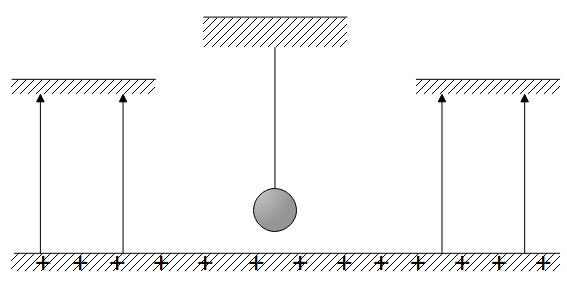
If a positively charged pendulum is oscillating in a uniform electric field as shown in figure. Its time period as compared to that when it was uncharged:
(A) Will increase
(B) will decrease
(C) will not change
(D) will first increase then decrease
Answer
 Verified
597.6k+ views
Hint: The given pendulum is present in the region where the electric field is opposing the gravitational field. The resultant of the two forces will give the net gravitational force that the bob experiences in the downwards direction and that g’ will determine the time period.
Formula Used:
The time period of a simple pendulum performing small oscillations is given as:
$T = 2\pi \sqrt {{g \over l}} $
where l is the length of the pendulum and g is the acceleration due to gravity.
Complete answer:
Consider the following free body diagram of the given pendulum:
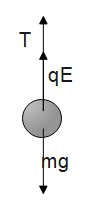
Total forces acting on the given pendulum are: (1) Tension of the string, (2) gravity, (3) electric force due to the field. While, if we consider the case of a general simple pendulum we have two forces only- tension and gravity (balancing each other).
Thus, for the case of a given pendulum we can say that the electric field is exerting a force on the given pendulum such that it pushes the pendulum upwards i.e., along the arrows. The resultant gravitational force that creates a g’ downwards now can be found as:
$\eqalign{
& mg' = mg - qE \cr
& \Rightarrow g' = g - {{qE} \over m} \cr} $
Therefore a simple conclusion follows from here that as the g’ obtained will be obviously less than the g, we can say that the time period which is directly proportional to the square root of g will decrease as g becomes g’ for the given pendulum and g’ is less than g.
Therefore the correct option is (B).
Note:
The electric field acts from positive end of the plates to negative end. As the positive end is placed below, it will do the job of repelling our positively charged bob. When we place a positive charge in the electric field, it moves along it and negative charge goes in the opposite direction of the arrows.
Formula Used:
The time period of a simple pendulum performing small oscillations is given as:
$T = 2\pi \sqrt {{g \over l}} $
where l is the length of the pendulum and g is the acceleration due to gravity.
Complete answer:
Consider the following free body diagram of the given pendulum:
Total forces acting on the given pendulum are: (1) Tension of the string, (2) gravity, (3) electric force due to the field. While, if we consider the case of a general simple pendulum we have two forces only- tension and gravity (balancing each other).
Thus, for the case of a given pendulum we can say that the electric field is exerting a force on the given pendulum such that it pushes the pendulum upwards i.e., along the arrows. The resultant gravitational force that creates a g’ downwards now can be found as:
$\eqalign{
& mg' = mg - qE \cr
& \Rightarrow g' = g - {{qE} \over m} \cr} $
Therefore a simple conclusion follows from here that as the g’ obtained will be obviously less than the g, we can say that the time period which is directly proportional to the square root of g will decrease as g becomes g’ for the given pendulum and g’ is less than g.
Therefore the correct option is (B).
Note:
The electric field acts from positive end of the plates to negative end. As the positive end is placed below, it will do the job of repelling our positively charged bob. When we place a positive charge in the electric field, it moves along it and negative charge goes in the opposite direction of the arrows.
Recently Updated Pages
Which will be the least stable resonating structure class 11 chemistry CBSE

How many 5 digit telephone numbers can be construc-class-11-maths-CBSE
How do you find the angle of the resultant vector class 11 physics CBSE
Draw labelled diagram of the following i Gram seed class 11 biology CBSE
1 Quintal is equal to a 110 kg b 10 kg c 100kg d 1000 class 11 physics CBSE
What is the need and importance of classification class 11 biology CBSE
Trending doubts
Find the value of the expression given below sin 30circ class 11 maths CBSE
The teeth used for biting and cutting food are called class 11 biology CBSE
Bond order ofO2 O2+ O2 and O22 is in order A O2 langle class 11 chemistry CBSE
Frogs heart when taken out of the body continues to class 11 biology CBSE
Can anyone list 10 advantages and disadvantages of friction
Draw a diagram of a plant cell and label at least eight class 11 biology CBSE