




If $ A = \left( { - 3,4} \right) $, $ B = \left( { - 1, - 2} \right) $, $ C = \left( {5,6} \right) $ and $ D = \left( {x, - 4} \right) $ are the vertices of a quadrilateral such that $ \Delta ABD = 2\Delta ACD $ . Then x, is equal to
A. $ 6 $
B. $ 9 $
C. $ 69 $
D. $ 96 $
Answer
 Verified
530.4k+ views
Hint: In this question, we are given a quadrilateral ABCD with given dimensions and in which one dimension is unknown and we have to find that unknown variable. In the question, we had a condition $ \Delta ABD = 2\Delta ACD $ so, in this question we need to use the formula for triangle as
$ ar(\Delta ) = \dfrac{1}{2}\left| {{x_1}\left( {{y_2} - {y_3}} \right) + {x_2}\left( {{y_3} - {y_1}} \right) + {x_3}\left( {{y_1} - {y_2}} \right)} \right| $
Complete step by step solution:
In the above question, we have to find the value of x, while we are provided with a quadrilateral with coordinates A, B, C, D with dimensions which is given in the question as
$ A = \left( { - 3,4} \right) $
$ B = \left( { - 1, - 2} \right) $
$ C = \left( {5,6} \right) $
$ D = \left( {x, - 4} \right) $
Firstly, drawing a quadrilateral and constructing a diagonal AD.
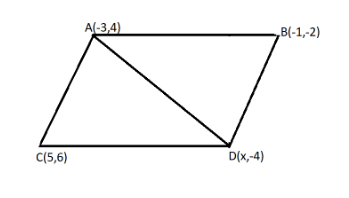
Now, using the formula
$ ar(\Delta ) = \dfrac{1}{2}\left| {{x_1}\left( {{y_2} - {y_3}} \right) + {x_2}\left( {{y_3} - {y_1}} \right) + {x_3}\left( {{y_1} - {y_2}} \right)} \right| $
In $ \Delta ABD $ ,
$ ar\left( {\Delta ABD} \right) = \dfrac{1}{2}\left| {\left( { - 3} \right)\left( { - 2 + 4} \right) + - 1\left( { - 4 - 4} \right) + x\left( {4 - ( - 2)} \right)} \right| $
$
= \dfrac{1}{2}\left| {2 + 6x} \right| \\
= \left| {1 + 3x} \right| \ldots \ldots \left( 1 \right) \;
$
Now, in $ \Delta ACD $
$
ar\left( {\Delta ACD} \right) = \dfrac{1}{2}\left| {\left( { - 3} \right)\left( {6 + 4} \right) + 5\left( { - 4 - 4} \right) + x\left( {4 - 6} \right)} \right| \\
= \dfrac{1}{2}\left| { - 70 - 2x} \right| \\
= 35 + x \ldots \ldots \left( 2 \right) \\
\left( {\therefore \left| { - 1} \right| = 1} \right) \;
$
We are given a condition in the question as $ \Delta ABD = 2\Delta ACD $ now substituting the values from the above two marked equations,
$
1 + 3x = 2(35 + x) \\
1 + 3x = 70 + 2x \\
69 = x \;
$
$ \Rightarrow x = 69 $
Hence, the value for x is $ 69. $
So, the correct answer is “Option C”.
Note: See the signs carefully while drawing the quadrilateral and make sure to draw the correct diagonal. We know that if the area of the triangle is zero then the three points are collinear, that is we will have a straight line. We also know that the sum of interior angles in a quadrilateral is 360 degrees but the sum of interior angles in a triangle is 180 degree.
$ ar(\Delta ) = \dfrac{1}{2}\left| {{x_1}\left( {{y_2} - {y_3}} \right) + {x_2}\left( {{y_3} - {y_1}} \right) + {x_3}\left( {{y_1} - {y_2}} \right)} \right| $
Complete step by step solution:
In the above question, we have to find the value of x, while we are provided with a quadrilateral with coordinates A, B, C, D with dimensions which is given in the question as
$ A = \left( { - 3,4} \right) $
$ B = \left( { - 1, - 2} \right) $
$ C = \left( {5,6} \right) $
$ D = \left( {x, - 4} \right) $
Firstly, drawing a quadrilateral and constructing a diagonal AD.
Now, using the formula
$ ar(\Delta ) = \dfrac{1}{2}\left| {{x_1}\left( {{y_2} - {y_3}} \right) + {x_2}\left( {{y_3} - {y_1}} \right) + {x_3}\left( {{y_1} - {y_2}} \right)} \right| $
In $ \Delta ABD $ ,
$ ar\left( {\Delta ABD} \right) = \dfrac{1}{2}\left| {\left( { - 3} \right)\left( { - 2 + 4} \right) + - 1\left( { - 4 - 4} \right) + x\left( {4 - ( - 2)} \right)} \right| $
$
= \dfrac{1}{2}\left| {2 + 6x} \right| \\
= \left| {1 + 3x} \right| \ldots \ldots \left( 1 \right) \;
$
Now, in $ \Delta ACD $
$
ar\left( {\Delta ACD} \right) = \dfrac{1}{2}\left| {\left( { - 3} \right)\left( {6 + 4} \right) + 5\left( { - 4 - 4} \right) + x\left( {4 - 6} \right)} \right| \\
= \dfrac{1}{2}\left| { - 70 - 2x} \right| \\
= 35 + x \ldots \ldots \left( 2 \right) \\
\left( {\therefore \left| { - 1} \right| = 1} \right) \;
$
We are given a condition in the question as $ \Delta ABD = 2\Delta ACD $ now substituting the values from the above two marked equations,
$
1 + 3x = 2(35 + x) \\
1 + 3x = 70 + 2x \\
69 = x \;
$
$ \Rightarrow x = 69 $
Hence, the value for x is $ 69. $
So, the correct answer is “Option C”.
Note: See the signs carefully while drawing the quadrilateral and make sure to draw the correct diagonal. We know that if the area of the triangle is zero then the three points are collinear, that is we will have a straight line. We also know that the sum of interior angles in a quadrilateral is 360 degrees but the sum of interior angles in a triangle is 180 degree.
Recently Updated Pages
Master Class 11 English: Engaging Questions & Answers for Success

Master Class 11 Maths: Engaging Questions & Answers for Success
Master Class 11 Biology: Engaging Questions & Answers for Success
Master Class 11 Social Science: Engaging Questions & Answers for Success
Master Class 11 Physics: Engaging Questions & Answers for Success
Master Class 11 Accountancy: Engaging Questions & Answers for Success
Trending doubts
One Metric ton is equal to kg A 10000 B 1000 C 100 class 11 physics CBSE
Discuss the various forms of bacteria class 11 biology CBSE
Draw a diagram of a plant cell and label at least eight class 11 biology CBSE
State the laws of reflection of light
Explain zero factorial class 11 maths CBSE
10 examples of friction in our daily life