




If a double-stranded DNA has 20 percent of cytosine, calculate the percent of adenine in the DNA.
Answer
 Verified
599.1k+ views
Hint: The structure of DNA is as such that there is complementary base pairing between the two strands of DNA. This complementary nature is between a purine and a pyrimidine which are bonded together with the help of hydrogen bonds.
Complete Answer:
To describe the complementary base pairing in DNA, Erwin Chargaff gave a preposition that for a double-stranded DNA, the ratios between Adenine (A) and Thymine (T) and Guanine (G) and Cytosine (C) are constant is the value is one. This is because of the fact that the purine adenine pairs with the pyrimidine thymine with the help of 2 hydrogen bonds. Hence their numbers in the DNA strand will be equal. Similarly, the purine Guanine pairs with the pyrimidine Cytosine with the help of 3 hydrogen bonds.
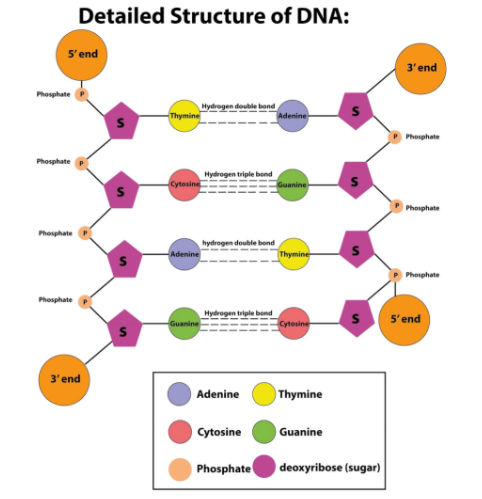
Hence if a DNA has $20\%$ cytosine, then the amount of guanine will be the same i.e. $20\%$.
Now $40\%$ of the base of DNA is formed by cytosine and guanine, thus the remaining $60\%$ will be formed by the remaining base pairs i.e. adenine and thymine.
Since the amount of adenine and thymine is equal, both will be forming $30\%$ each of the nitrogenous bases present in the DNA.
Note:
- In RNA, instead of thymine, uracil pairs with adenine as the complementary base.
- The difference in the structure between thymine and uracil is that thymine has an extra methyl group at the C-5 position.
- The double-stranded structure of DNA was proposed by Watson and Crick using the diffraction data produced by Wilkins and Franklin.
Complete Answer:
To describe the complementary base pairing in DNA, Erwin Chargaff gave a preposition that for a double-stranded DNA, the ratios between Adenine (A) and Thymine (T) and Guanine (G) and Cytosine (C) are constant is the value is one. This is because of the fact that the purine adenine pairs with the pyrimidine thymine with the help of 2 hydrogen bonds. Hence their numbers in the DNA strand will be equal. Similarly, the purine Guanine pairs with the pyrimidine Cytosine with the help of 3 hydrogen bonds.
Hence if a DNA has $20\%$ cytosine, then the amount of guanine will be the same i.e. $20\%$.
Now $40\%$ of the base of DNA is formed by cytosine and guanine, thus the remaining $60\%$ will be formed by the remaining base pairs i.e. adenine and thymine.
Since the amount of adenine and thymine is equal, both will be forming $30\%$ each of the nitrogenous bases present in the DNA.
Note:
- In RNA, instead of thymine, uracil pairs with adenine as the complementary base.
- The difference in the structure between thymine and uracil is that thymine has an extra methyl group at the C-5 position.
- The double-stranded structure of DNA was proposed by Watson and Crick using the diffraction data produced by Wilkins and Franklin.
Recently Updated Pages
Master Class 12 Business Studies: Engaging Questions & Answers for Success

Master Class 12 Biology: Engaging Questions & Answers for Success
Master Class 12 Chemistry: Engaging Questions & Answers for Success
Class 12 Question and Answer - Your Ultimate Solutions Guide
Master Class 11 Social Science: Engaging Questions & Answers for Success
Master Class 11 English: Engaging Questions & Answers for Success
Trending doubts
Which is more stable and why class 12 chemistry CBSE
What are the major means of transport Explain each class 12 social science CBSE
The value of constant k in coulombs law is beginalign class 12 physics CBSE
Why should a magnesium ribbon be cleaned before burning class 12 chemistry CBSE
Quantisation of charge implies a Charge does not exist class 12 physics CBSE
How much time does it take to bleed after eating p class 12 biology CBSE