




If a complex no: z satisfies $\left| 2z+10+10i \right|\le 5\sqrt{3}-5$, then the least principal argument of z is
$\begin{align}
& \text{(a) }\dfrac{-5\pi }{6} \\
& \text{(b) }\dfrac{-11\pi }{12} \\
& \text{(c) }\dfrac{-3\pi }{4} \\
& \text{(d) }\dfrac{-2\pi }{3} \\
\end{align}$
Answer
 Verified
625.8k+ views
Hint:Given an expression is the equation of a circle in complex form. Find the center and radius and draw figure. Line y = x pass through the center of the circle, which we will get as in the third quadrant. Draw AO and BO as the tangent to the circle and find the argument i.e., angle where the tangent touches the circle.
Complete step-by-step answer:
We have been given a complex no: z and given the expression,
$\left| 2z+10+10i \right|\le 5\sqrt{3}-5$
Let us take 2 common from the expression
$\begin{align}
& \left| 2z+5+5i \right|\le 5\sqrt{3}-5 \\
& \left| z+5+5i \right|\le \dfrac{5\sqrt{3}-5}{2} \\
\end{align}$
Now as $\left( \dfrac{5\sqrt{3}-5}{2} \right)$ is less that $\left| z+5+5i \right|$ , the given equation of z is of a circle. Thus, let us find the center of the circle and radius from the expression,
$\left| z+5i+5 \right|\le \dfrac{5\sqrt{3}-5}{2}$
The general equation of a circle whose center is at point having affix ${{z}_{0}}$ and radius r is $\left| z-{{z}_{0}} \right|=r$.
Here, $\left| z-{{z}_{0}} \right|$$<$r, represents interior of a circle \[\left| z-{{z}_{0}} \right|=r\].
Here \[{{z}_{0}}=-\left( 5i+5 \right)\]
Hence our circle is (-5, -5) and radius, $r=\dfrac{5\sqrt{3}-5}{2}$
Now let us draw the figure with a circle, which has centre (-5, -5) and $r=\dfrac{5\sqrt{3}-5}{2}$. The y = x line passes through the centre of the circle. The circle is in the 3rd quadrant as the centre is (-5, -5).
We can rewrite y = x, into the general form of a slope-intercept equation y = mx + b.
Where m is the slope, whose value is 1 and b is zero. By putting m=1 and b=0 in the equation, we get y = x.
Now z represents the boundary of the circle and the interior of the circle. Thus, the minimum can be found by drawing a tangent line to the circle.
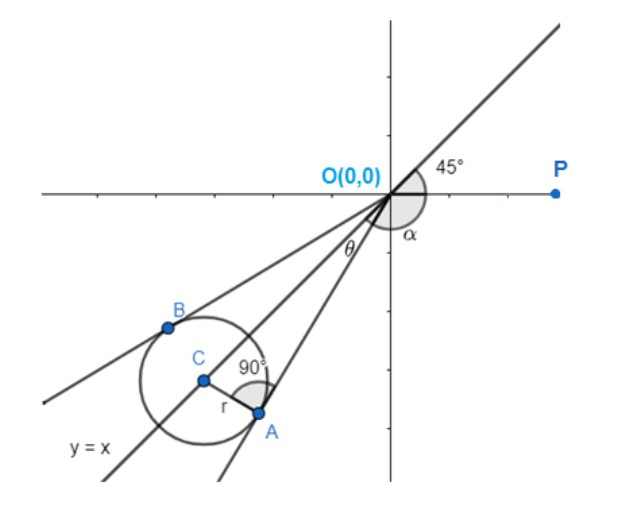
Now point A represents minimum argument and point B represents maximum argument.
i.e.,
$\begin{align}
& {{\text{z}}_{\text{A}}}\text{ = minimum argument} \\
& {{\text{z}}_{\text{B}}}\text{ = max argument} \\
\end{align}$
We are asked to find the least principal argument of z, which means that we need to find ${{z}_{A}}$. Thus, we need to find the angles POA (from the figure). If we join AC, it will be the radius of the circle as well as the perpendicular because that is the point of tangency. The tangent to a circle is always perpendicular to the radius.
Let us take $\angle COA=\theta $ (from figure)
Thus $\text{sin }\!\!\theta\!\!\text{ = }\dfrac{\text{opposite side}}{\text{hypotenuse}}$ by considering $\Delta COA$, right-angled at A.
$\sin \theta =\dfrac{AC}{OC}=\dfrac{r}{OC}$ ……………. (i)
By using distance formulas, we can find the value of OC.
Distance formula$=\sqrt{{{\left( {{x}_{2}}-{{x}_{1}} \right)}^{2}}+{{\left( {{y}_{2}}-{{y}_{1}} \right)}^{2}}}$
$\begin{align}
& O\left( 0,0 \right)=\left( {{x}_{1}},{{y}_{1}} \right),C\left( -5,-5 \right)=\left( {{x}_{2}},{{y}_{2}} \right) \\
& \therefore \text{distance OC} \\
& =\sqrt{{{\left( -5-0 \right)}^{2}}+{{\left( -5-0 \right)}^{2}}}=\sqrt{{{5}^{2}}+{{5}^{2}}} \\
& =\sqrt{25+25}=\sqrt{50}=5\sqrt{2} \\
\end{align}$
Hence, we got $OC=5\sqrt{2}$ and we know $r=\left( \dfrac{5\sqrt{3}-5}{2} \right)$ , now put there in equation (i), we get
$\begin{align}
& \sin \theta =\dfrac{\left( \dfrac{5\sqrt{3}-5}{2} \right)}{5\sqrt{2}}=\dfrac{5\left( \sqrt{3}-1 \right)}{5\times 2\sqrt{2}}=\dfrac{\sqrt{3}-1}{2\sqrt{2}} \\
& \therefore \sin \theta =\dfrac{\sqrt{3}-1}{2\sqrt{2}}=\sin 15 \\
\end{align}$
$\theta ={{15}^{\circ }}$
Now from the figure the y = x line bisects the axis, and the line y =x makes an angle of ${{45}^{\circ }}$with the x-axis.
Take angle POA as $\alpha $ .
Hence
$\begin{align}
& {{45}^{\circ }}+\alpha +\theta ={{180}^{\circ }} \\
& \therefore {{45}^{\circ }}+\alpha +{{15}^{\circ }}={{180}^{\circ }} \\
& \alpha =180-45-15 \\
& =180-60={{120}^{\circ }} \\
\end{align}$
Thus, we got the angle as ${{120}^{\circ }}=\dfrac{2\pi }{3}$
Thus, the minimum argument (z) becomes $\left( -\dfrac{2\pi }{3} \right)$, as the $\alpha $ is taken in clockwise motion, the argument is negative.
Thus, we got the least principal argument of z as $\left( \dfrac{-2\pi }{3} \right)$.
$\therefore $ option (d) is correct.
Note: The general equation of the circle is actually $z\overline{z}+a\overline{z}+\overline{a}z+b=0$ where a is a complex number and $b\in R$. The center and radius are (-a), $\sqrt{{{\left| a \right|}^{2}}-b}$ respectively. Here we were asked to find the least principal argument of z, hence we found ${{z}_{A}}$ . But if it was the maximum argument then take POB.
Complete step-by-step answer:
We have been given a complex no: z and given the expression,
$\left| 2z+10+10i \right|\le 5\sqrt{3}-5$
Let us take 2 common from the expression
$\begin{align}
& \left| 2z+5+5i \right|\le 5\sqrt{3}-5 \\
& \left| z+5+5i \right|\le \dfrac{5\sqrt{3}-5}{2} \\
\end{align}$
Now as $\left( \dfrac{5\sqrt{3}-5}{2} \right)$ is less that $\left| z+5+5i \right|$ , the given equation of z is of a circle. Thus, let us find the center of the circle and radius from the expression,
$\left| z+5i+5 \right|\le \dfrac{5\sqrt{3}-5}{2}$
The general equation of a circle whose center is at point having affix ${{z}_{0}}$ and radius r is $\left| z-{{z}_{0}} \right|=r$.
Here, $\left| z-{{z}_{0}} \right|$$<$r, represents interior of a circle \[\left| z-{{z}_{0}} \right|=r\].
Here \[{{z}_{0}}=-\left( 5i+5 \right)\]
Hence our circle is (-5, -5) and radius, $r=\dfrac{5\sqrt{3}-5}{2}$
Now let us draw the figure with a circle, which has centre (-5, -5) and $r=\dfrac{5\sqrt{3}-5}{2}$. The y = x line passes through the centre of the circle. The circle is in the 3rd quadrant as the centre is (-5, -5).
We can rewrite y = x, into the general form of a slope-intercept equation y = mx + b.
Where m is the slope, whose value is 1 and b is zero. By putting m=1 and b=0 in the equation, we get y = x.
Now z represents the boundary of the circle and the interior of the circle. Thus, the minimum can be found by drawing a tangent line to the circle.
Now point A represents minimum argument and point B represents maximum argument.
i.e.,
$\begin{align}
& {{\text{z}}_{\text{A}}}\text{ = minimum argument} \\
& {{\text{z}}_{\text{B}}}\text{ = max argument} \\
\end{align}$
We are asked to find the least principal argument of z, which means that we need to find ${{z}_{A}}$. Thus, we need to find the angles POA (from the figure). If we join AC, it will be the radius of the circle as well as the perpendicular because that is the point of tangency. The tangent to a circle is always perpendicular to the radius.
Let us take $\angle COA=\theta $ (from figure)
Thus $\text{sin }\!\!\theta\!\!\text{ = }\dfrac{\text{opposite side}}{\text{hypotenuse}}$ by considering $\Delta COA$, right-angled at A.
$\sin \theta =\dfrac{AC}{OC}=\dfrac{r}{OC}$ ……………. (i)
By using distance formulas, we can find the value of OC.
Distance formula$=\sqrt{{{\left( {{x}_{2}}-{{x}_{1}} \right)}^{2}}+{{\left( {{y}_{2}}-{{y}_{1}} \right)}^{2}}}$
$\begin{align}
& O\left( 0,0 \right)=\left( {{x}_{1}},{{y}_{1}} \right),C\left( -5,-5 \right)=\left( {{x}_{2}},{{y}_{2}} \right) \\
& \therefore \text{distance OC} \\
& =\sqrt{{{\left( -5-0 \right)}^{2}}+{{\left( -5-0 \right)}^{2}}}=\sqrt{{{5}^{2}}+{{5}^{2}}} \\
& =\sqrt{25+25}=\sqrt{50}=5\sqrt{2} \\
\end{align}$
Hence, we got $OC=5\sqrt{2}$ and we know $r=\left( \dfrac{5\sqrt{3}-5}{2} \right)$ , now put there in equation (i), we get
$\begin{align}
& \sin \theta =\dfrac{\left( \dfrac{5\sqrt{3}-5}{2} \right)}{5\sqrt{2}}=\dfrac{5\left( \sqrt{3}-1 \right)}{5\times 2\sqrt{2}}=\dfrac{\sqrt{3}-1}{2\sqrt{2}} \\
& \therefore \sin \theta =\dfrac{\sqrt{3}-1}{2\sqrt{2}}=\sin 15 \\
\end{align}$
$\theta ={{15}^{\circ }}$
Now from the figure the y = x line bisects the axis, and the line y =x makes an angle of ${{45}^{\circ }}$with the x-axis.
Take angle POA as $\alpha $ .
Hence
$\begin{align}
& {{45}^{\circ }}+\alpha +\theta ={{180}^{\circ }} \\
& \therefore {{45}^{\circ }}+\alpha +{{15}^{\circ }}={{180}^{\circ }} \\
& \alpha =180-45-15 \\
& =180-60={{120}^{\circ }} \\
\end{align}$
Thus, we got the angle as ${{120}^{\circ }}=\dfrac{2\pi }{3}$
Thus, the minimum argument (z) becomes $\left( -\dfrac{2\pi }{3} \right)$, as the $\alpha $ is taken in clockwise motion, the argument is negative.
Thus, we got the least principal argument of z as $\left( \dfrac{-2\pi }{3} \right)$.
$\therefore $ option (d) is correct.
Note: The general equation of the circle is actually $z\overline{z}+a\overline{z}+\overline{a}z+b=0$ where a is a complex number and $b\in R$. The center and radius are (-a), $\sqrt{{{\left| a \right|}^{2}}-b}$ respectively. Here we were asked to find the least principal argument of z, hence we found ${{z}_{A}}$ . But if it was the maximum argument then take POB.
Recently Updated Pages
Three beakers labelled as A B and C each containing 25 mL of water were taken A small amount of NaOH anhydrous CuSO4 and NaCl were added to the beakers A B and C respectively It was observed that there was an increase in the temperature of the solutions contained in beakers A and B whereas in case of beaker C the temperature of the solution falls Which one of the following statements isarecorrect i In beakers A and B exothermic process has occurred ii In beakers A and B endothermic process has occurred iii In beaker C exothermic process has occurred iv In beaker C endothermic process has occurred

Master Class 12 Social Science: Engaging Questions & Answers for Success
Master Class 12 Physics: Engaging Questions & Answers for Success
Master Class 12 Maths: Engaging Questions & Answers for Success
Master Class 12 Economics: Engaging Questions & Answers for Success
Master Class 12 Chemistry: Engaging Questions & Answers for Success
Three beakers labelled as A B and C each containing 25 mL of water were taken A small amount of NaOH anhydrous CuSO4 and NaCl were added to the beakers A B and C respectively It was observed that there was an increase in the temperature of the solutions contained in beakers A and B whereas in case of beaker C the temperature of the solution falls Which one of the following statements isarecorrect i In beakers A and B exothermic process has occurred ii In beakers A and B endothermic process has occurred iii In beaker C exothermic process has occurred iv In beaker C endothermic process has occurred
Master Class 12 Social Science: Engaging Questions & Answers for Success
Master Class 12 Physics: Engaging Questions & Answers for Success
Trending doubts
Which are the Top 10 Largest Countries of the World?
Draw a labelled sketch of the human eye class 12 physics CBSE
Differentiate between homogeneous and heterogeneous class 12 chemistry CBSE
What are the major means of transport Explain each class 12 social science CBSE
Sulphuric acid is known as the king of acids State class 12 chemistry CBSE
Why should a magnesium ribbon be cleaned before burning class 12 chemistry CBSE