




If a boat can have a speed of $4{\text{ km}}\,{\text{h}}{{\text{r}}^{{\text{ - 1}}}}$ in still water, for what values of speed of river flow, it can be managed to row boat right across the river, without any drift?
A. $\geqslant {\text{4km}}\,{\text{h}}{{\text{r}}^{{\text{ - 1}}}}$
B. Greater than zero but less than $4{\text{km}}\,{\text{h}}{{\text{r}}^{{\text{ - 1}}}}$
C. Only $4{\text{km}}\,{\text{h}}{{\text{r}}^{{\text{ - 1}}}}$
D. None of these
Answer
 Verified
491.1k+ views
Hint: First we have to draw a rough diagram showing all the speed, speed of river, speed of boat of and speed of boat with respect to the river speed. Now assume a speed for the river and then write the components of the speed of the boat with respect to the river then after do some rearrangement and equate the x-component to zero as there is no drift. Then we will find our solution.
Complete step by step answer:
As per the problem, a boat can have a speed of $4{\text{km}}\,{\text{h}}{{\text{r}}^{{\text{ - 1}}}}$ in still water. We need to find the speed of river flow so that it can manage to row boats right across the river, without any drift.
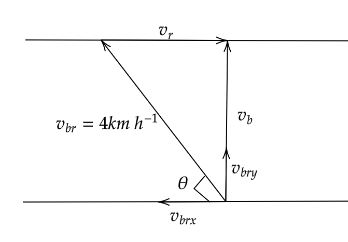
Now the boat is moving at an angle of $\theta $ opposite to the direction of speed of the river.Let us take the x-direction of the boat to be positive and the river to be opposite to it.Hence,
${v_{br}} = 4{\text{km}}\,{{\text{h}}^{{\text{ - 1}}}}$
Now splitting the speed of the boat with respect to river into two components we will get,
${v_{br}} = {v_{brx}} + {v_{bry}} = {v_{br}}\cos \theta {\text{ i}} + {v_{br}}\sin \theta {\text{ j}}$
Now putting the value we will get,
${v_{br}} = 4{\text{km}}\,{{\text{h}}^{{\text{ - 1}}}}\cos \theta {\text{ i}} + 4{\text{km}}\,{{\text{h}}^{{\text{ - 1}}}}\sin \theta {\text{ j}}$
We can say, ${v_{br}} = {v_b} - {v_r}$
Now on putting above we will get,
${v_b} - {v_r} = 4{\text{km}}\,{{\text{h}}^{{\text{ - 1}}}}\cos \theta {\text{ i}} + 4{\text{km}}\,{{\text{h}}^{{\text{ - 1}}}}\sin \theta {\text{ j}} \ldots \ldots \left( 1 \right)$
Now let us assume the speed of the river be,
${v_r} = - v\,{\text{i}}$
Now putting speed of river in place of equation $\left( 1 \right)$ we will get,
${v_b} - \left( { - v\,{\text{i}}} \right) = 4{\text{km}}\,{{\text{h}}^{{\text{ - 1}}}}\cos \theta {\text{ i}} + 4{\text{km}}\,{{\text{h}}^{{\text{ - 1}}}}\sin \theta {\text{ j}}$
Rearranging the equation we will get,
${v_b} = 4{\text{km}}\,{{\text{h}}^{{\text{ - 1}}}}\cos \theta {\text{ i}} - v{\text{ i}} + 4{\text{km}}\,{{\text{h}}^{{\text{ - 1}}}}\sin \theta {\text{ j}}$
Speed of the boat for zero drift the x-component should be zero.Hence,
$4{\text{km}}\,{{\text{h}}^{{\text{ - 1}}}}\cos \theta {\text{ }} - v{\text{ = 0}}$
$\Rightarrow 4{\text{km}}\,{{\text{h}}^{{\text{ - 1}}}}\cos \theta {\text{ = }}v$
So we can say the speed of the river should be,
$\therefore0 < v < 4{\text{km }}{{\text{h}}^{ - 1}}$
Therefore the correct option is B.
Note: Drift is distance along a river that a boat covers while crossing the river.Remember that when a boat is moving with a speed in still water then it is the speed of the boat with respect to the speed of the river. Another important formula for speed of boat in still water is defined as half the sum of downstream speed and upstream speed.
Complete step by step answer:
As per the problem, a boat can have a speed of $4{\text{km}}\,{\text{h}}{{\text{r}}^{{\text{ - 1}}}}$ in still water. We need to find the speed of river flow so that it can manage to row boats right across the river, without any drift.
Now the boat is moving at an angle of $\theta $ opposite to the direction of speed of the river.Let us take the x-direction of the boat to be positive and the river to be opposite to it.Hence,
${v_{br}} = 4{\text{km}}\,{{\text{h}}^{{\text{ - 1}}}}$
Now splitting the speed of the boat with respect to river into two components we will get,
${v_{br}} = {v_{brx}} + {v_{bry}} = {v_{br}}\cos \theta {\text{ i}} + {v_{br}}\sin \theta {\text{ j}}$
Now putting the value we will get,
${v_{br}} = 4{\text{km}}\,{{\text{h}}^{{\text{ - 1}}}}\cos \theta {\text{ i}} + 4{\text{km}}\,{{\text{h}}^{{\text{ - 1}}}}\sin \theta {\text{ j}}$
We can say, ${v_{br}} = {v_b} - {v_r}$
Now on putting above we will get,
${v_b} - {v_r} = 4{\text{km}}\,{{\text{h}}^{{\text{ - 1}}}}\cos \theta {\text{ i}} + 4{\text{km}}\,{{\text{h}}^{{\text{ - 1}}}}\sin \theta {\text{ j}} \ldots \ldots \left( 1 \right)$
Now let us assume the speed of the river be,
${v_r} = - v\,{\text{i}}$
Now putting speed of river in place of equation $\left( 1 \right)$ we will get,
${v_b} - \left( { - v\,{\text{i}}} \right) = 4{\text{km}}\,{{\text{h}}^{{\text{ - 1}}}}\cos \theta {\text{ i}} + 4{\text{km}}\,{{\text{h}}^{{\text{ - 1}}}}\sin \theta {\text{ j}}$
Rearranging the equation we will get,
${v_b} = 4{\text{km}}\,{{\text{h}}^{{\text{ - 1}}}}\cos \theta {\text{ i}} - v{\text{ i}} + 4{\text{km}}\,{{\text{h}}^{{\text{ - 1}}}}\sin \theta {\text{ j}}$
Speed of the boat for zero drift the x-component should be zero.Hence,
$4{\text{km}}\,{{\text{h}}^{{\text{ - 1}}}}\cos \theta {\text{ }} - v{\text{ = 0}}$
$\Rightarrow 4{\text{km}}\,{{\text{h}}^{{\text{ - 1}}}}\cos \theta {\text{ = }}v$
So we can say the speed of the river should be,
$\therefore0 < v < 4{\text{km }}{{\text{h}}^{ - 1}}$
Therefore the correct option is B.
Note: Drift is distance along a river that a boat covers while crossing the river.Remember that when a boat is moving with a speed in still water then it is the speed of the boat with respect to the speed of the river. Another important formula for speed of boat in still water is defined as half the sum of downstream speed and upstream speed.
Recently Updated Pages
Master Class 11 Computer Science: Engaging Questions & Answers for Success

Master Class 11 Business Studies: Engaging Questions & Answers for Success
Master Class 11 Economics: Engaging Questions & Answers for Success
Master Class 11 English: Engaging Questions & Answers for Success
Master Class 11 Maths: Engaging Questions & Answers for Success
Master Class 11 Biology: Engaging Questions & Answers for Success
Trending doubts
One Metric ton is equal to kg A 10000 B 1000 C 100 class 11 physics CBSE
There are 720 permutations of the digits 1 2 3 4 5 class 11 maths CBSE
Discuss the various forms of bacteria class 11 biology CBSE
Draw a diagram of a plant cell and label at least eight class 11 biology CBSE
State the laws of reflection of light
Explain zero factorial class 11 maths CBSE