




If a ball is thrown vertically upward from the ground with an initial velocity of $56$ feet per second, for how long will the ball be going upward?
Answer
 Verified
512.7k+ views
Hint: It is given in the question that a ball is thrown upward with an initial velocity. We have to find the time till which is moving upward. We will use motion’s equation, and substitute the values in it to get the answer. The ball moves upwards till its final velocity becomes zero.
Complete step by step solution:
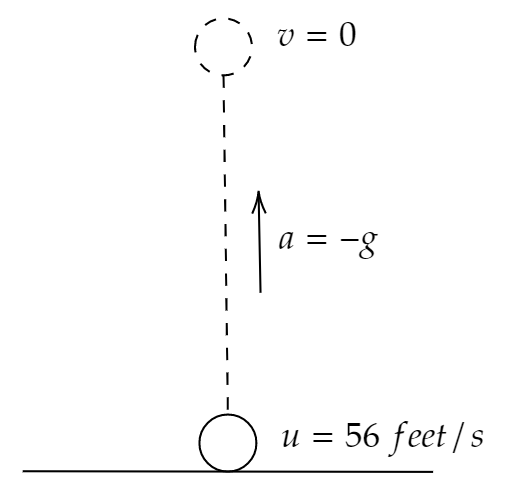
It is given in the question that a ball is vertically thrown upward with an initial speed of $56$ feet per second, we have to find the time it takes till it goes upward.
Hence, the ball will keep on going upward till its final velocity becomes $0$.
We have to consider the motion in the vertical axis only.
From the motion’s equation we get,
$v = u + at - - - - - \left( 1 \right)$
The variables are defined as,
$v = $ final velocity of the ball
$u = $ initial velocity of the ball
$a = $ acceleration of the ball
$t = $ total time period
For the given problem the final velocity must be $v = 0$ feet per second.
The initial velocity is given as $u = 56$ feet per second.
Acceleration of the ball is the acceleration due to gravity, $a = - g = - 10{\text{ }}\dfrac{m}{{{s^2}}}$
Substituting the values in the given equation $\left( 1 \right)$ we get,
$0 = 56 - 10t$
$ \Rightarrow t = 5.6$
The time till which the ball is going upwards is $5.6$ seconds.
Note:
It must be noted that the ball moves upwards till its final velocity becomes zero. The acceleration due to gravity is negative as the direction of acceleration of the ball is in the opposite direction to that of the acceleration due to gravity.
Complete step by step solution:
It is given in the question that a ball is vertically thrown upward with an initial speed of $56$ feet per second, we have to find the time it takes till it goes upward.
Hence, the ball will keep on going upward till its final velocity becomes $0$.
We have to consider the motion in the vertical axis only.
From the motion’s equation we get,
$v = u + at - - - - - \left( 1 \right)$
The variables are defined as,
$v = $ final velocity of the ball
$u = $ initial velocity of the ball
$a = $ acceleration of the ball
$t = $ total time period
For the given problem the final velocity must be $v = 0$ feet per second.
The initial velocity is given as $u = 56$ feet per second.
Acceleration of the ball is the acceleration due to gravity, $a = - g = - 10{\text{ }}\dfrac{m}{{{s^2}}}$
Substituting the values in the given equation $\left( 1 \right)$ we get,
$0 = 56 - 10t$
$ \Rightarrow t = 5.6$
The time till which the ball is going upwards is $5.6$ seconds.
Note:
It must be noted that the ball moves upwards till its final velocity becomes zero. The acceleration due to gravity is negative as the direction of acceleration of the ball is in the opposite direction to that of the acceleration due to gravity.
Recently Updated Pages
Master Class 11 English: Engaging Questions & Answers for Success

Master Class 11 Maths: Engaging Questions & Answers for Success
Class 11 Question and Answer - Your Ultimate Solutions Guide
Master Class 11 Biology: Engaging Questions & Answers for Success
Master Class 11 Physics: Engaging Questions & Answers for Success
Master Class 11 Accountancy: Engaging Questions & Answers for Success
Trending doubts
Differentiate between an exothermic and an endothermic class 11 chemistry CBSE
One Metric ton is equal to kg A 10000 B 1000 C 100 class 11 physics CBSE
In what year Guru Nanak Dev ji was born A15 April 1469 class 11 social science CBSE
Difference Between Prokaryotic Cells and Eukaryotic Cells
There are 720 permutations of the digits 1 2 3 4 5 class 11 maths CBSE
Draw a diagram of a plant cell and label at least eight class 11 biology CBSE