




If A, B, C, D are angles of a cyclic quadrilateral, then prove that cos A + cos B + cos C + cos D = 0.
Answer
 Verified
633.6k+ views
Hint: First of try to recollect what cyclic quadrilateral is. Now, we know that in a cyclic quadrilateral, opposite angles are supplementary, so replace C by (180 – A) and D by (180 – B) and use \[\cos \left( 180-\theta \right)=-\cos \theta \] to prove the desired result.
Complete step-by-step answer:
In this question, we are given that A, B, C, D are angles of a cyclic quadrilateral. We have to prove that cos A + cos B + cos C + cos D = 0. Before proceeding with this question, let us see what cyclic quadrilateral is. A cyclic quadrilateral or inscribed quadrilateral is a quadrilateral whose all vertices lie on a single circle. This circle is called circumcircle and vertices are said to be cyclic. In a cyclic quadrilateral, the sum of the opposite angles is always \[{{180}^{o}}\] , or in other words, we can say that the opposite angles of the cyclic quadrilateral are supplementary.
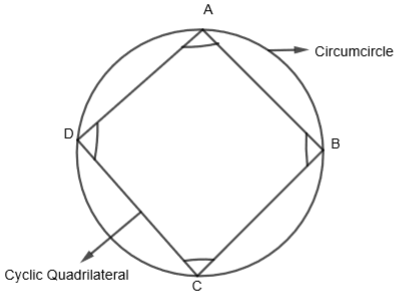
The above figure is of a cyclic quadrilateral. In the above figure,
\[\angle A+\angle C={{180}^{o}}\]
\[\angle B+\angle D={{180}^{o}}\]
Now, let us consider our question. Let us take the LHS of the equation given in the question, we get,
\[LHS=\cos A+\cos B+\cos C+\cos D.....\left( i \right)\]
We know that in a cyclic quadrilateral,
\[A+C={{180}^{o}}\]
\[\Rightarrow C={{180}^{o}}-A\]
By substituting the value of C in equation (i), we get,
\[LHS=\cos A+\cos B+\cos \left( {{180}^{o}}-A \right)+\cos D.....\left( ii \right)\]
Again, we know that in a cyclic quadrilateral,
\[B+D={{180}^{o}}\]
\[\Rightarrow D={{180}^{o}}-B\]
By substituting the value of D in equation (ii), we get,
\[LHS=\cos A+\cos B+\cos \left( {{180}^{o}}-A \right)+\cos \left( {{180}^{o}}-B \right)\]
We know that, \[\cos \left( {{180}^{o}}-\theta \right)=-\cos \theta \]. By using this in the above equation, we get,
\[LHS=\cos A+\cos B-\cos A-\cos B\]
By canceling the like terms of the above equation, we get,
\[LHS=0+0=0\]
So, we get, LHS = RHS
Hence proved.
Here, we have proved that in a cyclic quadrilateral, cos A + cos B + cos C + cos D = 0 where A, B, C, and D are angles of a quadrilateral.
Note: First of all, students must remember the properties of the cyclic quadrilateral and should always try to name the vertices in order because then only we will get \[A+C={{180}^{o}}\] and \[B+D={{180}^{o}}\]. Some students make the mistake of naming the vertices differently and still use the same formulas which is wrong. In that case, students should only remember that the sum of the opposite angles of a cyclic quadrilateral is \[{{180}^{o}}\].
Complete step-by-step answer:
In this question, we are given that A, B, C, D are angles of a cyclic quadrilateral. We have to prove that cos A + cos B + cos C + cos D = 0. Before proceeding with this question, let us see what cyclic quadrilateral is. A cyclic quadrilateral or inscribed quadrilateral is a quadrilateral whose all vertices lie on a single circle. This circle is called circumcircle and vertices are said to be cyclic. In a cyclic quadrilateral, the sum of the opposite angles is always \[{{180}^{o}}\] , or in other words, we can say that the opposite angles of the cyclic quadrilateral are supplementary.
The above figure is of a cyclic quadrilateral. In the above figure,
\[\angle A+\angle C={{180}^{o}}\]
\[\angle B+\angle D={{180}^{o}}\]
Now, let us consider our question. Let us take the LHS of the equation given in the question, we get,
\[LHS=\cos A+\cos B+\cos C+\cos D.....\left( i \right)\]
We know that in a cyclic quadrilateral,
\[A+C={{180}^{o}}\]
\[\Rightarrow C={{180}^{o}}-A\]
By substituting the value of C in equation (i), we get,
\[LHS=\cos A+\cos B+\cos \left( {{180}^{o}}-A \right)+\cos D.....\left( ii \right)\]
Again, we know that in a cyclic quadrilateral,
\[B+D={{180}^{o}}\]
\[\Rightarrow D={{180}^{o}}-B\]
By substituting the value of D in equation (ii), we get,
\[LHS=\cos A+\cos B+\cos \left( {{180}^{o}}-A \right)+\cos \left( {{180}^{o}}-B \right)\]
We know that, \[\cos \left( {{180}^{o}}-\theta \right)=-\cos \theta \]. By using this in the above equation, we get,
\[LHS=\cos A+\cos B-\cos A-\cos B\]
By canceling the like terms of the above equation, we get,
\[LHS=0+0=0\]
So, we get, LHS = RHS
Hence proved.
Here, we have proved that in a cyclic quadrilateral, cos A + cos B + cos C + cos D = 0 where A, B, C, and D are angles of a quadrilateral.
Note: First of all, students must remember the properties of the cyclic quadrilateral and should always try to name the vertices in order because then only we will get \[A+C={{180}^{o}}\] and \[B+D={{180}^{o}}\]. Some students make the mistake of naming the vertices differently and still use the same formulas which is wrong. In that case, students should only remember that the sum of the opposite angles of a cyclic quadrilateral is \[{{180}^{o}}\].
Recently Updated Pages
Master Class 12 Business Studies: Engaging Questions & Answers for Success

Master Class 12 Biology: Engaging Questions & Answers for Success
Master Class 12 Chemistry: Engaging Questions & Answers for Success
Class 12 Question and Answer - Your Ultimate Solutions Guide
Master Class 11 Social Science: Engaging Questions & Answers for Success
Master Class 11 English: Engaging Questions & Answers for Success
Trending doubts
Explain the Treaty of Vienna of 1815 class 10 social science CBSE
Which Indian city is known as the "City of Victory"?
Which instrument is used to measure the Blood Pressure?
Who Won 36 Oscar Awards? Record Holder Revealed
What is the median of the first 10 natural numbers class 10 maths CBSE
Why is it 530 pm in india when it is 1200 afternoon class 10 social science CBSE