




If A and B are two sets such that n(A $\cup $ B) = 50, n(A) = 28 and n(B) = 32. Find n(A $\cap $ B).
Answer
 Verified
610.2k+ views
Hint: Here we will apply the relation between the numbers of two sets with union and intersection between them. The relation is as n(A $\cup $ B) = n(A) + n(B) - n(A $\cap $ B). Here n represents numbers. This can be used only when the sets are finite.
Complete step-by-step answer:
According to the question we clearly have that the value of n(A $\cup $ B) is 50. And the individual values of the sets are given as n(A) = 28 and n(B) = 32.
We are here to find the value of n(A $\cap $ B). This can be done by the formula n(A $\cup $ B) = n(A) + n(B) - n(A $\cap $ B).
By directly substituting the values we have 50 = 28 + 32 - n(A $\cap $ B). By placing n(A $\cap $ B) to the left side of the equal sign and the constants to the right side of equal signs we get n(A $\cap $ B) = 28 + 32 - 50. So, we have n(A $\cap $ B) = 10.
The Venn diagram for the question is shown below where U is the universal set.
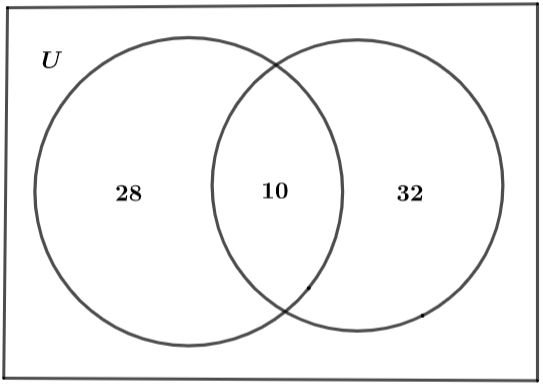
Hence, the value of n(A $\cap $ B) is given by 10.
Note: Here the union works as a total number of elements in the sets A and B. And the intersection between A and B is the number of common elements between A and B. The formula n(A $\cup $ B) = n(A) + n(B) - n(A $\cap $ B) is known as the cardinal property which is applied only to the sets which are finite in number.
Complete step-by-step answer:
According to the question we clearly have that the value of n(A $\cup $ B) is 50. And the individual values of the sets are given as n(A) = 28 and n(B) = 32.
We are here to find the value of n(A $\cap $ B). This can be done by the formula n(A $\cup $ B) = n(A) + n(B) - n(A $\cap $ B).
By directly substituting the values we have 50 = 28 + 32 - n(A $\cap $ B). By placing n(A $\cap $ B) to the left side of the equal sign and the constants to the right side of equal signs we get n(A $\cap $ B) = 28 + 32 - 50. So, we have n(A $\cap $ B) = 10.
The Venn diagram for the question is shown below where U is the universal set.
Hence, the value of n(A $\cap $ B) is given by 10.
Note: Here the union works as a total number of elements in the sets A and B. And the intersection between A and B is the number of common elements between A and B. The formula n(A $\cup $ B) = n(A) + n(B) - n(A $\cap $ B) is known as the cardinal property which is applied only to the sets which are finite in number.
Recently Updated Pages
Master Class 11 Computer Science: Engaging Questions & Answers for Success

Master Class 11 Business Studies: Engaging Questions & Answers for Success
Master Class 11 Economics: Engaging Questions & Answers for Success
Master Class 11 English: Engaging Questions & Answers for Success
Master Class 11 Maths: Engaging Questions & Answers for Success
Master Class 11 Biology: Engaging Questions & Answers for Success
Trending doubts
One Metric ton is equal to kg A 10000 B 1000 C 100 class 11 physics CBSE
There are 720 permutations of the digits 1 2 3 4 5 class 11 maths CBSE
Discuss the various forms of bacteria class 11 biology CBSE
Draw a diagram of a plant cell and label at least eight class 11 biology CBSE
State the laws of reflection of light
Explain zero factorial class 11 maths CBSE