




If A and B are two mutually exclusive events, then?
\[\begin{align}
& \text{A}\text{. P}\left( \text{A} \right)\le \text{P}\left( \text{B }\!\!'\!\!\text{ } \right) \\
& \text{B}\text{. P}\left( \text{A} \right)\le \text{P}\left( \text{B} \right) \\
& \text{C}\text{. P}\left( \text{A} \right)\ge \text{P}\left( \text{B }\!\!'\!\!\text{ } \right) \\
& \text{D}\text{. None of these} \\
\end{align}\]
Answer
 Verified
565.5k+ views
Hint: To solve this question, we need to learn about the probability. For mutually exclusive events, A and B, we know that \[P\left( A\cap B \right)=0\] and to find out the correct option, we need to elaborate the \[P\left( A\cap B \right)=0\], and then we get the required answer.
Complete step-by-step solution:
The probability that Events A and B both occur is the probability of the intersection of A and B. The probability of the intersection of Events A and B is denoted by \[P\left( A\cap B \right)=0\].
If Events A and B are mutually exclusive, \[P\left( A\cap B \right)=0\].
Condition for mutually exclusive events: If they cannot occur at the same time, two events can said to be mutually exclusive. Another word that means mutually exclusive is disjoint.
If two events are disjoint, then the probability of them both occurring at the same time is 0.
Three Events Are Mutually Exclusive If At Least Two Events Are Equal, With All Outcomes in Common.
Let us solve the given question,
Given that A and B are two mutually exclusive events,
\[P\left( A\cap B \right)=0\]
Elaborating the above probability form
\[P\left( A\cap B \right)=P\left( A \right)+P\left( B \right)-P\left( A\cup B \right)\]
We know that \[P\left( A\cap B \right)=0\], substituting in the above equation, then
\[\Rightarrow 0=P\left( A \right)+P\left( B \right)-P\left( A\cup B \right)\]
Which we can write as,
\[\begin{align}
& \Rightarrow P\left( A \right)+P\left( B \right)=P\left( A\cup B \right) \\
& \Rightarrow P\left( A \right)=P\left( A\cup B \right)-P\left( B \right) \\
& \therefore P\left( A \right)\le P\left( B' \right) \\
\end{align}\]
The correct option is (A).
Note: Students must know the probability formulas to solve these questions. We can also solve this problem using a Venn diagram.
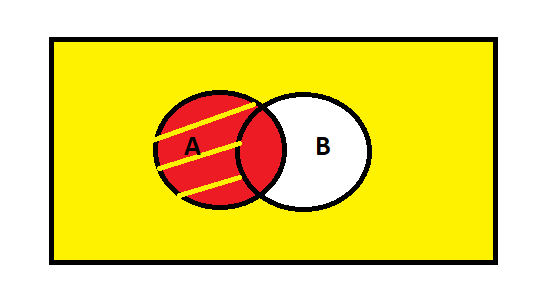
In the above figure, \[P\left( A \right)\] is shown in red colour and \[P\left( B' \right)\]is shown in yellow colour including the shaded portion in A. we can see that \[P\left( A \right)\le P\left( B' \right)\]..
Complete step-by-step solution:
The probability that Events A and B both occur is the probability of the intersection of A and B. The probability of the intersection of Events A and B is denoted by \[P\left( A\cap B \right)=0\].
If Events A and B are mutually exclusive, \[P\left( A\cap B \right)=0\].
Condition for mutually exclusive events: If they cannot occur at the same time, two events can said to be mutually exclusive. Another word that means mutually exclusive is disjoint.
If two events are disjoint, then the probability of them both occurring at the same time is 0.
Three Events Are Mutually Exclusive If At Least Two Events Are Equal, With All Outcomes in Common.
Let us solve the given question,
Given that A and B are two mutually exclusive events,
\[P\left( A\cap B \right)=0\]
Elaborating the above probability form
\[P\left( A\cap B \right)=P\left( A \right)+P\left( B \right)-P\left( A\cup B \right)\]
We know that \[P\left( A\cap B \right)=0\], substituting in the above equation, then
\[\Rightarrow 0=P\left( A \right)+P\left( B \right)-P\left( A\cup B \right)\]
Which we can write as,
\[\begin{align}
& \Rightarrow P\left( A \right)+P\left( B \right)=P\left( A\cup B \right) \\
& \Rightarrow P\left( A \right)=P\left( A\cup B \right)-P\left( B \right) \\
& \therefore P\left( A \right)\le P\left( B' \right) \\
\end{align}\]
The correct option is (A).
Note: Students must know the probability formulas to solve these questions. We can also solve this problem using a Venn diagram.
In the above figure, \[P\left( A \right)\] is shown in red colour and \[P\left( B' \right)\]is shown in yellow colour including the shaded portion in A. we can see that \[P\left( A \right)\le P\left( B' \right)\]..
Recently Updated Pages
Master Class 11 English: Engaging Questions & Answers for Success

Master Class 11 Social Science: Engaging Questions & Answers for Success
Master Class 11 Maths: Engaging Questions & Answers for Success
Master Class 11 Biology: Engaging Questions & Answers for Success
Master Class 11 Physics: Engaging Questions & Answers for Success
Master Class 11 Chemistry: Engaging Questions & Answers for Success
Trending doubts
Explain the Treaty of Vienna of 1815 class 10 social science CBSE
First Cotton Mill of India
In which year voting age was reduced from 21 to 18?
10 examples of evaporation in daily life with explanations
What planets have no moons Which one has only one moon class 10 physics CBSE
What is the full form of POSCO class 10 social science CBSE