




If A and B are the points (2, 1, -2), (3, -4, 5) then the angle OA makes with OB is
(a) \[{{\cos }^{-1}}\left( \dfrac{4\sqrt{2}}{15} \right)\]
(b) \[{{\cos }^{-1}}\left( \dfrac{4}{15\sqrt{2}} \right)\]
(c) \[{{\cos }^{-1}}\left( \dfrac{8\sqrt{2}}{15} \right)\]
(d) \[\dfrac{\pi }{2}\]
Answer
 Verified
638.7k+ views
Hint: To solve this question we will use the formula of dot product of two vectors which is given as, \[\overset{\to }{\mathop{P}}\,.\overset{\to }{\mathop{Q}}\,=\left| \overset{\to }{\mathop{P}}\, \right|\left| \overset{\to }{\mathop{Q}}\, \right|\cos \theta \], where \[\theta \] is angle between vectors, \[\overset{\to }{\mathop{P}}\,\] and \[\overset{\to }{\mathop{Q}}\,\], \[\left| \overset{\to }{\mathop{P}}\, \right|\] is length of vector \[\overset{\to }{\mathop{P}}\,\] also \[\left| \overset{\to }{\mathop{P}}\, \right|=\sqrt{{{a}^{2}}+{{b}^{2}}+{{c}^{2}}}\], where \[\overset{\to }{\mathop{P}}\,=\left( a,b,c \right)\]. Also the dot product of two vectors is given by \[\left( a\overset{\wedge }{\mathop{i}}\,+b\overset{\wedge }{\mathop{j}}\,+c\overset{\wedge }{\mathop{k}}\, \right).\left( x\overset{\wedge }{\mathop{i}}\,+y\overset{\wedge }{\mathop{j}}\,+z\overset{\wedge }{\mathop{k}}\, \right)=ax+by+cz\].
Complete step-by-step solution:
Given that, A = (2, 1, -2) and B = (3, -4, 5).
We have to find angles between \[\overset{\to }{\mathop{OA}}\,\] and \[\overset{\to }{\mathop{OB}}\,\] to do that first of all we will calculate \[\overset{\to }{\mathop{OA}}\,\] and \[\overset{\to }{\mathop{OB}}\,\].
Consider two points P and Q whose co – ordinates are,
\[\overset{\to }{\mathop{P}}\,=\left( a,b,c \right)\] and \[\overset{\to }{\mathop{Q}}\,=\left( x,y,z \right)\].
Then the value of PQ is, \[\overset{\to }{\mathop{PQ}}\,=\left( \left( x-a \right)\overset{\to }{\mathop{i}}\,+\left( y-b \right)\overset{\to }{\mathop{j}}\,+\left( z-c \right)\overset{\to }{\mathop{k}}\, \right)\].
Now we have OA, where O is the origin then O = (0, 0, 0).
Using the above formula we have,
\[OA=2\overset{\to }{\mathop{i}}\,+\overset{\to }{\mathop{j}}\,+\left( -2 \right)\overset{\to }{\mathop{k}}\,\] and similarly \[OB=3\overset{\to }{\mathop{i}}\,-4\overset{\to }{\mathop{j}}\,+5\overset{\to }{\mathop{k}}\,\].
Now finally we will use the formula of dot product of two vectors which is given as,
\[\overset{\to }{\mathop{P}}\,.\overset{\to }{\mathop{Q}}\,=\left| \overset{\to }{\mathop{P}}\, \right|\left| \overset{\to }{\mathop{Q}}\, \right|\cos \theta \], where \[\left| \overset{\to }{\mathop{P}}\, \right|\] is the length of \[\overset{\to }{\mathop{P}}\,\]. \[\left| \overset{\to }{\mathop{Q}}\, \right|\] is the length of \[\overset{\to }{\mathop{Q}}\,\].
And \[\theta \] is the angle between them as shown below,
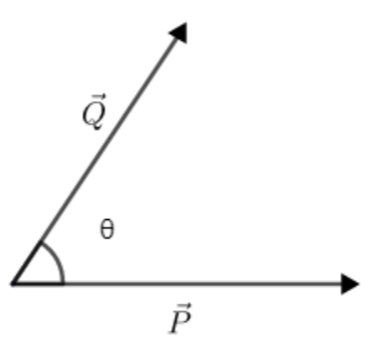
The formula to compute length of \[\overset{\to }{\mathop{P}}\,\] is,
\[\left| \overset{\to }{\mathop{P}}\, \right|=\sqrt{{{\left( a \right)}^{2}}+{{\left( b \right)}^{2}}+{{\left( c \right)}^{2}}}\], where \[\overset{\to }{\mathop{P}}\,=\left( a,b,c \right)\].
Now we will compute \[\left| \overset{\to }{\mathop{OA}}\, \right|\] and \[\left| \overset{\to }{\mathop{OB}}\, \right|\] using this formula,
\[\begin{align}
& \therefore \left| \overset{\to }{\mathop{OA}}\, \right|=\sqrt{{{\left( 2 \right)}^{2}}+{{\left( 1 \right)}^{2}}+{{\left( -2 \right)}^{2}}} \\
& \Rightarrow \left| \overset{\to }{\mathop{OA}}\, \right|=\sqrt{9}=3 \\
\end{align}\]
Similarly, \[\left| \overset{\to }{\mathop{OB}}\, \right|=\sqrt{{{\left( 3 \right)}^{2}}+{{\left( -4 \right)}^{2}}+{{5}^{2}}}\]
\[\begin{align}
& \Rightarrow \left| \overset{\to }{\mathop{OB}}\, \right|=\sqrt{9+16+25} \\
& \Rightarrow \left| \overset{\to }{\mathop{OB}}\, \right|=\sqrt{50} \\
\end{align}\]
Finally we will use the formula of dot product stated above to find the angle ‘\[\theta \]’. Let \[\theta \] be angle between OA & OB, then we have
\[\overset{\to }{\mathop{OA}}\,.\overset{\to }{\mathop{OB}}\,=\left| \overset{\to }{\mathop{OA}}\, \right|\left| \overset{\to }{\mathop{OB}}\, \right|\cos \theta \]
Substituting values of \[\left| \overset{\to }{\mathop{OA}}\, \right|\] & \[\left| \overset{\to }{\mathop{OB}}\, \right|\] obtained above we have,
\[\left( 2i+j+\left( -2 \right)k \right).\left( 3i-4j+5k \right)=3\times \sqrt{50}\cos \theta \]
Or product of two vectors given as,
\[\left( ai+bj+ck \right).\left( xi+yj+zk \right)=ax+by+cz\]
Using this above we get,
\[\begin{align}
& \Rightarrow 6-4-10=3\sqrt{50}\times \cos \theta \\
& \Rightarrow \cos \theta =\dfrac{6-14}{3\sqrt{50}} \\
& \Rightarrow \cos \theta =\dfrac{-8}{5\times 3\sqrt{2}} \\
\end{align}\]
Multiplying \[\sqrt{2}\] on both numerator & denominator we get,
\[\begin{align}
& \Rightarrow \cos \theta =\dfrac{-8\sqrt{2}}{15\times 2} \\
& \Rightarrow \cos \theta =\dfrac{-4\sqrt{2}}{15} \\
\end{align}\]
Now because \[\overset{\to }{\mathop{OA}}\,\] and \[\overset{\to }{\mathop{OB}}\,\] are having obtuse angle in between so, \[\cos \theta \] = +ve, anyway angle is always taken positive.
\[\begin{align}
& \Rightarrow \cos \theta =-\left( \dfrac{4\sqrt{2}}{15} \right) \\
& \Rightarrow \cos \theta =\dfrac{4\sqrt{2}}{15} \\
\end{align}\]
Taking \[{{\cos }^{-1}}\] both sides,
\[\Rightarrow \theta ={{\cos }^{-1}}\left( \dfrac{4\sqrt{2}}{15} \right)\], which is option (a).
Note: Do not get confuse while making \[\cos \theta \] positive at the end of solution. If the student has any doubt then refer to the formula.
\[\cos \theta =\left| \dfrac{\overset{\to }{\mathop{P}}\,.\overset{\to }{\mathop{Q}}\,}{\left| \overset{\to }{\mathop{P}}\, \right|\left| \overset{\to }{\mathop{Q}}\, \right|} \right|\] for angle between P & Q as \[\theta \].
The angle is always considered positive.
Note the key point to note in this question is that while calculating the position vector PQ where \[\overset{\to }{\mathop{P}}\,=\left( a,b,x \right)\] and \[\overset{\to }{\mathop{Q}}\,=\left( x,y,z \right)\] and \[\overset{\to }{\mathop{PQ}}\,=\left( x-a \right)\overset{\wedge }{\mathop{i}}\,+\left( y-b \right)\overset{\wedge }{\mathop{j}}\,+\left( z-c \right)\overset{\wedge }{\mathop{k}}\,\].
We can also use \[\overset{\to }{\mathop{QP}}\,=\overset{\to }{\mathop{PQ}}\,=\left( a-x \right)\overset{\wedge }{\mathop{i}}\,+\left( b-y \right)\overset{\wedge }{\mathop{j}}\,+\left( c-z \right)\overset{\wedge }{\mathop{k}}\,\] this is valid until and unless you use this in whole solution calculations.
Remember using \[\overset{\to }{\mathop{PQ}}\,=\left( x-a \right)\overset{\wedge }{\mathop{i}}\,+\left( y-b \right)\overset{\wedge }{\mathop{j}}\,+\left( z-c \right)\overset{\wedge }{\mathop{k}}\,\] at one part and \[\overset{\to }{\mathop{QP}}\,=\left( a-x \right)\overset{\wedge }{\mathop{i}}\,+\left( b-y \right)\overset{\wedge }{\mathop{j}}\,+\left( c-z \right)\overset{\wedge }{\mathop{k}}\,\] would differ the answer.
Complete step-by-step solution:
Given that, A = (2, 1, -2) and B = (3, -4, 5).
We have to find angles between \[\overset{\to }{\mathop{OA}}\,\] and \[\overset{\to }{\mathop{OB}}\,\] to do that first of all we will calculate \[\overset{\to }{\mathop{OA}}\,\] and \[\overset{\to }{\mathop{OB}}\,\].
Consider two points P and Q whose co – ordinates are,
\[\overset{\to }{\mathop{P}}\,=\left( a,b,c \right)\] and \[\overset{\to }{\mathop{Q}}\,=\left( x,y,z \right)\].
Then the value of PQ is, \[\overset{\to }{\mathop{PQ}}\,=\left( \left( x-a \right)\overset{\to }{\mathop{i}}\,+\left( y-b \right)\overset{\to }{\mathop{j}}\,+\left( z-c \right)\overset{\to }{\mathop{k}}\, \right)\].
Now we have OA, where O is the origin then O = (0, 0, 0).
Using the above formula we have,
\[OA=2\overset{\to }{\mathop{i}}\,+\overset{\to }{\mathop{j}}\,+\left( -2 \right)\overset{\to }{\mathop{k}}\,\] and similarly \[OB=3\overset{\to }{\mathop{i}}\,-4\overset{\to }{\mathop{j}}\,+5\overset{\to }{\mathop{k}}\,\].
Now finally we will use the formula of dot product of two vectors which is given as,
\[\overset{\to }{\mathop{P}}\,.\overset{\to }{\mathop{Q}}\,=\left| \overset{\to }{\mathop{P}}\, \right|\left| \overset{\to }{\mathop{Q}}\, \right|\cos \theta \], where \[\left| \overset{\to }{\mathop{P}}\, \right|\] is the length of \[\overset{\to }{\mathop{P}}\,\]. \[\left| \overset{\to }{\mathop{Q}}\, \right|\] is the length of \[\overset{\to }{\mathop{Q}}\,\].
And \[\theta \] is the angle between them as shown below,
The formula to compute length of \[\overset{\to }{\mathop{P}}\,\] is,
\[\left| \overset{\to }{\mathop{P}}\, \right|=\sqrt{{{\left( a \right)}^{2}}+{{\left( b \right)}^{2}}+{{\left( c \right)}^{2}}}\], where \[\overset{\to }{\mathop{P}}\,=\left( a,b,c \right)\].
Now we will compute \[\left| \overset{\to }{\mathop{OA}}\, \right|\] and \[\left| \overset{\to }{\mathop{OB}}\, \right|\] using this formula,
\[\begin{align}
& \therefore \left| \overset{\to }{\mathop{OA}}\, \right|=\sqrt{{{\left( 2 \right)}^{2}}+{{\left( 1 \right)}^{2}}+{{\left( -2 \right)}^{2}}} \\
& \Rightarrow \left| \overset{\to }{\mathop{OA}}\, \right|=\sqrt{9}=3 \\
\end{align}\]
Similarly, \[\left| \overset{\to }{\mathop{OB}}\, \right|=\sqrt{{{\left( 3 \right)}^{2}}+{{\left( -4 \right)}^{2}}+{{5}^{2}}}\]
\[\begin{align}
& \Rightarrow \left| \overset{\to }{\mathop{OB}}\, \right|=\sqrt{9+16+25} \\
& \Rightarrow \left| \overset{\to }{\mathop{OB}}\, \right|=\sqrt{50} \\
\end{align}\]
Finally we will use the formula of dot product stated above to find the angle ‘\[\theta \]’. Let \[\theta \] be angle between OA & OB, then we have
\[\overset{\to }{\mathop{OA}}\,.\overset{\to }{\mathop{OB}}\,=\left| \overset{\to }{\mathop{OA}}\, \right|\left| \overset{\to }{\mathop{OB}}\, \right|\cos \theta \]
Substituting values of \[\left| \overset{\to }{\mathop{OA}}\, \right|\] & \[\left| \overset{\to }{\mathop{OB}}\, \right|\] obtained above we have,
\[\left( 2i+j+\left( -2 \right)k \right).\left( 3i-4j+5k \right)=3\times \sqrt{50}\cos \theta \]
Or product of two vectors given as,
\[\left( ai+bj+ck \right).\left( xi+yj+zk \right)=ax+by+cz\]
Using this above we get,
\[\begin{align}
& \Rightarrow 6-4-10=3\sqrt{50}\times \cos \theta \\
& \Rightarrow \cos \theta =\dfrac{6-14}{3\sqrt{50}} \\
& \Rightarrow \cos \theta =\dfrac{-8}{5\times 3\sqrt{2}} \\
\end{align}\]
Multiplying \[\sqrt{2}\] on both numerator & denominator we get,
\[\begin{align}
& \Rightarrow \cos \theta =\dfrac{-8\sqrt{2}}{15\times 2} \\
& \Rightarrow \cos \theta =\dfrac{-4\sqrt{2}}{15} \\
\end{align}\]
Now because \[\overset{\to }{\mathop{OA}}\,\] and \[\overset{\to }{\mathop{OB}}\,\] are having obtuse angle in between so, \[\cos \theta \] = +ve, anyway angle is always taken positive.
\[\begin{align}
& \Rightarrow \cos \theta =-\left( \dfrac{4\sqrt{2}}{15} \right) \\
& \Rightarrow \cos \theta =\dfrac{4\sqrt{2}}{15} \\
\end{align}\]
Taking \[{{\cos }^{-1}}\] both sides,
\[\Rightarrow \theta ={{\cos }^{-1}}\left( \dfrac{4\sqrt{2}}{15} \right)\], which is option (a).
Note: Do not get confuse while making \[\cos \theta \] positive at the end of solution. If the student has any doubt then refer to the formula.
\[\cos \theta =\left| \dfrac{\overset{\to }{\mathop{P}}\,.\overset{\to }{\mathop{Q}}\,}{\left| \overset{\to }{\mathop{P}}\, \right|\left| \overset{\to }{\mathop{Q}}\, \right|} \right|\] for angle between P & Q as \[\theta \].
The angle is always considered positive.
Note the key point to note in this question is that while calculating the position vector PQ where \[\overset{\to }{\mathop{P}}\,=\left( a,b,x \right)\] and \[\overset{\to }{\mathop{Q}}\,=\left( x,y,z \right)\] and \[\overset{\to }{\mathop{PQ}}\,=\left( x-a \right)\overset{\wedge }{\mathop{i}}\,+\left( y-b \right)\overset{\wedge }{\mathop{j}}\,+\left( z-c \right)\overset{\wedge }{\mathop{k}}\,\].
We can also use \[\overset{\to }{\mathop{QP}}\,=\overset{\to }{\mathop{PQ}}\,=\left( a-x \right)\overset{\wedge }{\mathop{i}}\,+\left( b-y \right)\overset{\wedge }{\mathop{j}}\,+\left( c-z \right)\overset{\wedge }{\mathop{k}}\,\] this is valid until and unless you use this in whole solution calculations.
Remember using \[\overset{\to }{\mathop{PQ}}\,=\left( x-a \right)\overset{\wedge }{\mathop{i}}\,+\left( y-b \right)\overset{\wedge }{\mathop{j}}\,+\left( z-c \right)\overset{\wedge }{\mathop{k}}\,\] at one part and \[\overset{\to }{\mathop{QP}}\,=\left( a-x \right)\overset{\wedge }{\mathop{i}}\,+\left( b-y \right)\overset{\wedge }{\mathop{j}}\,+\left( c-z \right)\overset{\wedge }{\mathop{k}}\,\] would differ the answer.
Recently Updated Pages
Basicity of sulphurous acid and sulphuric acid are

Master Class 12 Economics: Engaging Questions & Answers for Success
Master Class 12 Biology: Engaging Questions & Answers for Success
Master Class 11 English: Engaging Questions & Answers for Success
Master Class 11 Physics: Engaging Questions & Answers for Success
Master Class 11 Computer Science: Engaging Questions & Answers for Success
Trending doubts
Draw a labelled sketch of the human eye class 12 physics CBSE
The chemical formula of tear gas is A CO Cl 2 B C 10 class 12 chemistry CBSE
Draw ray diagrams each showing i myopic eye and ii class 12 physics CBSE
Which are the Top 10 Largest Countries of the World?
Differentiate between homogeneous and heterogeneous class 12 chemistry CBSE
Which is the correct genotypic ratio of mendel dihybrid class 12 biology CBSE