




If A and B are subsets of a set $X$. Then
1)$A - B = A \cup B$
2)$A - B = A \cap B$
3)$A - B = {A^c} \cap B$
4)$A - B = A \cap {B^c}$
Answer
 Verified
556.5k+ views
Hint: First we will assume any arbitrary element that belongs to the set $X$, in such a way that, it satisfies the condition $A - B$, as in the left hand side of all the options of the question, we are to prove this. Then, we have to find the appropriate option such that the arbitrary element also belongs to the set formed on the right hand side of the equation. To find this, we have to find the correct option to this question, so that the set on the left hand side resembles the set that will be formed on the right hand side.
Complete step-by-step solution:
Let any arbitrary element $a \in X$ such that $a \in A - B$.
We know, $A - B$ implies a set that contains the elements of $A$ but not any element of $B$.
So, we can say that,
$a \in A - B$
$ \Rightarrow a \in A$ and $a \notin B$
Since, both $A$ and $B$ are subsets of $X$, therefore, ${B^c}$ is a set that contains all the elements instead of elements of $B$.
Therefore, we can write,
$ \Rightarrow a \in A$ and $a \notin {B^c}$
We know, “and” represents intersection in case of sets.
Therefore, we can write,
$ \Rightarrow a \in A \cap {B^c}$
Therefore, $a \in A - B$ and $a \in A \cap {B^c}$
Therefore, we can write it clearly, that,
$A - B = A \cap {B^c}$
Thus, the correct option is 4.
Note: Another way of solving this problem is with the help of Venn diagrams. By Venn Diagrams, we represent the sets as circles and any region common between the two set are represented by over-lapped portion shaded in dark. And if any set is subset of any bigger set, then the smaller set is shown as totally embedded within the larger set.
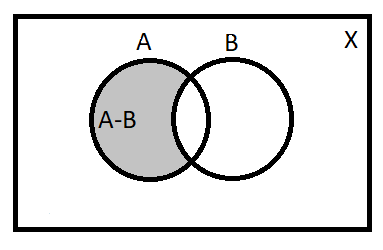
By observing the Venn Diagram we can easily finding the answer to our problem.
Complete step-by-step solution:
Let any arbitrary element $a \in X$ such that $a \in A - B$.
We know, $A - B$ implies a set that contains the elements of $A$ but not any element of $B$.
So, we can say that,
$a \in A - B$
$ \Rightarrow a \in A$ and $a \notin B$
Since, both $A$ and $B$ are subsets of $X$, therefore, ${B^c}$ is a set that contains all the elements instead of elements of $B$.
Therefore, we can write,
$ \Rightarrow a \in A$ and $a \notin {B^c}$
We know, “and” represents intersection in case of sets.
Therefore, we can write,
$ \Rightarrow a \in A \cap {B^c}$
Therefore, $a \in A - B$ and $a \in A \cap {B^c}$
Therefore, we can write it clearly, that,
$A - B = A \cap {B^c}$
Thus, the correct option is 4.
Note: Another way of solving this problem is with the help of Venn diagrams. By Venn Diagrams, we represent the sets as circles and any region common between the two set are represented by over-lapped portion shaded in dark. And if any set is subset of any bigger set, then the smaller set is shown as totally embedded within the larger set.
By observing the Venn Diagram we can easily finding the answer to our problem.
Recently Updated Pages
Master Class 11 Social Science: Engaging Questions & Answers for Success

Master Class 11 English: Engaging Questions & Answers for Success
Master Class 11 Accountancy: Engaging Questions & Answers for Success
Master Class 11 Physics: Engaging Questions & Answers for Success
Master Class 11 Computer Science: Engaging Questions & Answers for Success
Master Class 11 Business Studies: Engaging Questions & Answers for Success
Trending doubts
Find the value of the expression given below sin 30circ class 11 maths CBSE
One Metric ton is equal to kg A 10000 B 1000 C 100 class 11 physics CBSE
Draw a diagram of nephron and explain its structur class 11 biology CBSE
10 examples of friction in our daily life
Proton was discovered by A Thomson B Rutherford C Chadwick class 11 chemistry CBSE
The teeth used for biting and cutting food are called class 11 biology CBSE