




If a and b are real numbers between 0 and 1 such that the point \[(a,1),(1,b)\] and \[(0,0)\] from an equilateral triangle, find a and b.
Answer
 Verified
614.7k+ views
Hint: Here we are given the points from an equilateral triangle, we have to find the value of a and b. As all the sides are equal for an equilateral triangle, we get two different equations using a and b. Then solving them altogether will give us the needed value of a and b.
Complete step-by-step answer:
Given points \[(a,1),(1,b)\] and \[(0,0)\] from an equilateral triangle.
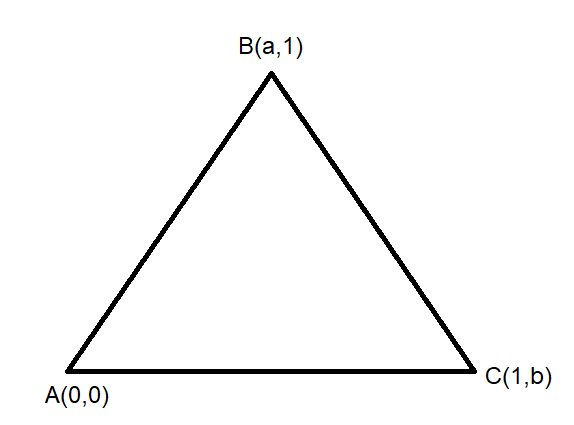
As all the sides are equal for an equilateral triangle, so we use the distance formula to find the distance between 2 points, i.e., for points \[(a,b)\] and \[(c,d)\] , the distance between them is \[\sqrt {{{(a - c)}^2} + {{(b - d)}^2}} \] .
We have the distance between \[(a,1)\] and \[(0,0)\]
\[ \Rightarrow \] \[\sqrt {{{(a - 0)}^2} + {{(1 - 0)}^2}} \] \[ = \sqrt {{a^2} + 1} \]
And, the distance between \[(0,0)\] and \[(1,b)\] is
\[ \Rightarrow \] \[\sqrt {{{(0 - 1)}^2} + {{(0 - b)}^2}} = \sqrt {{b^2} + 1} \]
Also, the distance between \[(a,1)\] and \[(1,b)\] is
\[ \Rightarrow \] \[\sqrt {{{(a - 1)}^2} + {{(1 - b)}^2}} \]
As it forms an equilateral triangle,
So, distance between any 2 points are equal.
Hence we have, \[\sqrt {{{(a - 1)}^2} + {{(1 - b)}^2}} = \sqrt {{a^2} + 1} = \sqrt {{b^2} + 1} \]
On squaring, we get
\[{(a - 1)^2} + {(1 - b)^2} = {a^2} + 1 = {b^2} + 1\] ………….(1)
From the last two, we get
\[{a^2} + 1 = {b^2} + 1\]
On subtracting 1 from both sides, we get
\[ \Rightarrow {a^2} = {b^2}\]
On taking square root, we get
\[ \Rightarrow a = \pm b\]
Now, again, from the first two terms of equation (1), we get
\[{(a - 1)^2} + {(1 - b)^2} = {a^2} + 1\]
On taking, \[b = a\]
\[ \Rightarrow \]\[{(a - 1)^2} + {(1 - a)^2} = {a^2} + 1\]
As \[{(a - 1)^2} = {(1 - a)^2}\], we get
\[ \Rightarrow 2{(a - 1)^2} = {a^2} + 1\]
On using \[{(a - 1)^2} = {a^2} - 2a + 1\] , we get
\[ \Rightarrow 2({a^2} - 2a + 1) = {a^2} + 1\]
On simplification, we get
\[ \Rightarrow 2{a^2} - 4a + 2 = {a^2} + 1\]
\[ \Rightarrow {a^2} - 4a + 1 = 0\]
For a quadratic equation \[a{x^2} + bx + c = 0\] the value of x is \[x = \dfrac{{ - b \pm \sqrt {{b^2} - 4ac} }}{{2a}}\] ,
Using this, we get
\[ \Rightarrow a = \dfrac{{ - ( - 4) \pm \sqrt {{{( - 4)}^2} - 4 \times 1 \times 1} }}{{2 \times 1}}\]
On simplification we get,
\[ \Rightarrow a = \dfrac{{4 \pm \sqrt {16 - 4} }}{2}\]
On solving the value under the root we get,
\[ \Rightarrow a = \dfrac{{4 \pm \sqrt {12} }}{2}\]
On further simplification we get,
\[ \Rightarrow a = \dfrac{{4 \pm 2\sqrt 3 }}{2}\]
On dividing we get,
\[ \Rightarrow a = 2 \pm \sqrt 3 \]
As, \[b = a\]
So, we will have,
\[ \Rightarrow b = 2 \pm \sqrt 3 \]
Note: For a equilateral triangle,
1.Three kinds of cevians coincide, and are equal, for (and only for) equilateral triangles:
2.The three altitudes have equal lengths.
3.The three medians have equal lengths.
4.The three angle bisectors have equal lengths.
Complete step-by-step answer:
Given points \[(a,1),(1,b)\] and \[(0,0)\] from an equilateral triangle.
As all the sides are equal for an equilateral triangle, so we use the distance formula to find the distance between 2 points, i.e., for points \[(a,b)\] and \[(c,d)\] , the distance between them is \[\sqrt {{{(a - c)}^2} + {{(b - d)}^2}} \] .
We have the distance between \[(a,1)\] and \[(0,0)\]
\[ \Rightarrow \] \[\sqrt {{{(a - 0)}^2} + {{(1 - 0)}^2}} \] \[ = \sqrt {{a^2} + 1} \]
And, the distance between \[(0,0)\] and \[(1,b)\] is
\[ \Rightarrow \] \[\sqrt {{{(0 - 1)}^2} + {{(0 - b)}^2}} = \sqrt {{b^2} + 1} \]
Also, the distance between \[(a,1)\] and \[(1,b)\] is
\[ \Rightarrow \] \[\sqrt {{{(a - 1)}^2} + {{(1 - b)}^2}} \]
As it forms an equilateral triangle,
So, distance between any 2 points are equal.
Hence we have, \[\sqrt {{{(a - 1)}^2} + {{(1 - b)}^2}} = \sqrt {{a^2} + 1} = \sqrt {{b^2} + 1} \]
On squaring, we get
\[{(a - 1)^2} + {(1 - b)^2} = {a^2} + 1 = {b^2} + 1\] ………….(1)
From the last two, we get
\[{a^2} + 1 = {b^2} + 1\]
On subtracting 1 from both sides, we get
\[ \Rightarrow {a^2} = {b^2}\]
On taking square root, we get
\[ \Rightarrow a = \pm b\]
Now, again, from the first two terms of equation (1), we get
\[{(a - 1)^2} + {(1 - b)^2} = {a^2} + 1\]
On taking, \[b = a\]
\[ \Rightarrow \]\[{(a - 1)^2} + {(1 - a)^2} = {a^2} + 1\]
As \[{(a - 1)^2} = {(1 - a)^2}\], we get
\[ \Rightarrow 2{(a - 1)^2} = {a^2} + 1\]
On using \[{(a - 1)^2} = {a^2} - 2a + 1\] , we get
\[ \Rightarrow 2({a^2} - 2a + 1) = {a^2} + 1\]
On simplification, we get
\[ \Rightarrow 2{a^2} - 4a + 2 = {a^2} + 1\]
\[ \Rightarrow {a^2} - 4a + 1 = 0\]
For a quadratic equation \[a{x^2} + bx + c = 0\] the value of x is \[x = \dfrac{{ - b \pm \sqrt {{b^2} - 4ac} }}{{2a}}\] ,
Using this, we get
\[ \Rightarrow a = \dfrac{{ - ( - 4) \pm \sqrt {{{( - 4)}^2} - 4 \times 1 \times 1} }}{{2 \times 1}}\]
On simplification we get,
\[ \Rightarrow a = \dfrac{{4 \pm \sqrt {16 - 4} }}{2}\]
On solving the value under the root we get,
\[ \Rightarrow a = \dfrac{{4 \pm \sqrt {12} }}{2}\]
On further simplification we get,
\[ \Rightarrow a = \dfrac{{4 \pm 2\sqrt 3 }}{2}\]
On dividing we get,
\[ \Rightarrow a = 2 \pm \sqrt 3 \]
As, \[b = a\]
So, we will have,
\[ \Rightarrow b = 2 \pm \sqrt 3 \]
Note: For a equilateral triangle,
1.Three kinds of cevians coincide, and are equal, for (and only for) equilateral triangles:
2.The three altitudes have equal lengths.
3.The three medians have equal lengths.
4.The three angle bisectors have equal lengths.
Recently Updated Pages
Master Class 12 Economics: Engaging Questions & Answers for Success

Master Class 12 English: Engaging Questions & Answers for Success
Master Class 12 Social Science: Engaging Questions & Answers for Success
Master Class 12 Maths: Engaging Questions & Answers for Success
Master Class 12 Physics: Engaging Questions & Answers for Success
Master Class 9 General Knowledge: Engaging Questions & Answers for Success
Trending doubts
Explain the Treaty of Vienna of 1815 class 10 social science CBSE
Why is it 530 pm in india when it is 1200 afternoon class 10 social science CBSE
What is the full form of POSCO class 10 social science CBSE
Define Potential, Developed, Stock and Reserved resources
Which Country Has the Largest Border with India?
Complete the sentence with the most appropriate word class 10 english CBSE