




If A and B are acute angles and $ \sin A = \cos B $ , then find the value of $ A + B $ .
Answer
 Verified
602.7k+ views
Hint: Let us say we have an angle A. Then the value of the sine function of angle A is equal to the value of cosine function of angle $ \left( {{{90}^ \circ } - A} \right) $ . Also given that A and B are acute angles which mean each angle measure below 90 degrees. The sum of three angles of a triangle is always 180 degrees. Use this info to further solve the problem.
Complete step-by-step answer:
We are given that A and B are acute angles and $ \sin A = \cos B $ .
We have to find the value of $ A + B $
A triangle has 3 sides and 3 angles. Three angles of the triangle must sum up to 180 degrees. Which means it can have 3 acute angles or 2 acute angles and one right angle.
Here we are given that A and B are acute angles and $ \sin A = \cos B $
We already know that $ \sin A $ is also equal to $ \cos \left( {{{90}^ \circ } - A} \right) $
Here we have $ \sin A = \cos B $ , which means
$ \cos \left( {{{90}^ \circ } - A} \right) = \cos B $
Equating the angle values,
$
{90^ \circ } - A = B \\
\Rightarrow {90^ \circ } = A + B \\
\therefore A + B = {90^ \circ } \;
$
Therefore the value of $ A + B $ is $ {90^ \circ } $
Note:: Another approach.
Here we are given that A and B are acute angles and $ \sin A = \cos B $
The value of cosine of angle A can also be written as sine of angle $ \left( {{{90}^ \circ } - A} \right) $ .
Here we have $ \sin A = \cos B $ , convert cosine function into sine function by using the above conversion.
This results $ \cos B = \sin \left( {{{90}^ \circ } - B} \right) $
On substituting the above value in $ \sin A = \cos B $ , we get
$
\sin A = \cos B \\
\Rightarrow \sin A = \sin \left( {{{90}^ \circ } - B} \right) \\
\Rightarrow A = {90^ \circ } - B \\
\therefore A + B = {90^ \circ } \;
$
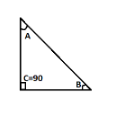
Therefore the value of $ A + B $ is $ {90^ \circ } $ , which means the remaining angle C of the triangle measures $ {90^ \circ } $ which is a right angle. So the triangle has 2 acute angles and one right angle.
Complete step-by-step answer:
We are given that A and B are acute angles and $ \sin A = \cos B $ .
We have to find the value of $ A + B $
A triangle has 3 sides and 3 angles. Three angles of the triangle must sum up to 180 degrees. Which means it can have 3 acute angles or 2 acute angles and one right angle.
Here we are given that A and B are acute angles and $ \sin A = \cos B $
We already know that $ \sin A $ is also equal to $ \cos \left( {{{90}^ \circ } - A} \right) $
Here we have $ \sin A = \cos B $ , which means
$ \cos \left( {{{90}^ \circ } - A} \right) = \cos B $
Equating the angle values,
$
{90^ \circ } - A = B \\
\Rightarrow {90^ \circ } = A + B \\
\therefore A + B = {90^ \circ } \;
$
Therefore the value of $ A + B $ is $ {90^ \circ } $
Note:: Another approach.
Here we are given that A and B are acute angles and $ \sin A = \cos B $
The value of cosine of angle A can also be written as sine of angle $ \left( {{{90}^ \circ } - A} \right) $ .
Here we have $ \sin A = \cos B $ , convert cosine function into sine function by using the above conversion.
This results $ \cos B = \sin \left( {{{90}^ \circ } - B} \right) $
On substituting the above value in $ \sin A = \cos B $ , we get
$
\sin A = \cos B \\
\Rightarrow \sin A = \sin \left( {{{90}^ \circ } - B} \right) \\
\Rightarrow A = {90^ \circ } - B \\
\therefore A + B = {90^ \circ } \;
$
Therefore the value of $ A + B $ is $ {90^ \circ } $ , which means the remaining angle C of the triangle measures $ {90^ \circ } $ which is a right angle. So the triangle has 2 acute angles and one right angle.
Recently Updated Pages
Master Class 11 Social Science: Engaging Questions & Answers for Success

Master Class 11 English: Engaging Questions & Answers for Success
Master Class 11 Maths: Engaging Questions & Answers for Success
Master Class 11 Chemistry: Engaging Questions & Answers for Success
Master Class 11 Biology: Engaging Questions & Answers for Success
Master Class 11 Physics: Engaging Questions & Answers for Success
Trending doubts
One Metric ton is equal to kg A 10000 B 1000 C 100 class 11 physics CBSE
Difference Between Prokaryotic Cells and Eukaryotic Cells
How many of the following diseases can be studied with class 11 biology CBSE
Which of the following enzymes is used for carboxylation class 11 biology CBSE
Two of the body parts which do not appear in MRI are class 11 biology CBSE
Draw a diagram of a plant cell and label at least eight class 11 biology CBSE