




If A (-5, 7), B (-4, -5), C (-1, -6) and D (4, 5) are vertices quadrilateral, find the area of the quadrilateral ABCD.
Answer
 Verified
692.1k+ views
Hint: In this question four vertices of a quadrilateral are given to us and we need to find its area. A quadrilateral can be converted into two triangles, then area of triangle with known vertices can be obtained using the direct formula $\dfrac{1}{2}\left| {\begin{array}{*{20}{c}}
{{x_1}}&{{y_1}}&1 \\
{{x_2}}&{{y_2}}&1 \\
{{x_3}}&{{y_3}}&1
\end{array}} \right|$where $({x_1},{y_1}),({x_2},{y_2}){\text{ and (}}{{\text{x}}_3},{y_3})$are the coordinates of vertices.
Complete step-by-step answer:
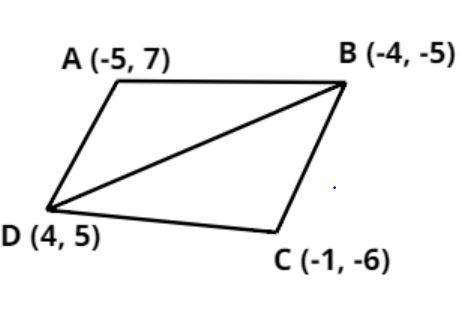
The quadrilateral ABCD is shown above where we join the coordinates B and D.
So the quadrilateral is converted into two triangles.
So the area (A) of the quadrilateral is the sum of the area (A1) of triangle ABD and the area (A2) of triangle BCD.
$ \Rightarrow A = {A_1} + {A_2}$
So first find out the area of triangle ABD
As we know if all the vertices of the triangle is given than the area of triangle is given as $\dfrac{1}{2}\left| {\begin{array}{*{20}{c}}
{{x_1}}&{{y_1}}&1 \\
{{x_2}}&{{y_2}}&1 \\
{{x_3}}&{{y_3}}&1
\end{array}} \right|$.
So let $A = \left( {{x_1},{y_1}} \right) \equiv \left( { - 5,7} \right)$, $B = \left( {{x_2},{y_2}} \right) \equiv \left( { - 4, - 5} \right)$, $C = \left( {{x_3},{y_3}} \right) \equiv \left( { - 1, - 6} \right)$, $D = \left( {{x_4},{y_4}} \right) \equiv \left( {4,5} \right)$
So the area of the triangle ABD is
$ \Rightarrow {A_1} = \dfrac{1}{2}\left| {\begin{array}{*{20}{c}}
{{x_1}}&{{y_1}}&1 \\
{{x_2}}&{{y_2}}&1 \\
{{x_4}}&{{y_4}}&1
\end{array}} \right| = \dfrac{1}{2}\left| {\begin{array}{*{20}{c}}
{ - 5}&7&1 \\
{ - 4}&{ - 5}&1 \\
4&5&1
\end{array}} \right|$
Now expand the determinant we have,
$ \Rightarrow {A_1} = \dfrac{1}{2}\left[ { - 5\left| {\begin{array}{*{20}{c}}
{ - 5}&1 \\
5&1
\end{array}} \right| - 7\left| {\begin{array}{*{20}{c}}
{ - 4}&1 \\
4&1
\end{array}} \right| + 1\left| {\begin{array}{*{20}{c}}
{ - 4}&{ - 5} \\
4&5
\end{array}} \right|} \right]$
$ \Rightarrow {A_1} = \dfrac{1}{2}\left[ { - 5\left( { - 5 - 5} \right) - 7\left( { - 4 - 4} \right) + 1\left( { - 20 + 20} \right)} \right]$
So on simplifying we get
$ \Rightarrow {A_1} = \dfrac{1}{2}\left[ {50 + 56} \right] = \dfrac{{106}}{2} = 53$ Square units.
Now calculate the area of the triangle BCD is
$ \Rightarrow {A_2} = \dfrac{1}{2}\left| {\begin{array}{*{20}{c}}
{{x_2}}&{{y_2}}&1 \\
{{x_3}}&{{y_3}}&1 \\
{{x_4}}&{{y_4}}&1
\end{array}} \right| = \dfrac{1}{2}\left| {\begin{array}{*{20}{c}}
{ - 4}&{ - 5}&1 \\
{ - 1}&{ - 6}&1 \\
4&5&1
\end{array}} \right|$
Now expand the determinant we have,
$ \Rightarrow {A_1} = \dfrac{1}{2}\left[ { - 4\left| {\begin{array}{*{20}{c}}
{ - 6}&1 \\
5&1
\end{array}} \right| - \left( { - 5} \right)\left| {\begin{array}{*{20}{c}}
{ - 1}&1 \\
4&1
\end{array}} \right| + 1\left| {\begin{array}{*{20}{c}}
{ - 1}&{ - 6} \\
4&5
\end{array}} \right|} \right]$
$ \Rightarrow {A_1} = \dfrac{1}{2}\left[ { - 4\left( { - 6 - 5} \right) + 5\left( { - 1 - 4} \right) + 1\left( { - 5 + 24} \right)} \right]$
So on simplifying we get
$ \Rightarrow {A_1} = \dfrac{1}{2}\left[ {44 - 25 + 19} \right] = \dfrac{{38}}{2} = 19$ Square units.
So the area (A) of the quadrilateral is
$ \Rightarrow A = {A_1} + {A_2} = 53 + 19 = 72$ Square units.
So this is the required area of the parallelogram.
Note: Whenever we face such types of problems the key concept is simply to have the gist of the direct formula to obtain the area of the triangle whose coordinates of vertices are known to us. Application of determinant expansion is a useful asset while solving problems of these kinds. This concept will help you get on the right track to reach the answer.
{{x_1}}&{{y_1}}&1 \\
{{x_2}}&{{y_2}}&1 \\
{{x_3}}&{{y_3}}&1
\end{array}} \right|$where $({x_1},{y_1}),({x_2},{y_2}){\text{ and (}}{{\text{x}}_3},{y_3})$are the coordinates of vertices.
Complete step-by-step answer:
The quadrilateral ABCD is shown above where we join the coordinates B and D.
So the quadrilateral is converted into two triangles.
So the area (A) of the quadrilateral is the sum of the area (A1) of triangle ABD and the area (A2) of triangle BCD.
$ \Rightarrow A = {A_1} + {A_2}$
So first find out the area of triangle ABD
As we know if all the vertices of the triangle is given than the area of triangle is given as $\dfrac{1}{2}\left| {\begin{array}{*{20}{c}}
{{x_1}}&{{y_1}}&1 \\
{{x_2}}&{{y_2}}&1 \\
{{x_3}}&{{y_3}}&1
\end{array}} \right|$.
So let $A = \left( {{x_1},{y_1}} \right) \equiv \left( { - 5,7} \right)$, $B = \left( {{x_2},{y_2}} \right) \equiv \left( { - 4, - 5} \right)$, $C = \left( {{x_3},{y_3}} \right) \equiv \left( { - 1, - 6} \right)$, $D = \left( {{x_4},{y_4}} \right) \equiv \left( {4,5} \right)$
So the area of the triangle ABD is
$ \Rightarrow {A_1} = \dfrac{1}{2}\left| {\begin{array}{*{20}{c}}
{{x_1}}&{{y_1}}&1 \\
{{x_2}}&{{y_2}}&1 \\
{{x_4}}&{{y_4}}&1
\end{array}} \right| = \dfrac{1}{2}\left| {\begin{array}{*{20}{c}}
{ - 5}&7&1 \\
{ - 4}&{ - 5}&1 \\
4&5&1
\end{array}} \right|$
Now expand the determinant we have,
$ \Rightarrow {A_1} = \dfrac{1}{2}\left[ { - 5\left| {\begin{array}{*{20}{c}}
{ - 5}&1 \\
5&1
\end{array}} \right| - 7\left| {\begin{array}{*{20}{c}}
{ - 4}&1 \\
4&1
\end{array}} \right| + 1\left| {\begin{array}{*{20}{c}}
{ - 4}&{ - 5} \\
4&5
\end{array}} \right|} \right]$
$ \Rightarrow {A_1} = \dfrac{1}{2}\left[ { - 5\left( { - 5 - 5} \right) - 7\left( { - 4 - 4} \right) + 1\left( { - 20 + 20} \right)} \right]$
So on simplifying we get
$ \Rightarrow {A_1} = \dfrac{1}{2}\left[ {50 + 56} \right] = \dfrac{{106}}{2} = 53$ Square units.
Now calculate the area of the triangle BCD is
$ \Rightarrow {A_2} = \dfrac{1}{2}\left| {\begin{array}{*{20}{c}}
{{x_2}}&{{y_2}}&1 \\
{{x_3}}&{{y_3}}&1 \\
{{x_4}}&{{y_4}}&1
\end{array}} \right| = \dfrac{1}{2}\left| {\begin{array}{*{20}{c}}
{ - 4}&{ - 5}&1 \\
{ - 1}&{ - 6}&1 \\
4&5&1
\end{array}} \right|$
Now expand the determinant we have,
$ \Rightarrow {A_1} = \dfrac{1}{2}\left[ { - 4\left| {\begin{array}{*{20}{c}}
{ - 6}&1 \\
5&1
\end{array}} \right| - \left( { - 5} \right)\left| {\begin{array}{*{20}{c}}
{ - 1}&1 \\
4&1
\end{array}} \right| + 1\left| {\begin{array}{*{20}{c}}
{ - 1}&{ - 6} \\
4&5
\end{array}} \right|} \right]$
$ \Rightarrow {A_1} = \dfrac{1}{2}\left[ { - 4\left( { - 6 - 5} \right) + 5\left( { - 1 - 4} \right) + 1\left( { - 5 + 24} \right)} \right]$
So on simplifying we get
$ \Rightarrow {A_1} = \dfrac{1}{2}\left[ {44 - 25 + 19} \right] = \dfrac{{38}}{2} = 19$ Square units.
So the area (A) of the quadrilateral is
$ \Rightarrow A = {A_1} + {A_2} = 53 + 19 = 72$ Square units.
So this is the required area of the parallelogram.
Note: Whenever we face such types of problems the key concept is simply to have the gist of the direct formula to obtain the area of the triangle whose coordinates of vertices are known to us. Application of determinant expansion is a useful asset while solving problems of these kinds. This concept will help you get on the right track to reach the answer.
Recently Updated Pages
Which of the following graphs shows the variation of class 12 physics CBSE

Draw a labelled diagram of the human male reproductive class 12 biology CBSE
Describe the experiment to compare the emf of two cells class 12 physics CBSE
What is standard hydrogen electrode
What is conventional current and electric current class 12 physics CBSE
2Bromopentane is treated with an alcoholic KOH solution class 12 chemistry CBSE
Trending doubts
Draw a labelled sketch of the human eye class 12 physics CBSE
Which are the Top 10 Largest Countries of the World?
Draw ray diagrams each showing i myopic eye and ii class 12 physics CBSE
Which is the correct genotypic ratio of mendel dihybrid class 12 biology CBSE
Which is the strongest oxidising agent out of the following class 12 chemistry CBSE
Differentiate between homogeneous and heterogeneous class 12 chemistry CBSE