




If $5\cot \theta =3$, find the value of \[\left( 5\sin \theta -3\cos \theta \right)\left( 4\sin \theta +3\cos \theta \right)\].
Answer
 Verified
607.8k+ views
Hint:Divide both sides of the given equation $5\cot \theta =3$ by 5. Assume that in the obtained function: $\cot \theta =\dfrac{3}{5}$, 3 is the length of base and 5 is the length of perpendicular of a right angle triangle. Use Pythagoras theorem given by: $\text{hypotenus}{{\text{e}}^{\text{2}}}=\text{bas}{{\text{e}}^{\text{2}}}+\text{perpendicula}{{\text{r}}^{\text{2}}}$, to determine the length of the hypotenuse of the right angle triangle. Now find, \[\sin \theta \] by taking the ratio of perpendicular and hypotenuse and $\cos \theta $ by taking the ratio of base and hypotenuse. Now, simplify the expression: \[\left( 5\sin \theta -3\cos \theta \right)\left( 4\sin \theta +3\cos \theta \right)\] by substituting the value of $\sin \theta $ and $\cos \theta $ in the expression to get the answer.
Complete step-by-step answer:
We have been provided with the trigonometric ratio relation: $5\cot \theta =3$. Dividing both sides by 5, we get, $\cot \theta =\dfrac{3}{5}$.
We know that, \[\cot \theta =\dfrac{\text{Base}}{\text{Perpendicular}}\]. Therefore, on comparing it with the above provided ratio, we have, 3 as the length of base and 5 as the length of perpendicular of a right angle triangle.
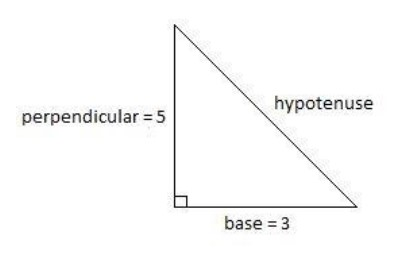
Now, using Pythagoras theorem: $\text{hypotenuse}{{\text{e}}^{\text{2}}}=\text{bas}{{\text{e}}^{\text{2}}}+\text{perpendicular}{{\text{r}}^{\text{2}}}$, we get,
\[\begin{align}
& \text{hypotenuse}{{\text{e}}^{\text{2}}}=\text{perpendicular}{{\text{r}}^{\text{2}}}+\text{bas}{{\text{e}}^{\text{2}}} \\
& \Rightarrow \text{hypotenuse}=\sqrt{\text{perpendicular}{{\text{r}}^{\text{2}}}\text{+bas}{{\text{e}}^{\text{2}}}} \\
& \Rightarrow \text{hypotenuse}=\sqrt{{{5}^{2}}+{{3}^{\text{2}}}} \\
& \Rightarrow \text{hypotenuse}=\sqrt{25+9} \\
& \Rightarrow \text{hypotenuse}=\sqrt{34} \\
\end{align}\]
We know that, \[\sin \theta =\dfrac{\text{Perpendicular}}{\text{Hypotenuse}}\].
$\Rightarrow \sin \theta =\dfrac{5}{\sqrt{34}}$
Also, \[\cos \theta =\dfrac{\text{Base}}{\text{Hypotenuse}}\]
$\Rightarrow \cos \theta =\dfrac{3}{\sqrt{34}}$
Here, we have to find the value of the expression: \[\left( 5\sin \theta -3\cos \theta \right)\left( 4\sin \theta +3\cos \theta \right)\].
Now, substituting $\cos \theta =\dfrac{3}{\sqrt{34}}$ and $\sin \theta =\dfrac{5}{\sqrt{34}}$ in the above expression, we get,
\[\begin{align}
& \left( 5\sin \theta -3\cos \theta \right)\left( 4\sin \theta +3\cos \theta \right) \\
& =\left( 5\times \dfrac{5}{\sqrt{34}}-3\times \dfrac{3}{\sqrt{34}} \right)\left( 4\times \dfrac{5}{\sqrt{34}}+3\times \dfrac{3}{\sqrt{34}} \right) \\
& =\left( \dfrac{25}{\sqrt{34}}-\dfrac{9}{\sqrt{34}} \right)\left( \dfrac{20}{\sqrt{34}}+\dfrac{9}{\sqrt{34}} \right) \\
& =\left( \dfrac{16}{\sqrt{34}} \right)\left( \dfrac{29}{\sqrt{34}} \right) \\
& =\dfrac{464}{34} \\
& =\dfrac{232}{17} \\
\end{align}\]
Note: It is important to note that we are dealing with the trigonometry of angles of the first quadrant only, therefore, all the values taken are positive. We can also change the given equation: $5\cot \theta =3$ such that we have to find only one trigonometric ratio. We have to write, $\cot \theta =\dfrac{\cos \theta }{\sin \theta }$ and then by cross-multiplying we will get a relation between \[\sin \theta \] and $\cos \theta $. From there we will substitute the value of either \[\sin \theta \] or $\cos \theta $ in terms of other, in the expression: \[\left( 5\sin \theta -3\cos \theta \right)\left( 4\sin \theta +3\cos \theta \right)\]. Now, the whole expression will be formed in one variable, that is, either \[\sin \theta \] or $\cos \theta $. Now, we have to find the value of only this variable and substitute in the expression.
Complete step-by-step answer:
We have been provided with the trigonometric ratio relation: $5\cot \theta =3$. Dividing both sides by 5, we get, $\cot \theta =\dfrac{3}{5}$.
We know that, \[\cot \theta =\dfrac{\text{Base}}{\text{Perpendicular}}\]. Therefore, on comparing it with the above provided ratio, we have, 3 as the length of base and 5 as the length of perpendicular of a right angle triangle.
Now, using Pythagoras theorem: $\text{hypotenuse}{{\text{e}}^{\text{2}}}=\text{bas}{{\text{e}}^{\text{2}}}+\text{perpendicular}{{\text{r}}^{\text{2}}}$, we get,
\[\begin{align}
& \text{hypotenuse}{{\text{e}}^{\text{2}}}=\text{perpendicular}{{\text{r}}^{\text{2}}}+\text{bas}{{\text{e}}^{\text{2}}} \\
& \Rightarrow \text{hypotenuse}=\sqrt{\text{perpendicular}{{\text{r}}^{\text{2}}}\text{+bas}{{\text{e}}^{\text{2}}}} \\
& \Rightarrow \text{hypotenuse}=\sqrt{{{5}^{2}}+{{3}^{\text{2}}}} \\
& \Rightarrow \text{hypotenuse}=\sqrt{25+9} \\
& \Rightarrow \text{hypotenuse}=\sqrt{34} \\
\end{align}\]
We know that, \[\sin \theta =\dfrac{\text{Perpendicular}}{\text{Hypotenuse}}\].
$\Rightarrow \sin \theta =\dfrac{5}{\sqrt{34}}$
Also, \[\cos \theta =\dfrac{\text{Base}}{\text{Hypotenuse}}\]
$\Rightarrow \cos \theta =\dfrac{3}{\sqrt{34}}$
Here, we have to find the value of the expression: \[\left( 5\sin \theta -3\cos \theta \right)\left( 4\sin \theta +3\cos \theta \right)\].
Now, substituting $\cos \theta =\dfrac{3}{\sqrt{34}}$ and $\sin \theta =\dfrac{5}{\sqrt{34}}$ in the above expression, we get,
\[\begin{align}
& \left( 5\sin \theta -3\cos \theta \right)\left( 4\sin \theta +3\cos \theta \right) \\
& =\left( 5\times \dfrac{5}{\sqrt{34}}-3\times \dfrac{3}{\sqrt{34}} \right)\left( 4\times \dfrac{5}{\sqrt{34}}+3\times \dfrac{3}{\sqrt{34}} \right) \\
& =\left( \dfrac{25}{\sqrt{34}}-\dfrac{9}{\sqrt{34}} \right)\left( \dfrac{20}{\sqrt{34}}+\dfrac{9}{\sqrt{34}} \right) \\
& =\left( \dfrac{16}{\sqrt{34}} \right)\left( \dfrac{29}{\sqrt{34}} \right) \\
& =\dfrac{464}{34} \\
& =\dfrac{232}{17} \\
\end{align}\]
Note: It is important to note that we are dealing with the trigonometry of angles of the first quadrant only, therefore, all the values taken are positive. We can also change the given equation: $5\cot \theta =3$ such that we have to find only one trigonometric ratio. We have to write, $\cot \theta =\dfrac{\cos \theta }{\sin \theta }$ and then by cross-multiplying we will get a relation between \[\sin \theta \] and $\cos \theta $. From there we will substitute the value of either \[\sin \theta \] or $\cos \theta $ in terms of other, in the expression: \[\left( 5\sin \theta -3\cos \theta \right)\left( 4\sin \theta +3\cos \theta \right)\]. Now, the whole expression will be formed in one variable, that is, either \[\sin \theta \] or $\cos \theta $. Now, we have to find the value of only this variable and substitute in the expression.
Recently Updated Pages
Master Class 11 Computer Science: Engaging Questions & Answers for Success

Master Class 11 Business Studies: Engaging Questions & Answers for Success
Master Class 11 Economics: Engaging Questions & Answers for Success
Master Class 11 English: Engaging Questions & Answers for Success
Master Class 11 Maths: Engaging Questions & Answers for Success
Master Class 11 Biology: Engaging Questions & Answers for Success
Trending doubts
One Metric ton is equal to kg A 10000 B 1000 C 100 class 11 physics CBSE
There are 720 permutations of the digits 1 2 3 4 5 class 11 maths CBSE
Discuss the various forms of bacteria class 11 biology CBSE
Draw a diagram of a plant cell and label at least eight class 11 biology CBSE
State the laws of reflection of light
Explain zero factorial class 11 maths CBSE