




If $40$ sweets were divided amongst $5$ children, what fraction of sweets did each child get?
Answer
 Verified
663.6k+ views
Hint: First, we will define what a fraction is. Then, we will find the answer of the question by dividing the total number of sweets by the number of children as given in the question, and hence, we will be getting the fraction of sweets each child gets.
Complete step by step answer:
First of all, we will understand that what is a fraction? So a fraction is a number we need for measuring. For counting, we have the natural numbers: $1,2,3,4.....$. But when we need to measure something, for example, length, it will not always be a whole number. Therefore, we need numbers that are less than $1$ that means the numbers that are the parts of $1$ : half of $1$, a third, a fifth, etc.
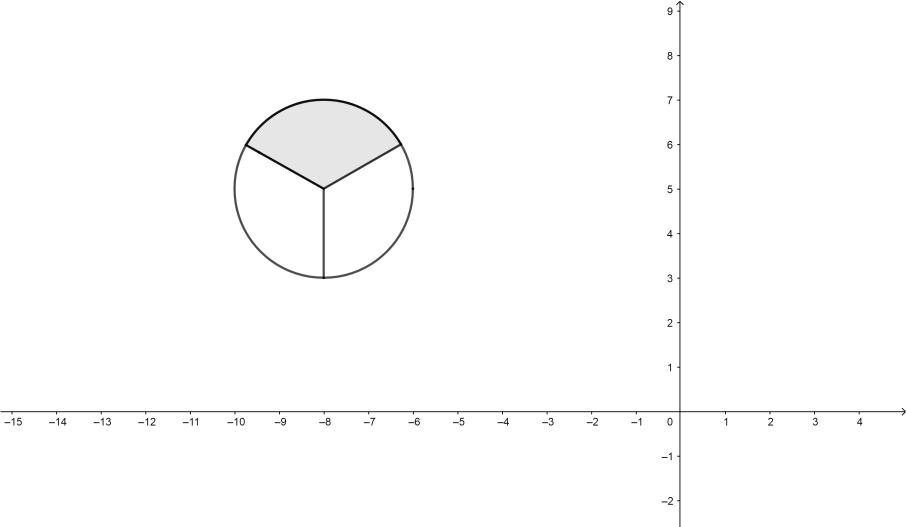
In simpler terms, let’s take one-third for an example. It is represented as: $\dfrac{1}{3}$ , which means 1 out of 3. The numerator of $\dfrac{1}{3}$ is $1$ and the denominator is $3$. They are called the terms of the fraction. The denominator shows the number of equal parts into which number $1$ has been divided. The numerator shows that how many of those parts we selected. For example, in the example above $\dfrac{1}{3}$, since the denominator is $3$, $1$ is divided into $3$equal parts and we selected one part out of it as shown in the figure below:
So, now we are given $40$ sweets and then they are divided amongst $5$ children, and therefore we will divide: $\dfrac{40}{5}=8$.
Hence, each child gets $8$ sweets.
Note:
Although, it is asked in the question to find the fraction of sweets distributed we get a whole number as our answer. Remember that, a whole number can be written as a fraction such as $8=\dfrac{8}{1}$ and hence it means that each kid will get a total of $8$ whole pieces.
Complete step by step answer:
First of all, we will understand that what is a fraction? So a fraction is a number we need for measuring. For counting, we have the natural numbers: $1,2,3,4.....$. But when we need to measure something, for example, length, it will not always be a whole number. Therefore, we need numbers that are less than $1$ that means the numbers that are the parts of $1$ : half of $1$, a third, a fifth, etc.
In simpler terms, let’s take one-third for an example. It is represented as: $\dfrac{1}{3}$ , which means 1 out of 3. The numerator of $\dfrac{1}{3}$ is $1$ and the denominator is $3$. They are called the terms of the fraction. The denominator shows the number of equal parts into which number $1$ has been divided. The numerator shows that how many of those parts we selected. For example, in the example above $\dfrac{1}{3}$, since the denominator is $3$, $1$ is divided into $3$equal parts and we selected one part out of it as shown in the figure below:
So, now we are given $40$ sweets and then they are divided amongst $5$ children, and therefore we will divide: $\dfrac{40}{5}=8$.
Hence, each child gets $8$ sweets.
Note:
Although, it is asked in the question to find the fraction of sweets distributed we get a whole number as our answer. Remember that, a whole number can be written as a fraction such as $8=\dfrac{8}{1}$ and hence it means that each kid will get a total of $8$ whole pieces.
Recently Updated Pages
Master Class 10 Computer Science: Engaging Questions & Answers for Success

Differentiate between voluntary action and reflex class 10 biology CBSE
The uses of bleaching powder are A It is used bleaching class 10 chemistry CBSE
Fill in the blanks with abstract nouns of the words class 10 english CBSE
How many threedigit numbers are there class 10 maths CBSE
What is a reflex arc class 10 biology CBSE
Trending doubts
Explain the Treaty of Vienna of 1815 class 10 social science CBSE
10 examples of evaporation in daily life with explanations
Which country is known as "The land of Fire and Ice"?
What is the full form of POSCO class 10 social science CBSE
Make a sketch of the human nerve cell What function class 10 biology CBSE
In which year voting age was reduced from 21 to 18?