




If (2,4), (2,6) are two vertices of an equilateral triangle then the third vertex is
(a) \[(2+\sqrt{3},\,5)\]
(b) \[(\sqrt{3}-2,\,5)\]
(c) \[(5,\,2+\sqrt{3})\]
(d) \[(5,\,2-\sqrt{3})\]
Answer
 Verified
646.5k+ views
Hint: Draw the equilateral triangle with the given vertices and let the third vertex be (x, y). As it is an equilateral triangle all sides are of equal length and the angle between all sides is \[{{60}^{\circ }}\]. We will be using distance formula which is \[d=\sqrt{\left[ {{({{x}_{2}}-{{x}_{1}})}^{2}}+{{({{y}_{2}}-{{y}_{1}})}^{2}} \right]}\] where \[({{x}_{1}},\,{{y}_{1}})\] and \[({{x}_{2}},\,{{y}_{2}})\] are the coordinates of any two points.
Complete step-by-step answer:
Before proceeding with the question, we should know about equilateral triangles. An equilateral triangle is a triangle whose all sides are equal and the angle between all sides is \[{{60}^{\circ }}\].
Let the coordinates of A be (2, 4) and B be (2, 6) and C be (x, y).
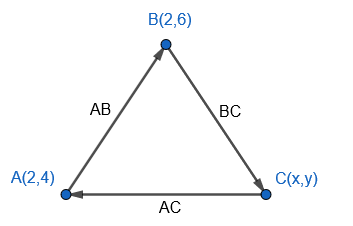
We will first calculate the distance AB between coordinates A and B, then the distance BC between B and C and finally the distance AC between A and C
\[AB=\sqrt{\left[ {{(2-2)}^{2}}+{{(6-4)}^{2}} \right]}=\sqrt{{{2}^{2}}}=2\,units.......(1)\]
\[BC=\sqrt{\left[ {{(2-x)}^{2}}+{{(6-y)}^{2}} \right]}=2\,units........(2)\]
\[AC=\sqrt{\left[ {{(2-x)}^{2}}+{{(4-y)}^{2}} \right]}=2\,units......(3)\]
We know that all the sides are equal so now \[AB=BC=AC\] .
Equating equation (2) and equation (3) that is \[BC=AC\] we get,
\[\,\Rightarrow \sqrt{\left[ {{(2-x)}^{2}}+{{(6-y)}^{2}} \right]}=\sqrt{\left[ {{(2-x)}^{2}}+{{(4-y)}^{2}} \right]}...........(4)\]
Now squaring both sides in equation (4) we get,
\[\,\Rightarrow {{(2-x)}^{2}}+{{(6-y)}^{2}}={{(2-x)}^{2}}+{{(4-y)}^{2}}.........(5)\]
Cancelling similar terms on both sides from equation (5) we get,
\[\,\Rightarrow {{(6-y)}^{2}}={{(4-y)}^{2}}.........(6)\]
Now expanding the remaining terms in equation (6) we get,
\[\,\Rightarrow 36+{{y}^{2}}-12y=16+{{y}^{2}}-8y........(7)\]
Cancelling similar terms on both sides from equation (7) and solving we get,
\[\begin{align}
& \,\Rightarrow 12y-8y=36-16 \\
& \,\Rightarrow 4y=20 \\
& \,\Rightarrow y=5......(8) \\
\end{align}\]
Now putting value of y from equation (8) in equation (2) we get,
\[\,\Rightarrow \sqrt{\left[ {{(2-x)}^{2}}+{{(6-5)}^{2}} \right]}=2\,.......(9)\]
Squaring both sides and solving we get,
\[\begin{align}
& \,\Rightarrow {{(2-x)}^{2}}+{{(6-5)}^{2}}=4\, \\
& \,\Rightarrow {{(2-x)}^{2}}+1=4 \\
& \,\Rightarrow {{(2-x)}^{2}}=3......(10) \\
\end{align}\]
Taking square root of both sides of equation (10) and solving for x we get,
\[\begin{align}
& \,\Rightarrow (2-x)=\pm \sqrt{3} \\
& \,\Rightarrow x=2\pm \sqrt{3} \\
\end{align}\]
Hence the possible coordinates of third vertex C are \[(2+\sqrt{3},\,5)\] and \[(2-\sqrt{3},\,5)\].
Hence the correct answer is option (a).
Note: We have to be very careful while using distance formula because in a hurry we may make simple calculation mistakes. Alternatively, we would have substituted the value of y in equation (3) then also we would have got the same answer.
Complete step-by-step answer:
Before proceeding with the question, we should know about equilateral triangles. An equilateral triangle is a triangle whose all sides are equal and the angle between all sides is \[{{60}^{\circ }}\].
Let the coordinates of A be (2, 4) and B be (2, 6) and C be (x, y).
We will first calculate the distance AB between coordinates A and B, then the distance BC between B and C and finally the distance AC between A and C
\[AB=\sqrt{\left[ {{(2-2)}^{2}}+{{(6-4)}^{2}} \right]}=\sqrt{{{2}^{2}}}=2\,units.......(1)\]
\[BC=\sqrt{\left[ {{(2-x)}^{2}}+{{(6-y)}^{2}} \right]}=2\,units........(2)\]
\[AC=\sqrt{\left[ {{(2-x)}^{2}}+{{(4-y)}^{2}} \right]}=2\,units......(3)\]
We know that all the sides are equal so now \[AB=BC=AC\] .
Equating equation (2) and equation (3) that is \[BC=AC\] we get,
\[\,\Rightarrow \sqrt{\left[ {{(2-x)}^{2}}+{{(6-y)}^{2}} \right]}=\sqrt{\left[ {{(2-x)}^{2}}+{{(4-y)}^{2}} \right]}...........(4)\]
Now squaring both sides in equation (4) we get,
\[\,\Rightarrow {{(2-x)}^{2}}+{{(6-y)}^{2}}={{(2-x)}^{2}}+{{(4-y)}^{2}}.........(5)\]
Cancelling similar terms on both sides from equation (5) we get,
\[\,\Rightarrow {{(6-y)}^{2}}={{(4-y)}^{2}}.........(6)\]
Now expanding the remaining terms in equation (6) we get,
\[\,\Rightarrow 36+{{y}^{2}}-12y=16+{{y}^{2}}-8y........(7)\]
Cancelling similar terms on both sides from equation (7) and solving we get,
\[\begin{align}
& \,\Rightarrow 12y-8y=36-16 \\
& \,\Rightarrow 4y=20 \\
& \,\Rightarrow y=5......(8) \\
\end{align}\]
Now putting value of y from equation (8) in equation (2) we get,
\[\,\Rightarrow \sqrt{\left[ {{(2-x)}^{2}}+{{(6-5)}^{2}} \right]}=2\,.......(9)\]
Squaring both sides and solving we get,
\[\begin{align}
& \,\Rightarrow {{(2-x)}^{2}}+{{(6-5)}^{2}}=4\, \\
& \,\Rightarrow {{(2-x)}^{2}}+1=4 \\
& \,\Rightarrow {{(2-x)}^{2}}=3......(10) \\
\end{align}\]
Taking square root of both sides of equation (10) and solving for x we get,
\[\begin{align}
& \,\Rightarrow (2-x)=\pm \sqrt{3} \\
& \,\Rightarrow x=2\pm \sqrt{3} \\
\end{align}\]
Hence the possible coordinates of third vertex C are \[(2+\sqrt{3},\,5)\] and \[(2-\sqrt{3},\,5)\].
Hence the correct answer is option (a).
Note: We have to be very careful while using distance formula because in a hurry we may make simple calculation mistakes. Alternatively, we would have substituted the value of y in equation (3) then also we would have got the same answer.
Recently Updated Pages
Master Class 10 English: Engaging Questions & Answers for Success

Master Class 10 Social Science: Engaging Questions & Answers for Success
Master Class 10 Computer Science: Engaging Questions & Answers for Success
Class 10 Question and Answer - Your Ultimate Solutions Guide
Master Class 10 General Knowledge: Engaging Questions & Answers for Success
Master Class 10 Maths: Engaging Questions & Answers for Success
Trending doubts
Explain the Treaty of Vienna of 1815 class 10 social science CBSE
Who Won 36 Oscar Awards? Record Holder Revealed
What is the median of the first 10 natural numbers class 10 maths CBSE
Why is it 530 pm in india when it is 1200 afternoon class 10 social science CBSE
Make a sketch of the human nerve cell What function class 10 biology CBSE
Define Potential, Developed, Stock and Reserved resources