




Identify the type of root given in the figure, from the given option
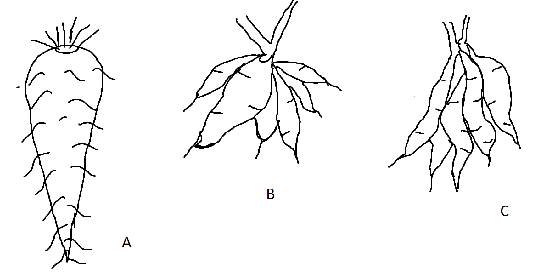
A) A- Fusiform, radish;B- Napiform, turmeric; C. Tuberous,sweet potato.
B) A. Conical,turnip; B. Nodulated,sweet potato; C. Tuberous, Curcuma amada
C) A. Conical,carrot; B. Tuberous,sweet potato; C. Fasciculated, Dahlia
D) A. Napiform, carrot; B. Tuberous,sweet potato; C. Fasciculated, Dahlia
Answer
 Verified
605.7k+ views
Hint: Roots provide nutrition to the plant, but in some plants the roots are modified. The modified roots perform additional functions than normal roots. These include storage of food, respiration and support.
Complete answer:
The plant roots play a vital role in conveying water, absorption and transport of nutrients from soil to the plant. There are two types of root system in plants, tap root system and adventitious root system. These root systems undergo modification in order to perform additional function of storage and vegetative propagation.
The tap root modifications have swollen tap roots and are fleshy with stored food. The secondary roots remain thin and the stem is reduced, discoid in the beginning bearing radical leaves. There are different types of tap roots depending upon the shape.
1) Conical : The tap roots are in a cone shape, therefore called conical. They are thickest towards the base and gradually tapering towards the apex. Example Daucus carota (carrot).
2) Fusiform: They have fleshy roots which are like spindles. They are thick in the middle and narrow towards its base and apex as well. Raphanus sativus (Radish) is a common example.
3) Napiform: They have a very thick fleshy root at base which is almost spherical. They appear thin at apex. Examples include Beet (Beta vulgaris), Turnip (Brassica rapa).
4) Tuberous Roots: Root are thick and fleshy but do not have any definite shape. Examples include Mirabilis jalapa (Four O` clock).
The adventitious roots are the roots that develop from unusual places other than radical or its branches.The fleshy adventitious root appears swollen, fleshy due to storage of the food. There are several types depending upon shape and place of swollen part.
1) Tuberous Root: These do not have definite shape and occur singly, e.g. Sweet potato (Ipomoea batatas)
2) Fasciculated fleshy roots: They occur in clusters. They are lying at the base of the stem or may occur as seen in Dahlia or they occur at intervals on normal roots as seen in Asparagus.
3) Palmata roots: These are thickened fleshy roots like the palm of the human hand and are similarly finger-like outgrowths. Examples include Orchids.
4) Nodulose roots: They are swollen only near the tips. Examples include Curucuma amada, (Mango ginger), Turmeric.
Hence, the carrot is conical in shape; Sweet potato belongs to tuberous root and Dahlia has a Fasciculate fleshy type of root.
Therefore, the correct answer is option ‘C’ i.e, A. Conical, carrot; B. Tuberous, sweet potato; C. Fasciculated, Dahlia.
Note: The tap roots have main root and through which lateral root develops while adventitious root does not have main root. The tap root develops from the radicle whereas adventitious roots can develop from any part including leaves.
Complete answer:
The plant roots play a vital role in conveying water, absorption and transport of nutrients from soil to the plant. There are two types of root system in plants, tap root system and adventitious root system. These root systems undergo modification in order to perform additional function of storage and vegetative propagation.
The tap root modifications have swollen tap roots and are fleshy with stored food. The secondary roots remain thin and the stem is reduced, discoid in the beginning bearing radical leaves. There are different types of tap roots depending upon the shape.
1) Conical : The tap roots are in a cone shape, therefore called conical. They are thickest towards the base and gradually tapering towards the apex. Example Daucus carota (carrot).
2) Fusiform: They have fleshy roots which are like spindles. They are thick in the middle and narrow towards its base and apex as well. Raphanus sativus (Radish) is a common example.
3) Napiform: They have a very thick fleshy root at base which is almost spherical. They appear thin at apex. Examples include Beet (Beta vulgaris), Turnip (Brassica rapa).
4) Tuberous Roots: Root are thick and fleshy but do not have any definite shape. Examples include Mirabilis jalapa (Four O` clock).
The adventitious roots are the roots that develop from unusual places other than radical or its branches.The fleshy adventitious root appears swollen, fleshy due to storage of the food. There are several types depending upon shape and place of swollen part.
1) Tuberous Root: These do not have definite shape and occur singly, e.g. Sweet potato (Ipomoea batatas)
2) Fasciculated fleshy roots: They occur in clusters. They are lying at the base of the stem or may occur as seen in Dahlia or they occur at intervals on normal roots as seen in Asparagus.
3) Palmata roots: These are thickened fleshy roots like the palm of the human hand and are similarly finger-like outgrowths. Examples include Orchids.
4) Nodulose roots: They are swollen only near the tips. Examples include Curucuma amada, (Mango ginger), Turmeric.
Hence, the carrot is conical in shape; Sweet potato belongs to tuberous root and Dahlia has a Fasciculate fleshy type of root.
Therefore, the correct answer is option ‘C’ i.e, A. Conical, carrot; B. Tuberous, sweet potato; C. Fasciculated, Dahlia.
Note: The tap roots have main root and through which lateral root develops while adventitious root does not have main root. The tap root develops from the radicle whereas adventitious roots can develop from any part including leaves.
Recently Updated Pages
If x a + bt + ct2 where x is in meters and t is in class 11 physics CBSE

A car covers the first half distance between two places class 11 physics CBSE
The resultant of two vectors overrightarrow P and overrightarrow class 11 physics CBSE
Find the value of cos 135 class 11 maths CBSE
A mass M is held in place by an applied force F and class 11 physics CBSE
A solution of glucose in water is labelled as 10 dfracwv class 11 chemistry CBSE
Trending doubts
One Metric ton is equal to kg A 10000 B 1000 C 100 class 11 physics CBSE
Find the value of the expression given below sin 30circ class 11 maths CBSE
What do you mean by retardation What is its SI uni class 11 physics CBSE
Draw a diagram of nephron and explain its structur class 11 biology CBSE
10 examples of friction in our daily life
Difference between physical and chemical change class 11 chemistry CBSE