




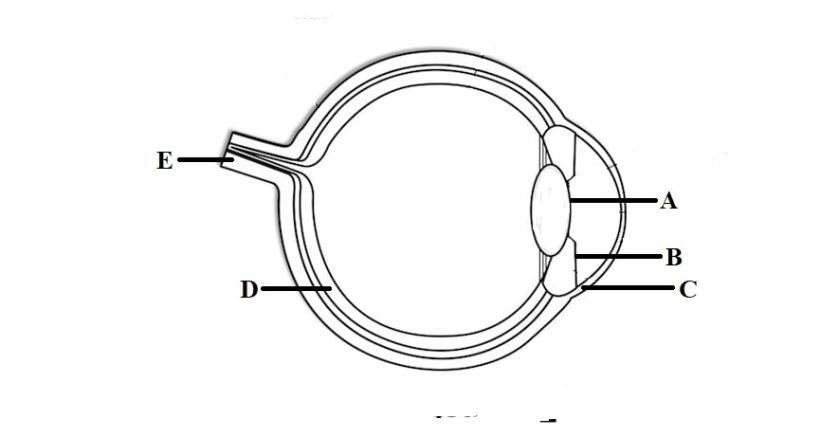
Identify the part “C” from the shown figure of the human eye.
(A). Retina
(B). Cornea
(C). Pupil
(D). Iris
Answer
 Verified
637.5k+ views
Hint: We will take a closer look at all the parts of a human eye to identify the given part in the diagram. We will make a human eye diagram locating different parts of the eye and will identify the marked part in the given diagram.
Complete step-by-step solution -
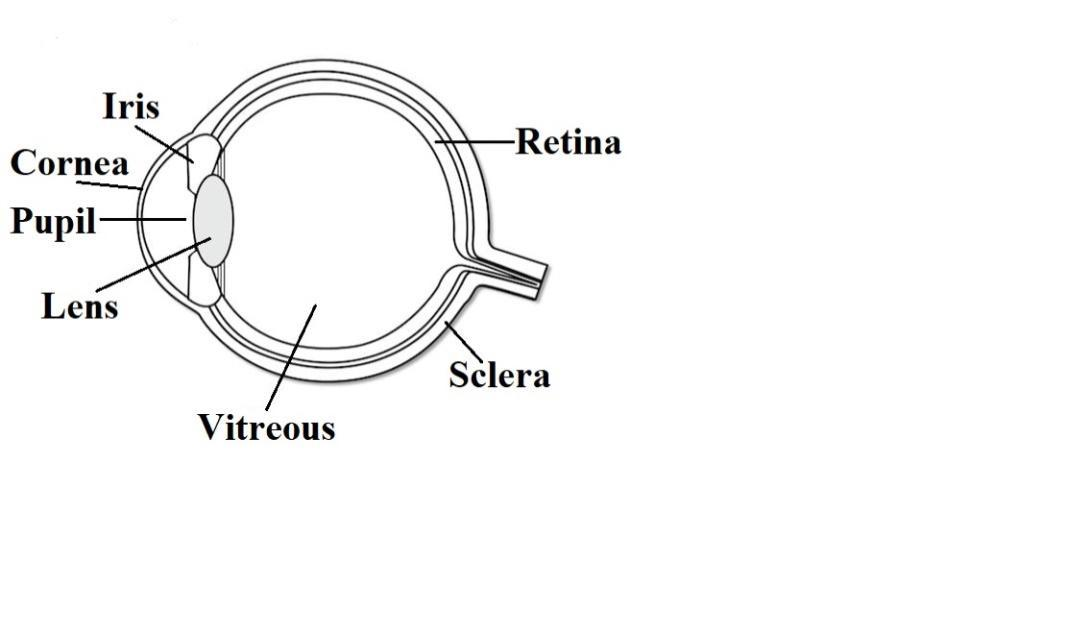
The human eye is a sense organ that reacts with light and allows light perception, colour vision and depth perception. The eye is made up of a number of parts, including the Iris, Pupil, Cornea and Retina. The eye has a total of six muscles that control the eye movement, all providing different tension and torque.
Different parts of Human eye:
Cornea – Light is focussed primarily by the Cornea, which is the clear front of the eye. Cornea acts like a camera lens for the human eye.
Iris – The Iris of the eye controls the amount of light reaching the back of the eye, by automatically adjusting the size of the aperture.
Eye lens – The eye’s crystalline lens is located directly behind the pupil and further focuses light.
Pupil – The pupil is a hole located in the centre of the Iris of the eye which allows the light to strike the retina.
Retina – Light focussed by the cornea and crystalline lens then reaches the retina, the light sensitive inner lining of the back of the eye. The purpose of the retina is to receive the light focussed by the lens, converting it into neural signals and sending these signals to the brain for visual recognition.
The marked part C in the diagram is Cornea.
Hence, the correct option is B.
Note: Cornea is the clear front of the eye and allows the light rays to enter the human eye. Also, students should not get confused between the Iris and the Pupil of the human eye. Iris is the part which controls the amount of light reaching the back of the eye while Pupil is a hole located in the centre of the Iris of the eye which allows the light to strike the retina. Light enters the eye through Pupil and Iris regulates the amount of light by controlling the size of the pupil.
Complete step-by-step solution -
The human eye is a sense organ that reacts with light and allows light perception, colour vision and depth perception. The eye is made up of a number of parts, including the Iris, Pupil, Cornea and Retina. The eye has a total of six muscles that control the eye movement, all providing different tension and torque.
Different parts of Human eye:
Cornea – Light is focussed primarily by the Cornea, which is the clear front of the eye. Cornea acts like a camera lens for the human eye.
Iris – The Iris of the eye controls the amount of light reaching the back of the eye, by automatically adjusting the size of the aperture.
Eye lens – The eye’s crystalline lens is located directly behind the pupil and further focuses light.
Pupil – The pupil is a hole located in the centre of the Iris of the eye which allows the light to strike the retina.
Retina – Light focussed by the cornea and crystalline lens then reaches the retina, the light sensitive inner lining of the back of the eye. The purpose of the retina is to receive the light focussed by the lens, converting it into neural signals and sending these signals to the brain for visual recognition.
The marked part C in the diagram is Cornea.
Hence, the correct option is B.
Note: Cornea is the clear front of the eye and allows the light rays to enter the human eye. Also, students should not get confused between the Iris and the Pupil of the human eye. Iris is the part which controls the amount of light reaching the back of the eye while Pupil is a hole located in the centre of the Iris of the eye which allows the light to strike the retina. Light enters the eye through Pupil and Iris regulates the amount of light by controlling the size of the pupil.
Recently Updated Pages
Master Class 12 Business Studies: Engaging Questions & Answers for Success

Master Class 12 Chemistry: Engaging Questions & Answers for Success
Master Class 12 Biology: Engaging Questions & Answers for Success
Class 12 Question and Answer - Your Ultimate Solutions Guide
Master Class 11 English: Engaging Questions & Answers for Success
Master Class 11 Social Science: Engaging Questions & Answers for Success
Trending doubts
Which are the Top 10 Largest Countries of the World?
Draw a labelled sketch of the human eye class 12 physics CBSE
The end of compass needle which points towards north class 12 physics CBSE
Differentiate between homogeneous and heterogeneous class 12 chemistry CBSE
Why is the cell called the structural and functional class 12 biology CBSE
When was the first election held in India a 194748 class 12 sst CBSE