



How do you identify the important parts of $ y = {x^2} - 36 $ to graph it ?
Answer
 Verified
594.9k+ views
Hint: In order to determine the important parts of the given quadratic equation, remember the graph of every quadratic equation is a parabola. If the coefficient of $ {x^2} $ then it is an upward open parabola otherwise it is a downward open parabola . The x-intercepts are the root or solution of the equation and y-intercept can be obtained by putting $ x = 0 $ in the equation.
Complete step by step solution:
We are given a quadratic equation as $ y = {x^2} - 36 $ .
As per the question, we have to find the important parts of the equation which will give us a better picture of the graph.
As we know, the graph of every quadratic equation is always a parabola. Parabola is basically a vague ’U’ Shaped graph.
Since the coefficient of variable $ x $ is positive , we can conclude that the parabola will be an upward opening parabola.
Now, to check how many times this parabola will intersect with the x-axis , we have to find the determinant $ D $ of the equation .
Lets first compare the given equation $ {x^2} - 36 $ with the standard quadratic equation $ a{x^2} + bx + c $ to get the values of $ a,b,c $ , we get
$
a = 1 \\
b = 0 \\
c = - 36 \;
$
Determinant $ D $ of quadratic equation is given as $ D = {b^2} - 4ac $
Putting the values of $ a,b,c $ , we get the determinant as
\[
D = {\left( 0 \right)^2} - 4\left( 1 \right)\left( { - 36} \right) \\
D = 144 \\
\]
Since, we got $ D > 0 $ , which means there are two distinct real roots or in other words the equation has two x-intercepts.
The Root or intercepts of x-axis are $ x = \dfrac{{ - b \pm \sqrt D }}{{2a}} $
$
\Rightarrow {x_1} = \dfrac{{ - 0 + \sqrt {144} }}{{2\left( 1 \right)}} \\
{x_1} = \dfrac{{12}}{2} \\
{x_1} = 6 \\
\Rightarrow {x_2} = \dfrac{{ - 0 - \sqrt {144} }}{{2\left( 1 \right)}} \\
{x_2} = \dfrac{{ - 12}}{2} \\
{x_2} = - 6 \;
$
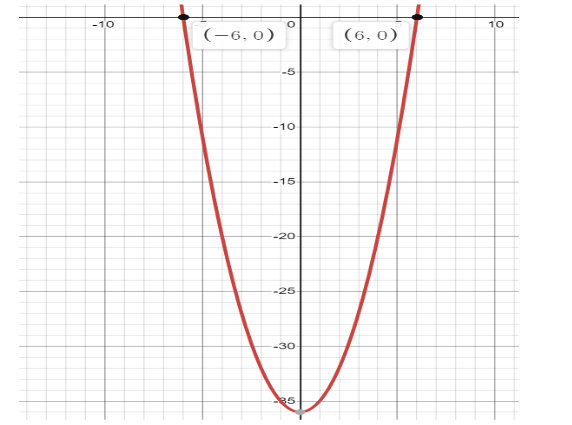
$ x = 6\,and\,x = - 6 $ are the intercepts of the x-axis which we can plot .
For the y-intercept put $ x = 0 $ in the equation $ y = {x^2} - 36 $ , we get
$ y = {\left( 0 \right)^2} - 36 $
$ y = - 36 $ this is our y-intercept.
Now using the x-intercepts as $ x = 6\,and\,x = - 6 $ and y-intercept as $ y = - 36 $ , we can graph our upward opening parabola as
Note: Quadratic Equation: A quadratic equation is a equation which can be represented in the form of $ a{x^2} + bx + c $ where $ x $ is the unknown variable and a,b,c are the numbers known where $ a \ne 0 $ .If $ a = 0 $ then the equation will become linear equation and will no more quadratic .
The degree of the quadratic equation is of the order 2.
Every Quadratic equation has 2 roots.
Discriminant: $ D = {b^2} - 4ac $
Using Discriminant, we can find out the nature of the roots
If D is equal to zero, then both of the roots will be the same and real.
If D is a positive number then, both of the roots are real solutions.
If D is a negative number, then the root are the pair of complex solutions
Complete step by step solution:
We are given a quadratic equation as $ y = {x^2} - 36 $ .
As per the question, we have to find the important parts of the equation which will give us a better picture of the graph.
As we know, the graph of every quadratic equation is always a parabola. Parabola is basically a vague ’U’ Shaped graph.
Since the coefficient of variable $ x $ is positive , we can conclude that the parabola will be an upward opening parabola.
Now, to check how many times this parabola will intersect with the x-axis , we have to find the determinant $ D $ of the equation .
Lets first compare the given equation $ {x^2} - 36 $ with the standard quadratic equation $ a{x^2} + bx + c $ to get the values of $ a,b,c $ , we get
$
a = 1 \\
b = 0 \\
c = - 36 \;
$
Determinant $ D $ of quadratic equation is given as $ D = {b^2} - 4ac $
Putting the values of $ a,b,c $ , we get the determinant as
\[
D = {\left( 0 \right)^2} - 4\left( 1 \right)\left( { - 36} \right) \\
D = 144 \\
\]
Since, we got $ D > 0 $ , which means there are two distinct real roots or in other words the equation has two x-intercepts.
The Root or intercepts of x-axis are $ x = \dfrac{{ - b \pm \sqrt D }}{{2a}} $
$
\Rightarrow {x_1} = \dfrac{{ - 0 + \sqrt {144} }}{{2\left( 1 \right)}} \\
{x_1} = \dfrac{{12}}{2} \\
{x_1} = 6 \\
\Rightarrow {x_2} = \dfrac{{ - 0 - \sqrt {144} }}{{2\left( 1 \right)}} \\
{x_2} = \dfrac{{ - 12}}{2} \\
{x_2} = - 6 \;
$
$ x = 6\,and\,x = - 6 $ are the intercepts of the x-axis which we can plot .
For the y-intercept put $ x = 0 $ in the equation $ y = {x^2} - 36 $ , we get
$ y = {\left( 0 \right)^2} - 36 $
$ y = - 36 $ this is our y-intercept.
Now using the x-intercepts as $ x = 6\,and\,x = - 6 $ and y-intercept as $ y = - 36 $ , we can graph our upward opening parabola as
Note: Quadratic Equation: A quadratic equation is a equation which can be represented in the form of $ a{x^2} + bx + c $ where $ x $ is the unknown variable and a,b,c are the numbers known where $ a \ne 0 $ .If $ a = 0 $ then the equation will become linear equation and will no more quadratic .
The degree of the quadratic equation is of the order 2.
Every Quadratic equation has 2 roots.
Discriminant: $ D = {b^2} - 4ac $
Using Discriminant, we can find out the nature of the roots
If D is equal to zero, then both of the roots will be the same and real.
If D is a positive number then, both of the roots are real solutions.
If D is a negative number, then the root are the pair of complex solutions

Recently Updated Pages
Master Class 12 Economics: Engaging Questions & Answers for Success

Master Class 12 Social Science: Engaging Questions & Answers for Success
Master Class 12 English: Engaging Questions & Answers for Success
Master Class 12 Maths: Engaging Questions & Answers for Success
Master Class 12 Physics: Engaging Questions & Answers for Success
Master Class 12 Biology: Engaging Questions & Answers for Success
Trending doubts
How many sides does a circle have a 10 sides b 20 sides class 8 maths CBSE
What is BLO What is the full form of BLO class 8 social science CBSE
What does the color green in the national flag of India class 8 social science CBSE
Citizens of India can vote at the age of A 18 years class 8 social science CBSE
Full form of STD, ISD and PCO
One cusec is equal to how many liters class 8 maths CBSE