




Identify the given figure of a protozoan protist and select the correct option.
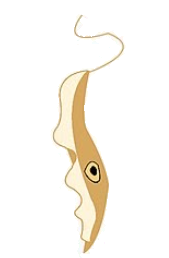
a. Entamoeba histolytica
b. Plasmodium vivax
c. Giardia intestinalis
d. Trypanosoma gambiense
Answer
 Verified
576.9k+ views
Hint: The figure given above is a protozoan protist belonging to the phylum Euglenozoa. This parasite is the reason for the vector-borne disease in humans. It causes African sleeping sickness disease in humans to spread through tsetse fly. Its transmission occurs through the bite of the tsetse fly.
Complete answer:
- Trypanosoma gambiense is a parasitic species belonging to the phylum Euglenozoa. Sir David Bruce discovered this parasite in 1894.
- This parasite is the reason for the vector-borne disease in humans.
- In animals, it causes a disease called animal trypanosomiasis.
- In humans it causes the African sleeping sickness, this parasite is carried by certain blood-sucking insects in the human body and transmits them with bites.
- The insect spreading this parasite is the tsetse fly.
- These parasites undergo complex morphological changes when they enter the human blood as they travel between the insects and mammals during the course of their life cycle.
- African sleeping sickness is also known as African trypanosomiasis and it’s symptoms include fever, joint pain, headache, and itchiness initially. Then after months, the symptoms include confusion, sleeping trouble, and poor coordination.
Hence, the correct answer is option (D).
Note: The tsetse fly acts as both host and the vector for Trypanosoma gambiense parasites. This fly injects the parasite into the skin tissue while taking blood. The parasite enters the lymphatic system and then passes into the bloodstream where they transform into trypomastigotes then reach to other body sites. They replicate into the body by binary fission.
Complete answer:
- Trypanosoma gambiense is a parasitic species belonging to the phylum Euglenozoa. Sir David Bruce discovered this parasite in 1894.
- This parasite is the reason for the vector-borne disease in humans.
- In animals, it causes a disease called animal trypanosomiasis.
- In humans it causes the African sleeping sickness, this parasite is carried by certain blood-sucking insects in the human body and transmits them with bites.
- The insect spreading this parasite is the tsetse fly.
- These parasites undergo complex morphological changes when they enter the human blood as they travel between the insects and mammals during the course of their life cycle.
- African sleeping sickness is also known as African trypanosomiasis and it’s symptoms include fever, joint pain, headache, and itchiness initially. Then after months, the symptoms include confusion, sleeping trouble, and poor coordination.
Hence, the correct answer is option (D).
Note: The tsetse fly acts as both host and the vector for Trypanosoma gambiense parasites. This fly injects the parasite into the skin tissue while taking blood. The parasite enters the lymphatic system and then passes into the bloodstream where they transform into trypomastigotes then reach to other body sites. They replicate into the body by binary fission.
Recently Updated Pages
Master Class 11 Computer Science: Engaging Questions & Answers for Success

Master Class 11 Business Studies: Engaging Questions & Answers for Success
Master Class 11 Economics: Engaging Questions & Answers for Success
Master Class 11 English: Engaging Questions & Answers for Success
Master Class 11 Maths: Engaging Questions & Answers for Success
Master Class 11 Biology: Engaging Questions & Answers for Success
Trending doubts
One Metric ton is equal to kg A 10000 B 1000 C 100 class 11 physics CBSE
There are 720 permutations of the digits 1 2 3 4 5 class 11 maths CBSE
Discuss the various forms of bacteria class 11 biology CBSE
Draw a diagram of a plant cell and label at least eight class 11 biology CBSE
State the laws of reflection of light
Explain zero factorial class 11 maths CBSE