




Identify the figures showing the process of budding in yeast.
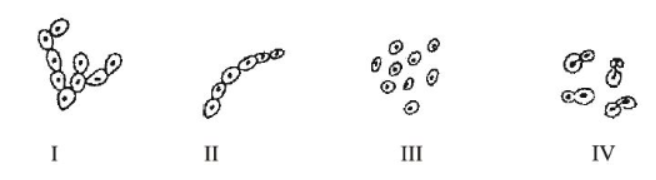
A- I,II and III
B- II and IV
C- I,II and IV
D- III,IV and I
Answer
 Verified
601.5k+ views
Hint: Asexual reproduction includes the budding process. A tube-like small projection coming out from the cell is known as a bud. The new organism split from the parent organism only when it is matured and behind it the new mature organism leaving the scratch tissue.
Complete answer:
Let us get the correct answer from the given option
>According to option A primarily in yeast bud form multiple chain then it forms single chain and after it single cell is formed which is totally wrong.
>According to option b only II and IV options are involved. In budding yeast bud form the chain and then divide into two parts which is also wrong.
>Option c is also wrong because according to it in budding formation in yeast the 1st step is bud multiple chain formation then bud forms a single chain and then its single cell divides in two parts.
>Option d is correct because according to it bud is formed in a single cell. Then the bud develops and divides into two parts and then a chain of buds is formed.
Additional information:There are four major types of asexual reproduction.
1- Binary fission- In this a single parent is divided in two parts and doubles its DNA.It occurs in bacteria.
2- Budding- Bud forms on the surface of the parent body which detach after maturation.Its examples are yeast and hydra.
3- Fragmentation- In this process the new organism developed by fragmentation of the parent body. It occurs in starfish, coral ,sponges etc.
4- Parthenogenesis- In this the embryo develops from an unfertilized egg. Amphibians ,fishes, reptiles are examples.
Note:Budding and fragmentation are not the same . In budding buds is an outgrowth that develops from the parent body while in fragmentation the body of parent breaks in fragments and these fragments form the new individual.
Complete answer:
Let us get the correct answer from the given option
>According to option A primarily in yeast bud form multiple chain then it forms single chain and after it single cell is formed which is totally wrong.
>According to option b only II and IV options are involved. In budding yeast bud form the chain and then divide into two parts which is also wrong.
>Option c is also wrong because according to it in budding formation in yeast the 1st step is bud multiple chain formation then bud forms a single chain and then its single cell divides in two parts.
>Option d is correct because according to it bud is formed in a single cell. Then the bud develops and divides into two parts and then a chain of buds is formed.
Additional information:There are four major types of asexual reproduction.
1- Binary fission- In this a single parent is divided in two parts and doubles its DNA.It occurs in bacteria.
2- Budding- Bud forms on the surface of the parent body which detach after maturation.Its examples are yeast and hydra.
3- Fragmentation- In this process the new organism developed by fragmentation of the parent body. It occurs in starfish, coral ,sponges etc.
4- Parthenogenesis- In this the embryo develops from an unfertilized egg. Amphibians ,fishes, reptiles are examples.
Note:Budding and fragmentation are not the same . In budding buds is an outgrowth that develops from the parent body while in fragmentation the body of parent breaks in fragments and these fragments form the new individual.
Recently Updated Pages
Master Class 12 Social Science: Engaging Questions & Answers for Success

Master Class 12 Physics: Engaging Questions & Answers for Success
Master Class 12 Maths: Engaging Questions & Answers for Success
Master Class 12 Economics: Engaging Questions & Answers for Success
Master Class 12 Chemistry: Engaging Questions & Answers for Success
Master Class 12 Business Studies: Engaging Questions & Answers for Success
Trending doubts
Which are the Top 10 Largest Countries of the World?
Draw a labelled sketch of the human eye class 12 physics CBSE
Explain the structure of megasporangium class 12 biology CBSE
What are the major means of transport Explain each class 12 social science CBSE
How many chromosomes are found in human ovum a 46 b class 12 biology CBSE
The diagram of the section of a maize grain is given class 12 biology CBSE