




Identify the correct statements regarding structure of diborane:
(This question has multiple correct options)
A. There are two bridging hydrogen atoms
B. Each boron atom forms four bonds
C. The hydrogen atoms are not in the same plane
D. Each boron atom is in \[s{{p}^{3}}\] hybridized state
Answer
 Verified
660.6k+ views
Hint: Diborane has bridge bonding and it has \[3C-2{{e}^{-}}\] bond. The Boron element has \[1{{s}^{2}}2{{s}^{2}}2{{p}^{1}}\] configuration and its valency is 3. Configuration of boron in borane is \[s{{p}^{2}}\].
Step by step solution:
Diborane is formed by dimerisation of borane:
\[B{{H}_{3}}\xrightarrow{Dimerisation}{{B}_{2}}{{H}_{6}}\]
Diborane has non-planar structure.
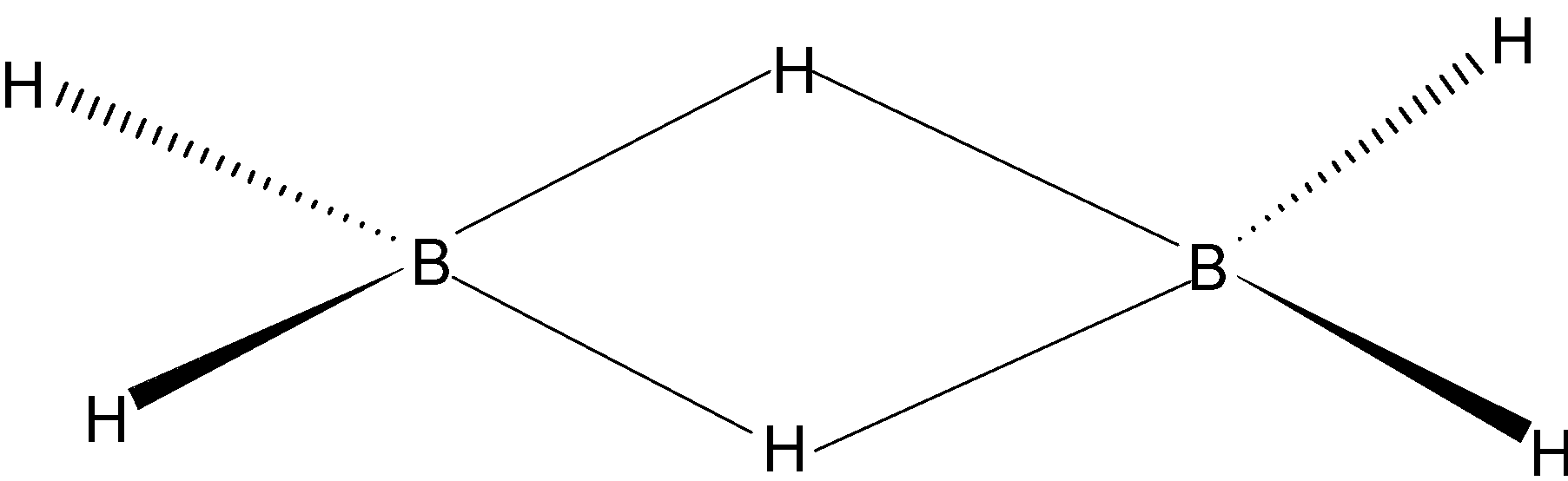
“A” is correct, because in diborane there are 6 hydrogen atoms in which 2 hydrogens are bridged and the other 4 are in the same plane.
“B” is correct, because each boron forms four bonds, two bonds with two bridged hydrogen (\[3C-2{{e}^{-}}\]) and two bonds (\[2C-2{{e}^{-}}\]) with the same planar hydrogen.
“C” is correct, because 4 hydrogens are in the same plane and two bridged hydrogens are there to reduce the bond pair – bond pair repulsion.
“D” is correct, because this molecule has a total 12 valance electrons, 3 from boron and 6 from hydrogen. Here, 8 e- are used in normal \[2C-2{{e}^{-}}\] bonds and other 4valence electrons are shared by remaining 2 hydrogens and borons for making banana bonds. Each atom contributes one orbital to form \[3C-2{{e}^{-}}\] bond. Boron uses its vacant p orbital, so its configuration is \[s{{p}^{3}}\].
Note: \[3C-2{{e}^{-}}\] bond is also known as banana bond/p-seudo bond/tau bond. It is a non-planar structure, which we can understand from the configuration of boron (\[s{{p}^{3}}\]). Banana bonds are covalent in nature, so there are 2 electrons which are shared by 3 centres.
Step by step solution:
Diborane is formed by dimerisation of borane:
\[B{{H}_{3}}\xrightarrow{Dimerisation}{{B}_{2}}{{H}_{6}}\]
Diborane has non-planar structure.
“A” is correct, because in diborane there are 6 hydrogen atoms in which 2 hydrogens are bridged and the other 4 are in the same plane.
“B” is correct, because each boron forms four bonds, two bonds with two bridged hydrogen (\[3C-2{{e}^{-}}\]) and two bonds (\[2C-2{{e}^{-}}\]) with the same planar hydrogen.
“C” is correct, because 4 hydrogens are in the same plane and two bridged hydrogens are there to reduce the bond pair – bond pair repulsion.
“D” is correct, because this molecule has a total 12 valance electrons, 3 from boron and 6 from hydrogen. Here, 8 e- are used in normal \[2C-2{{e}^{-}}\] bonds and other 4valence electrons are shared by remaining 2 hydrogens and borons for making banana bonds. Each atom contributes one orbital to form \[3C-2{{e}^{-}}\] bond. Boron uses its vacant p orbital, so its configuration is \[s{{p}^{3}}\].
Note: \[3C-2{{e}^{-}}\] bond is also known as banana bond/p-seudo bond/tau bond. It is a non-planar structure, which we can understand from the configuration of boron (\[s{{p}^{3}}\]). Banana bonds are covalent in nature, so there are 2 electrons which are shared by 3 centres.
Recently Updated Pages
Which will be the least stable resonating structure class 11 chemistry CBSE

How many 5 digit telephone numbers can be construc-class-11-maths-CBSE
How do you find the angle of the resultant vector class 11 physics CBSE
Draw labelled diagram of the following i Gram seed class 11 biology CBSE
What is the need and importance of classification class 11 biology CBSE
The way in which the sparrows expressed their sorrow class 11 english CBSE
Trending doubts
One Metric ton is equal to kg A 10000 B 1000 C 100 class 11 physics CBSE
Find the value of the expression given below sin 30circ class 11 maths CBSE
1 Quintal is equal to a 110 kg b 10 kg c 100kg d 1000 class 11 physics CBSE
Draw a diagram of nephron and explain its structur class 11 biology CBSE
10 examples of friction in our daily life
Proton was discovered by A Thomson B Rutherford C Chadwick class 11 chemistry CBSE