




Identify the correct order of blood flow through the heart, entering from the vena cava.
(a)Left atrium 🡪 Left ventricle 🡪 Right ventricle 🡪 Right atrium
(b)Left ventricle 🡪 Left atrium 🡪 Right ventricle 🡪 Right atrium
(c)Right atrium 🡪 Right ventricle 🡪 Left atrium 🡪 Left ventricle
(d)Right ventricle 🡪 Right atrium 🡪 Left atrium 🡪 Left ventricle
(e)Right ventricle 🡪 Right atrium 🡪 Left ventricle 🡪 Left atrium
Answer
 Verified
629.1k+ views
Hint: Human heart pumps oxygen and nutrient-rich blood throughout the body to sustain life. The left and right halves of the heart carry oxygenated and deoxygenated blood respectively. The flow starts with deoxygenated blood.
Complete answer:
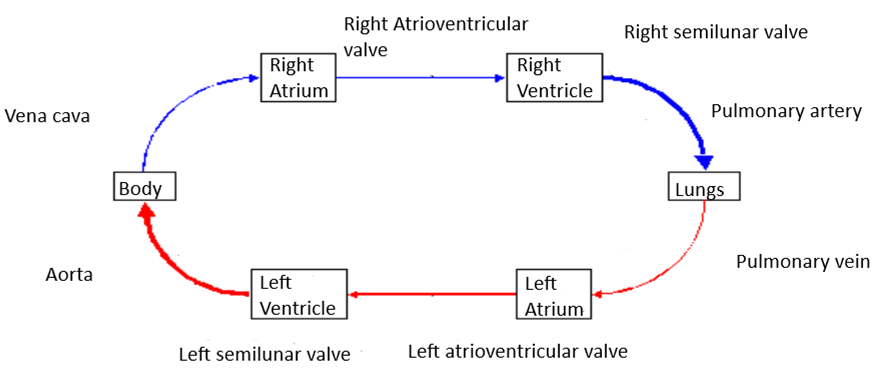
The right atrium receives deoxygenated blood returning from systemic circulation via vena cava. Blood pumps from the right ventricle flows into the pulmonary trunk, that carry deoxygenated blood to the lungs via pulmonary artery. The left atrium receives oxygen-rich blood from the lungs via pulmonary veins. The left ventricle pumps this oxygenated blood into the aorta. Arterial branches from the aorta supply oxygen-rich blood to all the organ systems (except lungs).
Additional Information: The blood through the human heart passes twice during one complete cycle of the body via left and right halves carrying oxygenated and deoxygenated blood respectively. Thus, human circulation is known as double circulation.
The human heart is actually two separate pumps. The left side carries out systemic circulation i.e. it pumps blood to the body and the right-side carries out pulmonary circulation i.e. it pumps blood to the lungs (pulmonary circulation). Each side has an atrium and a ventricle.
So, the correct answer is ‘Right atrium 🡪 Right ventricle 🡪 Left atrium 🡪 Left ventricle’.
Note: This fist-sized powerhouse (heart) beats i.e. expands and contracts 100,000 times per day, pumping five or six quarts of blood each minute, or about 2,000 gallons per day. The vast system of blood vessels - arteries, veins, and capillaries is over 60,000 miles long. That's long enough to go around the world more than twice!
Complete answer:
Fig: Flow of blood
The right atrium receives deoxygenated blood returning from systemic circulation via vena cava. Blood pumps from the right ventricle flows into the pulmonary trunk, that carry deoxygenated blood to the lungs via pulmonary artery. The left atrium receives oxygen-rich blood from the lungs via pulmonary veins. The left ventricle pumps this oxygenated blood into the aorta. Arterial branches from the aorta supply oxygen-rich blood to all the organ systems (except lungs).
Additional Information: The blood through the human heart passes twice during one complete cycle of the body via left and right halves carrying oxygenated and deoxygenated blood respectively. Thus, human circulation is known as double circulation.
The human heart is actually two separate pumps. The left side carries out systemic circulation i.e. it pumps blood to the body and the right-side carries out pulmonary circulation i.e. it pumps blood to the lungs (pulmonary circulation). Each side has an atrium and a ventricle.
So, the correct answer is ‘Right atrium 🡪 Right ventricle 🡪 Left atrium 🡪 Left ventricle’.
Note: This fist-sized powerhouse (heart) beats i.e. expands and contracts 100,000 times per day, pumping five or six quarts of blood each minute, or about 2,000 gallons per day. The vast system of blood vessels - arteries, veins, and capillaries is over 60,000 miles long. That's long enough to go around the world more than twice!
Recently Updated Pages
Master Class 11 English: Engaging Questions & Answers for Success

Master Class 11 Social Science: Engaging Questions & Answers for Success
Master Class 11 Maths: Engaging Questions & Answers for Success
Master Class 11 Biology: Engaging Questions & Answers for Success
Master Class 11 Physics: Engaging Questions & Answers for Success
Master Class 11 Chemistry: Engaging Questions & Answers for Success
Trending doubts
One Metric ton is equal to kg A 10000 B 1000 C 100 class 11 physics CBSE
Difference Between Prokaryotic Cells and Eukaryotic Cells
Find the value of the expression given below sin 30circ class 11 maths CBSE
Difference between physical and chemical change class 11 chemistry CBSE
Two of the body parts which do not appear in MRI are class 11 biology CBSE
Draw a diagram of a plant cell and label at least eight class 11 biology CBSE