



Identify the conclusions which can be concluded by the given statements:
Statement 1: All diameters are chords.
Statement 2: No chord is a radius.
Conclusion A: Some diameters are radii.
Conclusion B: Some chords are diameters.
A. If only conclusion A follows.
B. If only conclusion B follows.
C. If either A or B follows.
D. If neither A or B follows.
E. If both A and B follows.
Answer
 Verified
543.9k+ views
Hint: In the circle chord is the line segment that intersects the circle at two points. If the chord passes through the centre of the circle then the chord is known as the diameter of the circle. So chord and diameter both are related to each other.
Complete step by step solution:
Here we are given two statements and the two conclusions and we need to find which conclusion does the statement follows. Now here statement 1 is given that all diameters are chords. Now let us see what is the meaning of chord and the diameter? So basically chord is the line segment that intersects the circle at two points but when the chord passes through the centre then it is known as the diameter of the circle. Now let us draw the diagram to understand it clearly.
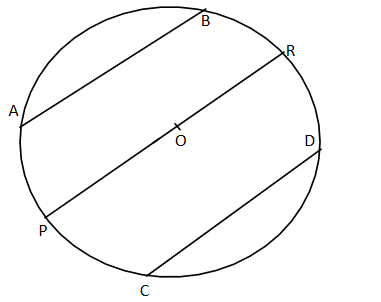
Here we consider the circle whose centre is at O and the line segment $AB,CD,PR$ intersect the circle at two points so here we can say that $AB,CD,PR$ are all the chords of the circle but here $PR$ passes through the centre of the circle so it is the diameter of the circle as well as the chord of the circle but it is called the largest chord of the circle because no other chord of the circle is as long as it. So we can say that all the diameters are the chords but all the chords are not the diameters of the circle.
So the conclusion B that some chords are the diameters is true for the statement 1 that all diameters are chords of the circle.
Now as we saw that conclusion A that is some diameters are radii but this is wrong as diameter is equal to twice the radii of the circle.
So statement 1 and 2 can be concluded from the conclusion B only as the conclusion A is wrong.
So, the correct answer is “Option B”.
Note: In a circle there are an infinite number of chords and diameter is the largest chord of the circle and also the perpendicular drawn from the centre to the chord bisect the chord. One point we should keep in mind that it is not always necessary that the chord should pass through the center of the circle.
Complete step by step solution:
Here we are given two statements and the two conclusions and we need to find which conclusion does the statement follows. Now here statement 1 is given that all diameters are chords. Now let us see what is the meaning of chord and the diameter? So basically chord is the line segment that intersects the circle at two points but when the chord passes through the centre then it is known as the diameter of the circle. Now let us draw the diagram to understand it clearly.
Here we consider the circle whose centre is at O and the line segment $AB,CD,PR$ intersect the circle at two points so here we can say that $AB,CD,PR$ are all the chords of the circle but here $PR$ passes through the centre of the circle so it is the diameter of the circle as well as the chord of the circle but it is called the largest chord of the circle because no other chord of the circle is as long as it. So we can say that all the diameters are the chords but all the chords are not the diameters of the circle.
So the conclusion B that some chords are the diameters is true for the statement 1 that all diameters are chords of the circle.
Now as we saw that conclusion A that is some diameters are radii but this is wrong as diameter is equal to twice the radii of the circle.
So statement 1 and 2 can be concluded from the conclusion B only as the conclusion A is wrong.
So, the correct answer is “Option B”.
Note: In a circle there are an infinite number of chords and diameter is the largest chord of the circle and also the perpendicular drawn from the centre to the chord bisect the chord. One point we should keep in mind that it is not always necessary that the chord should pass through the center of the circle.
Recently Updated Pages
Master Class 9 General Knowledge: Engaging Questions & Answers for Success

Master Class 9 Social Science: Engaging Questions & Answers for Success
Master Class 9 English: Engaging Questions & Answers for Success
Master Class 9 Maths: Engaging Questions & Answers for Success
Master Class 9 Science: Engaging Questions & Answers for Success
Class 9 Question and Answer - Your Ultimate Solutions Guide
Trending doubts
Difference Between Plant Cell and Animal Cell
Fill the blanks with the suitable prepositions 1 The class 9 english CBSE
Who is eligible for RTE class 9 social science CBSE
Which places in India experience sunrise first and class 9 social science CBSE
What is pollution? How many types of pollution? Define it
Name 10 Living and Non living things class 9 biology CBSE