




Identify the components labeled as A, B, C, and D in the given figure of cell membrane from the list (i) to (vii) given along with and select the correct option.
Components
i. Suga
ii. Protein
iii.Lipid bilayer
iv.Integral protein
v.Cytoplasm
vi.Cell wall
vii.External protein
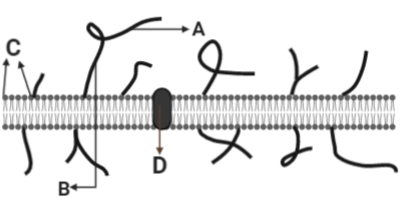
The correct matching of components is
A. A-(i), B-(ii), C-(iii), D-(iv)
B. A-(ii), B-(i), C-(iii), D-(iv)
C. A-(i), B-(ii), C-(iii), D-(vi)
D. A-(i), B-(ii), C-(iii), D-(vii)
Answer
 Verified
643.5k+ views
Hint: The fluid mosaic model of the membrane is representing in the given diagram. Substance D is protruding from both sides of the membrane and is embedded in the layer. The element B is also extending on the side and has an extension A.
Step by step answer:The diagram given in the question is of a phospholipid bilayer. It is the structure of the plasma membrane. The model accepted is called the fluid mosaic model which was first proposed in 1972. This model evolved over time. According to the model, the plasma membrane is like a mosaic. The components of which are phospholipids, cholesterol, and different types of proteins which are able to move freely and fluidly in the plane of the plasma membrane.
-A phospholipid is a lipid made of glycerol. It has two fatty acid tails and a phosphate-linked head group. The plasma membrane has two layers of phospholipids with their tails pointing inwards. That is why the arrangement is called a phospholipid bilayer.
-Cholesterol is another lipid which comprises four fused carbon rings. Membrane proteins are protein molecules attached to the plasma membrane. The membranes are either embedded between the layer or extend from one end or loosely attached to its inside or outside face. The different types are integral membrane proteins, transmembrane proteins, and peripheral membrane proteins.
-Carbohydrate groups or sugars are present only on the outer surface of the plasma membrane. They are attached to proteins and form glycoproteins or glycolipids.
-In the diagram, A is a glycoprotein, B is a protein on which the lipid molecule is attached, C is the bilayer itself and D is an integral protein.
Hence, the correct answer is option A.
Note: The plasma membrane provides protection to the cell. It also provides a fixed and suitable environment inside the cell. It also transports nutrients into the cell and transports toxic substances out of the cell. It has certain receptors that bind to foreign molecules and hence facilitate transportation. It also helps in cell signaling.
Step by step answer:The diagram given in the question is of a phospholipid bilayer. It is the structure of the plasma membrane. The model accepted is called the fluid mosaic model which was first proposed in 1972. This model evolved over time. According to the model, the plasma membrane is like a mosaic. The components of which are phospholipids, cholesterol, and different types of proteins which are able to move freely and fluidly in the plane of the plasma membrane.
-A phospholipid is a lipid made of glycerol. It has two fatty acid tails and a phosphate-linked head group. The plasma membrane has two layers of phospholipids with their tails pointing inwards. That is why the arrangement is called a phospholipid bilayer.
-Cholesterol is another lipid which comprises four fused carbon rings. Membrane proteins are protein molecules attached to the plasma membrane. The membranes are either embedded between the layer or extend from one end or loosely attached to its inside or outside face. The different types are integral membrane proteins, transmembrane proteins, and peripheral membrane proteins.
-Carbohydrate groups or sugars are present only on the outer surface of the plasma membrane. They are attached to proteins and form glycoproteins or glycolipids.
-In the diagram, A is a glycoprotein, B is a protein on which the lipid molecule is attached, C is the bilayer itself and D is an integral protein.
Hence, the correct answer is option A.
Note: The plasma membrane provides protection to the cell. It also provides a fixed and suitable environment inside the cell. It also transports nutrients into the cell and transports toxic substances out of the cell. It has certain receptors that bind to foreign molecules and hence facilitate transportation. It also helps in cell signaling.
Recently Updated Pages
Which will be the least stable resonating structure class 11 chemistry CBSE

How many 5 digit telephone numbers can be construc-class-11-maths-CBSE
How do you find the angle of the resultant vector class 11 physics CBSE
Draw labelled diagram of the following i Gram seed class 11 biology CBSE
1 Quintal is equal to a 110 kg b 10 kg c 100kg d 1000 class 11 physics CBSE
What is the need and importance of classification class 11 biology CBSE
Trending doubts
One Metric ton is equal to kg A 10000 B 1000 C 100 class 11 physics CBSE
Find the value of the expression given below sin 30circ class 11 maths CBSE
Draw a diagram of nephron and explain its structur class 11 biology CBSE
10 examples of friction in our daily life
Proton was discovered by A Thomson B Rutherford C Chadwick class 11 chemistry CBSE
The teeth used for biting and cutting food are called class 11 biology CBSE