




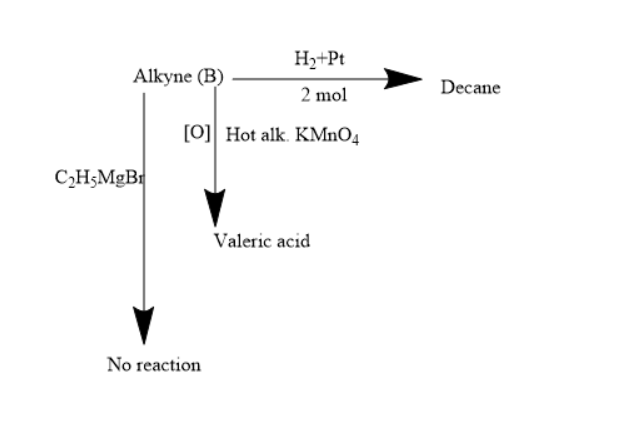
Identify the alkynes A, B, $ \left( {{C_{10}}{H_{18}}} \right) $ and $ \left( {{C_{10}}{H_{16}}} \right) $ which gives the following reactions. What is (B)?
$ A)Dec - 6 - yne $
$ B)Hex - 1 - yne $
$ C)Dec - 5 - yne $
$ D)Non - 5 - yne $
Answer
 Verified
569.7k+ views
Hint :Alkynes are unsaturated hydrocarbons consisting of a triple bond and can be reduced to alkenes and alkanes by treating with hydrogen in presence of platinum. Thus, alkyne can be reduced to alkane. In presence of alkaline potassium permanganate cleaves the triple bond and forms acid. Grignard reagents do not react with alkynes.
Complete Step By Step Answer:
Given molecules are alkyne, alkyne when treated with hydrogen in the presence of platinum forms alkenes or alkanes. Given that decane is formed when alkyne is treated with hydrogen in presence of platinum. Thus, the alkyne will consist of $ 10 $ carbon atoms.
Given that alkyne treated with hot alkaline potassium permanganate, undergoes oxidation and forms valeric acid. Valeric acid is also known as pentatonic acid. Two moles of pentatonic acid will be formed in the given reaction. Thus, the position of the triple bond position will be at the $ {5^{th}} $ position of alkyne consisting of $ 10 $ carbon atoms.
The given alkynes do not react with Grignard reagents.
Thus, from all the above conditions and formation of products the alkyne (B) will be $ Dec - 5 - yne $ .
$ Dec - 6 - yne $ has the position of the alkyne functional group at $ {6^{th}} $ position. Thus, it is not the correct option.
In the given options $ Dec - 5 - yne $ is the C option.
Thus, option C is the correct one.
Note :
Potassium permanganate is an oxidizing agent and oxidises the alkynes to carboxylic acids. The cleavage of carbon -carbon bond takes place at the position of triple bond in alkynes. The $ Dec - 5 - yne $ is not a terminal alkyne, so it does not react with Grignard reagent.
Complete Step By Step Answer:
Given molecules are alkyne, alkyne when treated with hydrogen in the presence of platinum forms alkenes or alkanes. Given that decane is formed when alkyne is treated with hydrogen in presence of platinum. Thus, the alkyne will consist of $ 10 $ carbon atoms.
Given that alkyne treated with hot alkaline potassium permanganate, undergoes oxidation and forms valeric acid. Valeric acid is also known as pentatonic acid. Two moles of pentatonic acid will be formed in the given reaction. Thus, the position of the triple bond position will be at the $ {5^{th}} $ position of alkyne consisting of $ 10 $ carbon atoms.
The given alkynes do not react with Grignard reagents.
Thus, from all the above conditions and formation of products the alkyne (B) will be $ Dec - 5 - yne $ .
$ Dec - 6 - yne $ has the position of the alkyne functional group at $ {6^{th}} $ position. Thus, it is not the correct option.
In the given options $ Dec - 5 - yne $ is the C option.
Thus, option C is the correct one.
Note :
Potassium permanganate is an oxidizing agent and oxidises the alkynes to carboxylic acids. The cleavage of carbon -carbon bond takes place at the position of triple bond in alkynes. The $ Dec - 5 - yne $ is not a terminal alkyne, so it does not react with Grignard reagent.
Recently Updated Pages
If x a + bt + ct2 where x is in meters and t is in class 11 physics CBSE

A car covers the first half distance between two places class 11 physics CBSE
The resultant of two vectors overrightarrow P and overrightarrow class 11 physics CBSE
Find the value of cos 135 class 11 maths CBSE
A mass M is held in place by an applied force F and class 11 physics CBSE
A solution of glucose in water is labelled as 10 dfracwv class 11 chemistry CBSE
Trending doubts
What is the maximum height of a projectile class 11 physics CBSE
Describe various types of epithelial tissues with the class 11 biology CBSE
Lysosomes are known as suicidal bags of cell why class 11 biology CBSE
Simon Commission came to India in A 1927 B 1928 C 1929 class 11 social science CBSE
State and derive law of conservation of momentum class 11 physics CBSE
How are involuntary actions and reflex actions different class 11 biology CBSE