




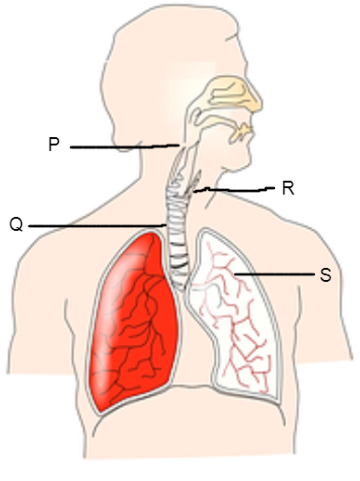
Identify and describe the function of the parts marked P, Q, R and S
Answer
 Verified
525.3k+ views
Hint: In order to accommodate the heart, which is situated on the left side of the body, people's left lung is smaller than their right lung. Lungs have the ability to float. They are the only organs in the body that can float, owing to the air found within alveoli.
Complete answer:
The respiratory system is a set of organs and tissues that assist in breathing. Our airways, lungs, and blood vessels are all part of it. The respiratory system includes the muscles that power our lungs. These components work together to transport oxygen across the body while also removing waste gases such as carbon dioxide.
The given figure is the diagram of the human respiratory system, the name and function of the parts marked are as follows-
P. Pharynx- The pharynx is the part of the throat that lies behind the mouth and nasal cavity and above the oesophagus and trachea, which are the tubes that lead to the stomach and lungs. It can be found in both vertebrates and invertebrates, though the structure differs depending on the species.
R. Larynx – It protects the lower airways, stimulates respiration, and is essential for phonation. It is also known as the voice box, is an organ in the top of the neck that helps with breathing, sound production, and protecting the trachea from food aspiration. The width of the opening between the larynx and the pharynx is approximately 4 to 5 cm.
Q. Trachea- The trachea is a tube that carries air into the lungs, moistens and warms it as it moves through, and protects the respiratory surface from foreign particles. The trachea is lined with a moist mucous-membrane layer made up of cells with thin hairlike projections called cilia. It runs from the larynx to the two primary bronchi.
S. Bronchioles- Bronchioles are air passages inside the lungs that branch out from the bronchi like tree branches. The bronchi, bronchioles, and terminal bronchioles are a network of branching airways that transport air from the trachea to the alveolar ducts and alveoli, where gas exchange takes place.
Note: Gas exchange, sound production, breathing, olfactory assistance, and protection from dust and microbes are some of the functions performed by the respiratory system in humans.
Complete answer:
The respiratory system is a set of organs and tissues that assist in breathing. Our airways, lungs, and blood vessels are all part of it. The respiratory system includes the muscles that power our lungs. These components work together to transport oxygen across the body while also removing waste gases such as carbon dioxide.
The given figure is the diagram of the human respiratory system, the name and function of the parts marked are as follows-
P. Pharynx- The pharynx is the part of the throat that lies behind the mouth and nasal cavity and above the oesophagus and trachea, which are the tubes that lead to the stomach and lungs. It can be found in both vertebrates and invertebrates, though the structure differs depending on the species.
R. Larynx – It protects the lower airways, stimulates respiration, and is essential for phonation. It is also known as the voice box, is an organ in the top of the neck that helps with breathing, sound production, and protecting the trachea from food aspiration. The width of the opening between the larynx and the pharynx is approximately 4 to 5 cm.
Q. Trachea- The trachea is a tube that carries air into the lungs, moistens and warms it as it moves through, and protects the respiratory surface from foreign particles. The trachea is lined with a moist mucous-membrane layer made up of cells with thin hairlike projections called cilia. It runs from the larynx to the two primary bronchi.
S. Bronchioles- Bronchioles are air passages inside the lungs that branch out from the bronchi like tree branches. The bronchi, bronchioles, and terminal bronchioles are a network of branching airways that transport air from the trachea to the alveolar ducts and alveoli, where gas exchange takes place.
Note: Gas exchange, sound production, breathing, olfactory assistance, and protection from dust and microbes are some of the functions performed by the respiratory system in humans.
Recently Updated Pages
Master Class 10 Computer Science: Engaging Questions & Answers for Success

Master Class 10 General Knowledge: Engaging Questions & Answers for Success
Master Class 10 English: Engaging Questions & Answers for Success
Master Class 10 Social Science: Engaging Questions & Answers for Success
Master Class 10 Maths: Engaging Questions & Answers for Success
Master Class 10 Science: Engaging Questions & Answers for Success
Trending doubts
What is the median of the first 10 natural numbers class 10 maths CBSE
Which women's tennis player has 24 Grand Slam singles titles?
Who is the Brand Ambassador of Incredible India?
Why is there a time difference of about 5 hours between class 10 social science CBSE
Write a letter to the principal requesting him to grant class 10 english CBSE
A moving boat is observed from the top of a 150 m high class 10 maths CBSE