




Identify a non – terminating repeating decimal:-
a)\[\dfrac{24}{1600}\]
b)\[\dfrac{171}{800}\]
c)\[\dfrac{123}{{{2}^{2}}\times {{5}^{3}}}\]
d)\[\dfrac{145}{{{2}^{3}}\times {{5}^{2}}\times {{7}^{2}}}\]
Answer
 Verified
637.5k+ views
Hint:-Before solving this question, we must know about terminating and non – terminating repeating decimals.
TERMINATING DECIMALS: Terminating decimals are those decimals which come to an end after a few repetitions after decimal point. Example: 0.5, 2.456, 123.456, etc.
NON – TERMINATING DECIMALS: Non terminating decimals are those which keep on continuing after the decimal point (i.e. they go on forever).
Complete step-by-step answer:
Let us now solve the question. We shall consider each option.
a)\[\dfrac{24}{1600}\]
We will firstly simplify this fraction and then divide the numerator by the denominator.
After simplifying this question, the fraction we get is \[\dfrac{3}{200}\] .
Now, we will divide 3 by 200.
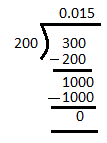
The quotient of this division is 0.015.
As we can see that this division is not endless, i.e. it is terminated, therefore, this is a terminating decimal number.
Hence, this is not the correct option.
b)\[\dfrac{171}{800}\]
We will firstly simplify this fraction and then divide the numerator by the denominator.
But, as we can see that this fraction cannot be simplified, we will divide 171 by 800.
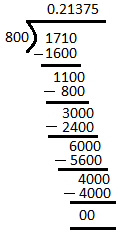
The quotient of this division is 0.21375.
As we can see that this division is not endless, i.e. it is terminated, therefore this is a terminating decimal number.
Hence, this is not the correct option.
c)\[\dfrac{123}{{{2}^{2}}\times {{5}^{3}}}\]
We will firstly simplify the numbers with exponents.
After simplifying them, we shall get \[\dfrac{123}{500}\] .
So now, we will divide 123 by 500.
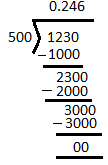
The quotient of this division is 0.246.
As we can see that this division is not endless, i.e. it is terminated, therefore this is a terminating decimal number.
Hence, this is not the correct option.
d)\[\dfrac{145}{{{2}^{3}}\times {{5}^{2}}\times {{7}^{2}}}\]
We will firstly simplify the numbers with exponents.
After simplifying them, we shall get \[\dfrac{145}{8\times 25\times 49}\] .
We will simplify this fraction further.
After simplifying the fraction, we get \[\dfrac{29}{1960}\] .
Now, we shall divide 29 by 1960.
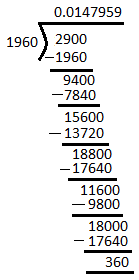
As we can see that there is a remainder left in this division.
This shows that 0.0147959 is a non – terminating decimal.
Hence, this is the correct option for this question.
Note:-One must do all the calculations in this question very carefully.
Also not only in this question, the students must be very careful while solving any such questions as if there is any mistake in the calculus, then the answer can come out to be wrong.
TERMINATING DECIMALS: Terminating decimals are those decimals which come to an end after a few repetitions after decimal point. Example: 0.5, 2.456, 123.456, etc.
NON – TERMINATING DECIMALS: Non terminating decimals are those which keep on continuing after the decimal point (i.e. they go on forever).
Complete step-by-step answer:
Let us now solve the question. We shall consider each option.
a)\[\dfrac{24}{1600}\]
We will firstly simplify this fraction and then divide the numerator by the denominator.
After simplifying this question, the fraction we get is \[\dfrac{3}{200}\] .
Now, we will divide 3 by 200.
The quotient of this division is 0.015.
As we can see that this division is not endless, i.e. it is terminated, therefore, this is a terminating decimal number.
Hence, this is not the correct option.
b)\[\dfrac{171}{800}\]
We will firstly simplify this fraction and then divide the numerator by the denominator.
But, as we can see that this fraction cannot be simplified, we will divide 171 by 800.
The quotient of this division is 0.21375.
As we can see that this division is not endless, i.e. it is terminated, therefore this is a terminating decimal number.
Hence, this is not the correct option.
c)\[\dfrac{123}{{{2}^{2}}\times {{5}^{3}}}\]
We will firstly simplify the numbers with exponents.
After simplifying them, we shall get \[\dfrac{123}{500}\] .
So now, we will divide 123 by 500.
The quotient of this division is 0.246.
As we can see that this division is not endless, i.e. it is terminated, therefore this is a terminating decimal number.
Hence, this is not the correct option.
d)\[\dfrac{145}{{{2}^{3}}\times {{5}^{2}}\times {{7}^{2}}}\]
We will firstly simplify the numbers with exponents.
After simplifying them, we shall get \[\dfrac{145}{8\times 25\times 49}\] .
We will simplify this fraction further.
After simplifying the fraction, we get \[\dfrac{29}{1960}\] .
Now, we shall divide 29 by 1960.
As we can see that there is a remainder left in this division.
This shows that 0.0147959 is a non – terminating decimal.
Hence, this is the correct option for this question.
Note:-One must do all the calculations in this question very carefully.
Also not only in this question, the students must be very careful while solving any such questions as if there is any mistake in the calculus, then the answer can come out to be wrong.

Recently Updated Pages
Master Class 12 Business Studies: Engaging Questions & Answers for Success

Master Class 12 Biology: Engaging Questions & Answers for Success
Master Class 12 Chemistry: Engaging Questions & Answers for Success
Class 12 Question and Answer - Your Ultimate Solutions Guide
Master Class 11 Social Science: Engaging Questions & Answers for Success
Master Class 11 English: Engaging Questions & Answers for Success
Trending doubts
What is BLO What is the full form of BLO class 8 social science CBSE
Citizens of India can vote at the age of A 18 years class 8 social science CBSE
Right to vote is a AFundamental Right BFundamental class 8 social science CBSE
Name the states through which the Tropic of Cancer class 8 social science CBSE
Give me the opposite gender of Duck class 8 english CBSE
What are the 12 elements of nature class 8 chemistry CBSE