




Identify A, B, C and D in the given figure of E. coli cloning vector pBR322 and select the correct option.
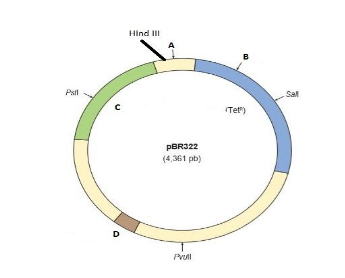
A)A – Hind
B – EcoRI
C – $amp^R$
D – ori
B)A – Hindi
B – BamHI
C – kanR
D – $amp^R$
C)A – BamHI
B – PstI
C – Ori
D -$amp^R$
D)A – EcoRI
B – BamHI
C –$amp^R$
D – ori
Answer
 Verified
564k+ views
Hint: pBR322 is a plasmid. A plasmid is a thin, circular piece of DNA, distinct from a chromosomal DNA, which contains the entire genetic material in the chromosomes of an organism. Independent of chromosomal DNA, it replicates. Plasmids are primarily present in bacteria, but they can also be found in archaea and multicellular species.
Complete answer:
The ability of a plasmid to replicate independently makes the plasmid a suitable cloning vector for recombinant DNA technology and for transferring and manipulating genes. Many antibiotic-resistant genes are present in bacterial plasmids. The base pairs can vary from a few to several thousands.
A widely used plasmid cloning vector is pBR322. The pBR322 plasmid nomenclature is as follows: P-Plasmid, BR- Stands for Bolivar and Rodriguez who created this plasmid, 322- Number given to differentiate this plasmid from the other plasmids that were created in the same lab. pBR322 is a double-stranded circle which consists of 4,361 base pairs in length. Plasmid pBR322 has two resistance genes which are considered valuable for selectable markers- tetracycline resistance and ampicillin resistance. Selectable markers help in identifying host cells containing the transformed vectors and exclude non-transformants. pBR322 can be amplified with chloramphenicol. The weight of the molecule is $2.83 \times 10^6$ Daltons.
Plasmids are helpful in any organism of the species, but are not strictly present in all the organisms. Plasmids have their own ORI (origin of replication) and replicate within the cell, so that each daughter cell also has a copy of the plasmid. Apart from the origin of replication, It also includes antibiotic resistance genes for the development of toxins and other relevant genes that may be important for cell survival.
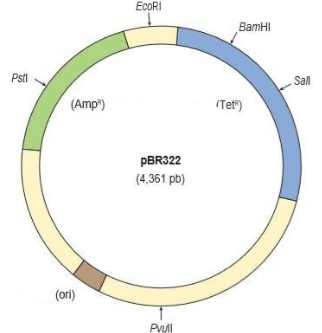
Hence, the correct answer is option (D).
Note: Plasmids are helpful in any organism of the species, but are not strictly present in all the organisms. Plasmids have their own ORI (origin of replication) and replicate within the cell, so that each daughter cell also has a copy of the plasmid. Apart from the origin of replication, It also includes antibiotic resistance genes for the development of toxins and other relevant genes that may be important for cell survival.
Complete answer:
The ability of a plasmid to replicate independently makes the plasmid a suitable cloning vector for recombinant DNA technology and for transferring and manipulating genes. Many antibiotic-resistant genes are present in bacterial plasmids. The base pairs can vary from a few to several thousands.
A widely used plasmid cloning vector is pBR322. The pBR322 plasmid nomenclature is as follows: P-Plasmid, BR- Stands for Bolivar and Rodriguez who created this plasmid, 322- Number given to differentiate this plasmid from the other plasmids that were created in the same lab. pBR322 is a double-stranded circle which consists of 4,361 base pairs in length. Plasmid pBR322 has two resistance genes which are considered valuable for selectable markers- tetracycline resistance and ampicillin resistance. Selectable markers help in identifying host cells containing the transformed vectors and exclude non-transformants. pBR322 can be amplified with chloramphenicol. The weight of the molecule is $2.83 \times 10^6$ Daltons.
Plasmids are helpful in any organism of the species, but are not strictly present in all the organisms. Plasmids have their own ORI (origin of replication) and replicate within the cell, so that each daughter cell also has a copy of the plasmid. Apart from the origin of replication, It also includes antibiotic resistance genes for the development of toxins and other relevant genes that may be important for cell survival.
Hence, the correct answer is option (D).
Note: Plasmids are helpful in any organism of the species, but are not strictly present in all the organisms. Plasmids have their own ORI (origin of replication) and replicate within the cell, so that each daughter cell also has a copy of the plasmid. Apart from the origin of replication, It also includes antibiotic resistance genes for the development of toxins and other relevant genes that may be important for cell survival.
Recently Updated Pages
Master Class 12 Social Science: Engaging Questions & Answers for Success

Master Class 12 Physics: Engaging Questions & Answers for Success
Master Class 12 Maths: Engaging Questions & Answers for Success
Master Class 12 Economics: Engaging Questions & Answers for Success
Master Class 12 Chemistry: Engaging Questions & Answers for Success
Master Class 12 Business Studies: Engaging Questions & Answers for Success
Trending doubts
Which are the Top 10 Largest Countries of the World?
Draw a labelled sketch of the human eye class 12 physics CBSE
Explain the structure of megasporangium class 12 biology CBSE
What are the major means of transport Explain each class 12 social science CBSE
How many chromosomes are found in human ovum a 46 b class 12 biology CBSE
The diagram of the section of a maize grain is given class 12 biology CBSE