




Why is ice a crystalline compound?
Answer
 Verified
574.8k+ views
Hint: Solids are of two types: 1) Crystalline and 2) amorphous. In crystalline solids, atoms are present in long range orderly arrangement while amorphous solids contain short range orderly arrangement of atoms. The smallest cell which is repeated in three dimensions to form crystalline solid is called unit cell.
Complete answer:
When water solidifies, ice is formed. This process is called solidification. The formed ice is a crystalline compound because water molecules are arranged in long range orderly arrangement which ultimately lead to cage-like structure. This is illustrate in the following diagram-
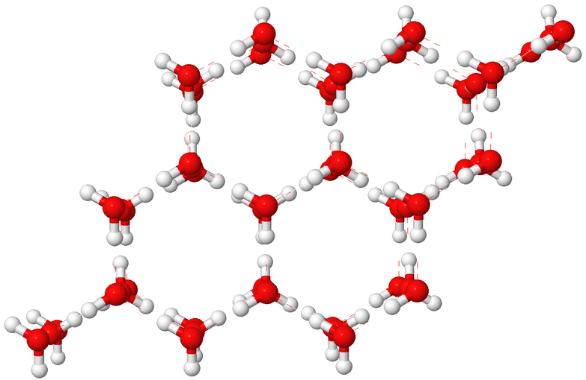
In the above diagram, the red circle represents the oxygen atom and white circle represents the hydrogen atom. In cage-like structure, each water molecule is tetrahedrally bonded to four other water molecules via hydrogen bonding.
Additional Information:
There are several points of difference between crystalline and amorphous solids. Crystalline solids have sharp melting points and are anisotropic in nature while amorphous melts over a range of temperature and is isotropic in nature. Anisotropy means different values of several properties occur when measurement is done in different directions. Moreover, the Crystallization process is used in labs in order to form pure crystals from the mother liquor. X-ray crystallography is a technique which is used to determine the structure of a crystal.
Note:
It is important to note that ice is a crystalline compound because of the long range orderly arrangement of water molecules. This long range order arrangement leads to the cage-like structure. Each water molecule is tetrahedrally bonded to four other water molecules via hydrogen bonding.
Complete answer:
When water solidifies, ice is formed. This process is called solidification. The formed ice is a crystalline compound because water molecules are arranged in long range orderly arrangement which ultimately lead to cage-like structure. This is illustrate in the following diagram-
In the above diagram, the red circle represents the oxygen atom and white circle represents the hydrogen atom. In cage-like structure, each water molecule is tetrahedrally bonded to four other water molecules via hydrogen bonding.
Additional Information:
There are several points of difference between crystalline and amorphous solids. Crystalline solids have sharp melting points and are anisotropic in nature while amorphous melts over a range of temperature and is isotropic in nature. Anisotropy means different values of several properties occur when measurement is done in different directions. Moreover, the Crystallization process is used in labs in order to form pure crystals from the mother liquor. X-ray crystallography is a technique which is used to determine the structure of a crystal.
Note:
It is important to note that ice is a crystalline compound because of the long range orderly arrangement of water molecules. This long range order arrangement leads to the cage-like structure. Each water molecule is tetrahedrally bonded to four other water molecules via hydrogen bonding.
Recently Updated Pages
If x a + bt + ct2 where x is in meters and t is in class 11 physics CBSE

A car covers the first half distance between two places class 11 physics CBSE
The resultant of two vectors overrightarrow P and overrightarrow class 11 physics CBSE
Find the value of cos 135 class 11 maths CBSE
A mass M is held in place by an applied force F and class 11 physics CBSE
A solution of glucose in water is labelled as 10 dfracwv class 11 chemistry CBSE
Trending doubts
What is the maximum height of a projectile class 11 physics CBSE
Describe various types of epithelial tissues with the class 11 biology CBSE
Lysosomes are known as suicidal bags of cell why class 11 biology CBSE
Simon Commission came to India in A 1927 B 1928 C 1929 class 11 social science CBSE
State and derive law of conservation of momentum class 11 physics CBSE
How are involuntary actions and reflex actions different class 11 biology CBSE