




(i) The ratio between the length and the breadth of the rectangular field is 1:4. If its area is $\dfrac{3}{5}$ hectares, then what is the perimeter of the field.
(ii) The circumference of the base of the cylindrical vessel is 154cm and its height is 30cm. How many litres of water can it hold?
Answer
 Verified
628.8k+ views
Hint: We will first assume that length and breadth of the rectangle is l and b respectively and then write two equations to find l and b by using the area of a rectangle formula which is given by $\left( Length\times Breadth \right)$ and note that \[1\text{ }hectares=10000{{m}^{2}}\] and second by using the relation given between length and the breadth in the question. Perimeter of the rectangle is given by $2\times \left( Length+Breadth \right)$
Now, for the second part. Litres of water which a cylindrical vessel can hold = Capacity of the cylindrical vessel = volume of that cylinder. Volume of the cylinder is given by $\pi \times {{r}^{2}}\times h$, where ‘r’ is radius and ‘h’ is height of the cylinder. Circumference of the base of the cylinder is given by $2\times \pi \times r$, where ‘r’ is the radius of the cylinder. Also, $1cm=\dfrac{1}{100}m$ and $1{{m}^{3}}=1000litres$
Complete step by step answer:
(i) Let us assume that $l$ and $b$ are the length and breadth of the rectangular field.
Since, according to the question $l:b=1:4$
So, $\dfrac{l}{b}=\dfrac{1}{4}$
$\Rightarrow 4l=b...........(1)$
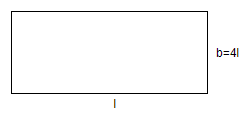
From the question we know that area of rectangular field is $\dfrac{3}{5}$ hectares and we also know that \[1\text{ }hectares=10000{{m}^{2}}\]
Hence, area of rectangular field = $\dfrac{3}{5}\times 10000{{m}^{2}}$
$\Rightarrow area=\text{length of rectangular field}\times \text{breadth of rectangular field}$
$\therefore l\times b=\dfrac{3}{5}\times 10000{{m}^{2}}.............(2)$
Now, we will substituting the value of $b$from equation (1) to equation (2), we will get:
$\Rightarrow 4{{l}^{2}}=\dfrac{3}{5}\times 10000{{m}^{2}}$
$\Rightarrow {{l}^{2}}=\dfrac{3}{5}\times \dfrac{10000}{4}{{m}^{2}}$
$\Rightarrow l=\sqrt{3\times 500}m$
$\therefore l=38.73m$
Form equation (1), we know that:
$\Rightarrow b=4l$
$\Rightarrow b=4\times 38.73m$
$\therefore b=154.92m$
Now, we know perimeter of the rectangular field = $2\times \left( Length+Breadth \right)$
Here, length = $l$ and breadth = $b$as we have assumed above.
So, perimeter of the rectangular field = $2\times \left( 39.73+154.92 \right)m$
Hence, perimeter of the field = \[389.3m\]. It is our required perimeter.
(ii) From the question we know that circumference of the base of cylindrical vessel = 154cm
So, Circumference of the base of cylindrical = $2\times \pi \times r$, where ‘r’ is radius of cylinder.
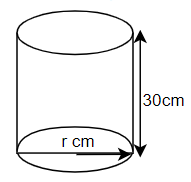
So, $2\times \pi \times r=154cm$
$\Rightarrow r=\dfrac{154}{2\times \pi }cm$
$\Rightarrow r=\dfrac{154\times 7}{2\times 22}cm$
$\Rightarrow r=\dfrac{49}{2}cm$
Now, from the question we know that height of the cylindrical vessel is 30cm.
Let, h be the height of the cylindrical vessel.
So, h = 30cm
Now, volume of the cylindrical vessel = $\pi \times {{r}^{2}}\times h$
Put the value of r and h in the above equation, then we will get:
Volume of the cylindrical vessel = $\dfrac{22}{7}\times {{\left( \dfrac{49}{2} \right)}^{2}}\times 30c{{m}^{3}}$
$=56595c{{m}^{3}}$
We know that $1cm=\dfrac{1}{100}m$,so:
$\Rightarrow 56595c{{m}^{3}}=56595\times {{\left( \dfrac{1}{100} \right)}^{3}}{{m}^{3}}$
We also know that $1{{m}^{3}}=1000litres$
Hence, litres of water which can be hold by the cylindrical vessel is: $\Rightarrow 56595\times {{\left( \dfrac{1}{100} \right)}^{3}}{{m}^{3}}=56595\times {{\left( \dfrac{1}{100} \right)}^{3}}\times 1000liters$
$=56595\times 0.001litres$
$=56.595litres$
Hence, litres of water cylindrical vessel can hold =56.595litres
Note: Students are required to memorizes the conversions of units ${{m}^{3}}$ to litres (i.e.$1{{m}^{3}}=1000litres$) . Otherwise they will not be able to find the required answer, and also keep in mind that the volume of the solids gives the capacity of that solid. Also, we should avoid the calculations mistakes. Read the question carefully, in the first part, take the ratio of l:b as 1:4 and not vice versa. In the second part, make sure to consider 154 cm as circumference and not diameter of cylinder by mistake.
Now, for the second part. Litres of water which a cylindrical vessel can hold = Capacity of the cylindrical vessel = volume of that cylinder. Volume of the cylinder is given by $\pi \times {{r}^{2}}\times h$, where ‘r’ is radius and ‘h’ is height of the cylinder. Circumference of the base of the cylinder is given by $2\times \pi \times r$, where ‘r’ is the radius of the cylinder. Also, $1cm=\dfrac{1}{100}m$ and $1{{m}^{3}}=1000litres$
Complete step by step answer:
(i) Let us assume that $l$ and $b$ are the length and breadth of the rectangular field.
Since, according to the question $l:b=1:4$
So, $\dfrac{l}{b}=\dfrac{1}{4}$
$\Rightarrow 4l=b...........(1)$
From the question we know that area of rectangular field is $\dfrac{3}{5}$ hectares and we also know that \[1\text{ }hectares=10000{{m}^{2}}\]
Hence, area of rectangular field = $\dfrac{3}{5}\times 10000{{m}^{2}}$
$\Rightarrow area=\text{length of rectangular field}\times \text{breadth of rectangular field}$
$\therefore l\times b=\dfrac{3}{5}\times 10000{{m}^{2}}.............(2)$
Now, we will substituting the value of $b$from equation (1) to equation (2), we will get:
$\Rightarrow 4{{l}^{2}}=\dfrac{3}{5}\times 10000{{m}^{2}}$
$\Rightarrow {{l}^{2}}=\dfrac{3}{5}\times \dfrac{10000}{4}{{m}^{2}}$
$\Rightarrow l=\sqrt{3\times 500}m$
$\therefore l=38.73m$
Form equation (1), we know that:
$\Rightarrow b=4l$
$\Rightarrow b=4\times 38.73m$
$\therefore b=154.92m$
Now, we know perimeter of the rectangular field = $2\times \left( Length+Breadth \right)$
Here, length = $l$ and breadth = $b$as we have assumed above.
So, perimeter of the rectangular field = $2\times \left( 39.73+154.92 \right)m$
Hence, perimeter of the field = \[389.3m\]. It is our required perimeter.
(ii) From the question we know that circumference of the base of cylindrical vessel = 154cm
So, Circumference of the base of cylindrical = $2\times \pi \times r$, where ‘r’ is radius of cylinder.
So, $2\times \pi \times r=154cm$
$\Rightarrow r=\dfrac{154}{2\times \pi }cm$
$\Rightarrow r=\dfrac{154\times 7}{2\times 22}cm$
$\Rightarrow r=\dfrac{49}{2}cm$
Now, from the question we know that height of the cylindrical vessel is 30cm.
Let, h be the height of the cylindrical vessel.
So, h = 30cm
Now, volume of the cylindrical vessel = $\pi \times {{r}^{2}}\times h$
Put the value of r and h in the above equation, then we will get:
Volume of the cylindrical vessel = $\dfrac{22}{7}\times {{\left( \dfrac{49}{2} \right)}^{2}}\times 30c{{m}^{3}}$
$=56595c{{m}^{3}}$
We know that $1cm=\dfrac{1}{100}m$,so:
$\Rightarrow 56595c{{m}^{3}}=56595\times {{\left( \dfrac{1}{100} \right)}^{3}}{{m}^{3}}$
We also know that $1{{m}^{3}}=1000litres$
Hence, litres of water which can be hold by the cylindrical vessel is: $\Rightarrow 56595\times {{\left( \dfrac{1}{100} \right)}^{3}}{{m}^{3}}=56595\times {{\left( \dfrac{1}{100} \right)}^{3}}\times 1000liters$
$=56595\times 0.001litres$
$=56.595litres$
Hence, litres of water cylindrical vessel can hold =56.595litres
Note: Students are required to memorizes the conversions of units ${{m}^{3}}$ to litres (i.e.$1{{m}^{3}}=1000litres$) . Otherwise they will not be able to find the required answer, and also keep in mind that the volume of the solids gives the capacity of that solid. Also, we should avoid the calculations mistakes. Read the question carefully, in the first part, take the ratio of l:b as 1:4 and not vice versa. In the second part, make sure to consider 154 cm as circumference and not diameter of cylinder by mistake.
Recently Updated Pages
Master Class 11 English: Engaging Questions & Answers for Success

Master Class 11 Social Science: Engaging Questions & Answers for Success
Master Class 11 Maths: Engaging Questions & Answers for Success
Master Class 11 Biology: Engaging Questions & Answers for Success
Master Class 11 Physics: Engaging Questions & Answers for Success
Master Class 11 Chemistry: Engaging Questions & Answers for Success